Monastery of Saint George of Choziba
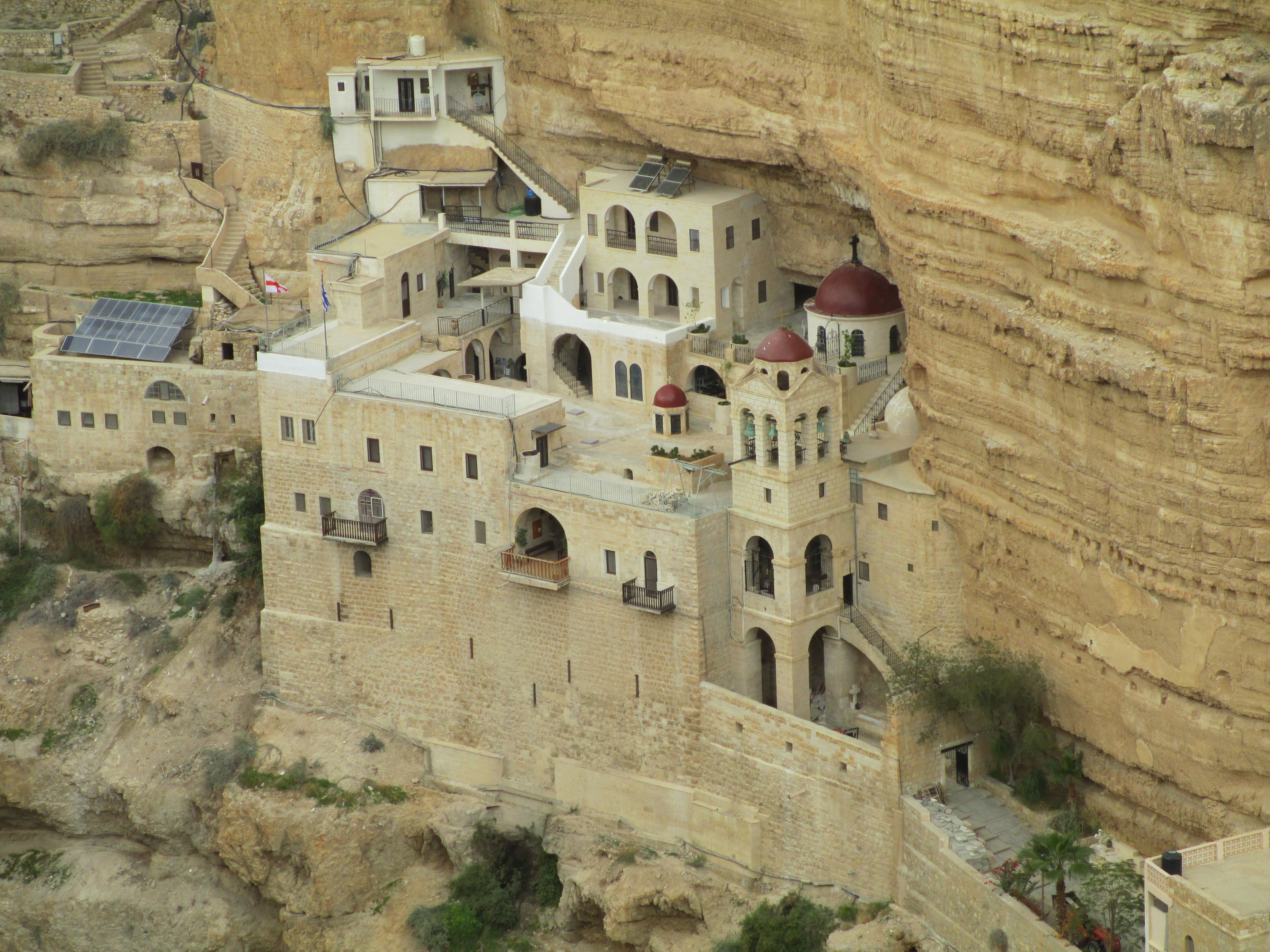
The monastery appears impossible. It clings to the vertical north face of Wadi Qelt, a deep gorge cutting through the Judean Desert between Jerusalem and Jericho, its walls and balconies seemingly growing from the cliff itself. The wadi parallels the old Roman road to Jericho, the same road that provides the setting for the parable of the Good Samaritan, and the descent to reach the monastery is steep enough that young men with donkeys still offer rides down and back up for a negotiable fee. Monks have lived in these cliffs since around 420 CE, drawn by the same arid solitude that once drew the prophet Elijah, and the building has been destroyed and rebuilt so many times that its persistence feels like its own kind of miracle.
Hermits and Ravens
Monastic life here began around 420 CE, when a handful of monks seeking the desert experience of the biblical prophets settled around a cave where tradition held that Elijah had been fed by ravens. They lived as a lavra, a loose community of hermits occupying caves in the surrounding cliffs, gathering weekly for mass and a communal meal. Between 480 and 530 CE, John of Thebes, an Egyptian monk who had migrated to Syria Palaestina, reorganized the community into a formal monastery and dedicated it to the Mother of God. The site accumulated layers of religious association: tradition connected it to Elijah's journey to Sinai and to Saint Joachim, who according to legend wept here when an angel announced the conception of Mary. A chapel dedicated to Saint Stephen and a church of the Virgin Mary were built within the complex.
Destruction and Silence
The Persians destroyed the monastery in 614 CE, killing monks whose bones and skulls are still kept in a chapel outside the monastery walls. Crusaders rebuilt it in the 12th century, but after their defeat and expulsion from the region, the monastery was abandoned again. The Russian pilgrim Agrefeny, who visited around 1370, was the last person to record seeing it for five centuries. The gorge swallowed the ruins back into itself. Desert wind eroded what the Persians and time had not already taken. For roughly 500 years, the cliffs of Wadi Qelt held only the memory of habitation, silent except for the call of birds and the rare trickle of water through the wadi's dry bed.
Kalinikos and the Rebuilding
In 1878, a Greek monk named Kalinikos settled among the ruins and began restoring the monastery, a project that took 23 years and was completed in 1901 with help from the Jerusalem Patriarchate. The rebuilt complex follows the contours of the cliff, its walkways and chambers fitted into the rock face at vertiginous angles. The main church houses the relics of three saints closely associated with Choziba: John of Thebes, George of Choziba, the 7th-century monk for whom the monastery is now named, and Saint John Iacob the New Chozevite, a Romanian monk-priest who arrived in 1952 and retreated to the nearby Cave of Saint Anne, where he lived until his death in 1960. He was canonized by the Romanian Orthodox Patriarchate in 1992 and recognized by the Greek Orthodox Patriarchate of Jerusalem in 2016.
Faith Under Duress
The monastery's modern history has not been peaceful. Father Germanos Tsibouktzakis arrived in 1993 and devoted himself to the monastic life in the tradition of the ancient Wadi Qelt hermits, offering hospitality to visitors, improving the stone pilgrim path, repairing aqueducts, and tending gardens of olive and shade trees. He was killed during the Second Intifada in 2001. The current abbot, Father Constantinos, continues the community's centuries-long presence. The monastery is open daily except Sundays and certain holidays, from 9 AM to 1 PM, and enforces a strict dress code: no shorts for men, no trousers for women, long skirts and modest tops required. These rules feel less like restriction and more like continuity, a small echo of the discipline that has governed life in this gorge for sixteen hundred years.
The Cliff and the Road Below
Reaching the monastery requires commitment. From Highway 1 between the Dead Sea and Jerusalem, visitors turn off to Mitzpe Yericho and follow signs to a parking lot perched on the opposite rim of the wadi. The hike down is about one kilometer but punishingly steep, and in the desert heat, the climb back up can be dangerous for the unprepared. A longer three-hour trail follows the wadi itself. From below, the monastery reveals its full improbability: ancient walls, blue-painted doors, and flowering balconies stacked against raw limestone cliff, connected by narrow stairs and corridors. Inside, icons gleam in candlelight, and the relics of the martyred monks killed by Persians fourteen centuries ago rest in quiet proximity to the relics of saints canonized within living memory. The road from Jerusalem to Jericho runs below, as it has since Roman times, and the monastery watches over it from the cliffs.
From the Air
Located at 31.843N, 35.415E in Wadi Qelt, the deep gorge running through the Judean Desert between Jerusalem and Jericho. The monastery is built into the north cliff face of the wadi and is difficult to spot from directly above but visible as a cluster of buildings on the cliff when viewed from an angle. The wadi itself is a dramatic landscape feature visible from the air. Ben Gurion International Airport (LLBG) is approximately 55 km to the west-northwest. Best viewed from 3,000-5,000 ft AGL. The Dead Sea is visible to the east, and Jericho lies at the wadi's eastern mouth.