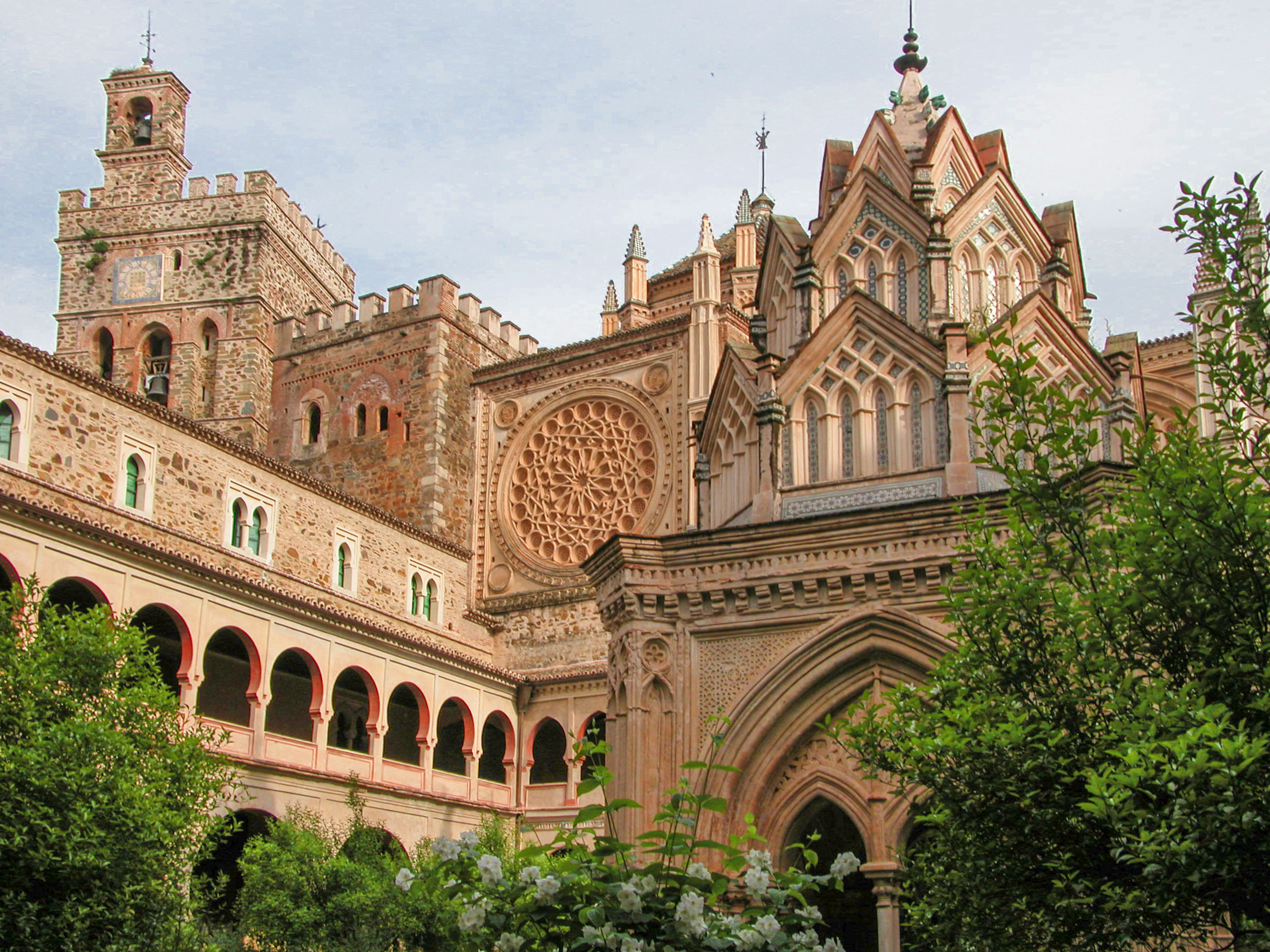
Monastery of Saint Mary of Guadalupe
Christopher Columbus came here first. Not to Seville, not to Barcelona, not to any of the ports or palaces that claim a piece of his legacy. After returning from the Americas in 1493, Columbus made his first pilgrimage to the Royal Monastery of Saint Mary of Guadalupe, deep in the hills of Extremadura, to thank heaven for his discovery. The monastery had been Spain's most important cloister for a century by then, and it would remain so for three centuries more. UNESCO declared it a World Heritage Site in 1993, but the monks who tend it might argue that the real honor came much earlier - in the late 13th century, when a shepherd named Gil Cordero found a statue on a riverbank and changed the course of Spanish religious life.
The Shepherd and the King
According to tradition, Gil Cordero, a shepherd from Caceres, discovered a statue of the Blessed Virgin on the bank of the Guadalupe River in the late 13th century. It had been hidden there, the story goes, by local inhabitants fleeing the Moorish invasion of 714. A chapel rose on the site of the discovery, dedicated as Our Lady of Guadalupe. The chapel might have remained a minor rural shrine if not for King Alfonso XI, who visited more than once and invoked the Virgin of Guadalupe before the Battle of Rio Salado. Victory followed. The king attributed it to the Madonna's intercession, declared Guadalupe a royal sanctuary, and launched an ambitious rebuilding program. In 1389, the Hieronymite monks took control and made it their principal house, transforming a shepherd's roadside chapel into one of the most powerful religious institutions in Iberia.
Where Crowns and Chains Intersected
Royal power shaped Guadalupe as much as faith did. In 1474, Henry IV of Castile was entombed here beside his mother. Twelve years later, King Ferdinand II of Aragon issued the Sentencia Arbitral de Guadalupe from within these walls on 21 April 1486, a decree that effectively ended the feudal "evil customs" allowing Catalan nobles to mistreat and bind the remensa peasants to their lands. The monastery's connections extended across the Atlantic - the Caribbean island of Guadeloupe takes its name from this Extremaduran valley. Even after the Hieronymites founded the Escorial, far closer to the royal capital of Madrid, Guadalupe retained its patronage. It remained Spain's preeminent cloister until the confiscation of monasteries in 1835 emptied its halls. The Franciscan Order revived it in the 20th century, and in 1955 Pope Pius XII declared the shrine a Minor Papal Basilica.
Stone, Paint, and Gold
The architecture evolved across centuries without losing coherence. The main church, built by Alfonso XI and his successors in the 14th and 15th centuries, still dominates. The Mudejar cloister, completed between 1389 and 1405, combines Islamic-influenced geometric patterns with a magnificent Plateresque portal. A late Gothic cloister followed in the 1530s. Behind the basilica, the Camarin de la Virgen - an octagonal Baroque structure built between 1687 and 1696 - houses the stuccoed Chamber of the Virgin with nine paintings by Luca Giordano. At its center sits the throne holding the original statue that Gil Cordero found by the river. The sacristy, lavishly decorated between 1638 and 1647, contains a series of paintings by Zurbaran. The museum holds works by Goya and El Greco, carvings by Egas Cueman, and an ivory crucifix attributed to Michelangelo.
A Living Archive
Walk through Guadalupe and you walk through layers of Spanish history compressed into a single compound. The Embroidery Museum preserves liturgical vestments spanning the 15th to 19th centuries, made in the monastery's own workshop. The Museum of Books and Cantonals displays more than ninety oversized choir books and two 15th-century passionaries. Queen Isabella I had a palace here between 1487 and 1491, though it was pulled down in 1856. A new church, commissioned by one of Columbus's descendants in 1730, speaks to the enduring connection between Guadalupe and the age of exploration. The monastery sits at the foot of the Sierra de las Villuercas, surrounded by terrain that feels far removed from the bustle of Madrid or Seville. That remoteness is part of its power. Pilgrims still come, as they have for seven centuries, drawn by the same impulse that brought a king to his knees after battle and an explorer to prayer after crossing an ocean.
From the Air
Located at 39.45N, 5.33W at the foot of the Sierra de las Villuercas in Extremadura, central-western Spain. The monastery complex is the largest structure in the small town of Guadalupe and visible from altitude against the surrounding mountainous terrain. Nearest airports include Talavera la Real Air Base (LEAB) near Badajoz, approximately 130 km southwest, and Madrid-Barajas (LEMD) approximately 250 km northeast. The terrain is hilly with elevations around 600-700 meters. Best viewed at 3,000-6,000 feet. The surrounding landscape is characterized by oak dehesa woodlands and rugged sierras.