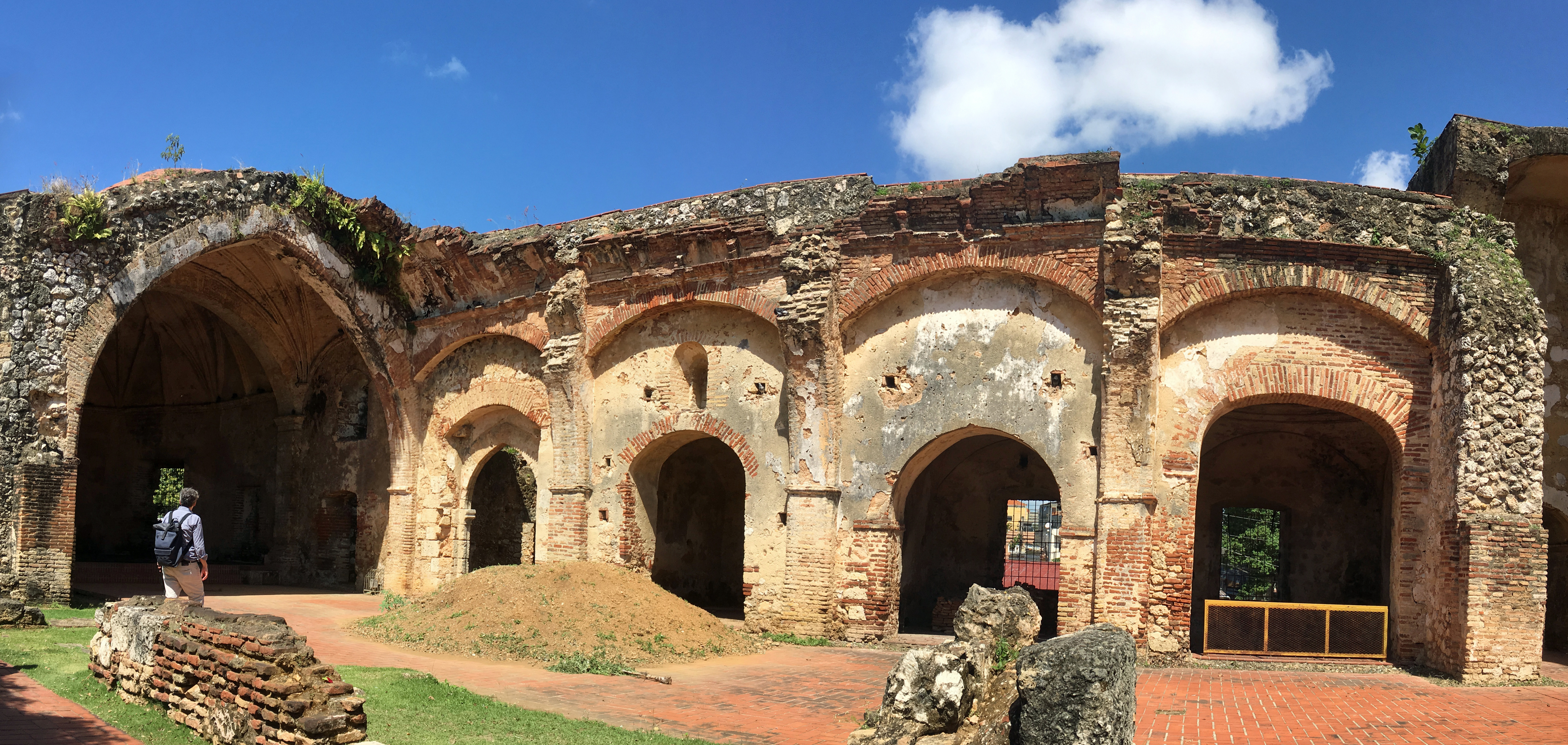
Monastery of San Francisco, Santo Domingo
Somewhere beneath the entrance of this ruin lies Alonso de Ojeda, the conquistador who explored the coasts of Venezuela and Colombia, who named a gulf and claimed a continent, and who died penniless in Santo Domingo around 1515. Historians say he was buried at the main door of the Monastery of San Francisco, the first monastery in the New World, as though the brothers wanted every visitor to step over a reminder of how the Americas consumed the men who conquered them. The remains of Bartholomew Columbus, Christopher's younger brother and the island's former governor, were also found here. This monastery has been collecting history since 1508, when Franciscan friars arrived under the direction of Governor Nicolas de Ovando and began building on a hill overlooking what would become the oldest continuously inhabited European settlement in the Western Hemisphere.
Five Centuries of Ruin
The monastery took fifty-two years to complete, from 1508 to 1560, and almost immediately began falling apart. Not from neglect - from violence. In 1586, the English privateer Francis Drake looted the complex during his sack of Santo Domingo, stripping it of anything portable. Repairs dragged on until 1664, only for earthquakes in 1673 and 1751 to crack the walls and collapse sections of the architecture. During the Siege of Santo Domingo in 1809, French forces stationed artillery on the roof of the main church, cutting through the vault to install a wooden platform for cannons. The platform eventually collapsed under the weight. When Haiti controlled the eastern side of Hispaniola from 1822 to 1844, workers stripped the monastery's stones and architectural details for use as construction material elsewhere. The San Zenon hurricane of 1930 destroyed much of what remained. By 1940, the ruins housed a leprosy hospital and asylum run by Padre Billini. The bells of San Francisco were relocated to the neighboring Church of Santa Barbara, where they ring today for a different congregation.
Built on a Hill, Buried by History
The main church of the complex was begun by the architect Liendo in 1544 on a hilltop and completed on July 23, 1556. The elevated position was strategic - it made the monastery visible from the harbor and from the colonial streets below - but it also made it a target. Every army that besieged Santo Domingo recognized the value of the high ground the monastery occupied. The French in 1809 were not the first to use it as a military position, and each occupation left the structure more damaged than the last. What survived the armies, the earthquakes took. What survived the earthquakes, the hurricanes erased. The monastery's history reads like a catalog of Caribbean catastrophe, each century adding another layer of destruction to a building that was never given enough peace to simply age.
The First Aqueduct
Among the ruins sits a detail that is easy to overlook: the remains of the Chapel of the Tercera Orden de Garay, also known as the Chapel of Maria de Toledo. Through its water system - a tub connected to a network of pipes - the monastery distributed water to the inhabitants of the Ciudad Colonial. It was, in effect, the city's first aqueduct, a piece of infrastructure tucked inside a religious complex. This was typical of colonial monasteries, which functioned as more than houses of prayer. They were schools, hospitals, centers of civil engineering, and seats of political influence. The Franciscans who built this monastery were not just saving souls; they were building a city. Their water system survived long enough to serve a population that had forgotten who built it, which may be the most fitting legacy a monastic order could ask for.
Ruins That Refuse to Die
UNESCO included the Monastery of San Francisco in its 1990 declaration of Santo Domingo's Colonial City as a World Heritage Site, recognizing it as the oldest monastery in the Americas. Today, the ruins are protected by Dominican law and maintained by the Permanent National Commission of National Ephemeris. But protection has not turned them into a static monument. The open-air ruins now host social and cultural events - concerts, performances, gatherings that fill the roofless nave with music and crowd noise in place of liturgy. There is something fitting about this second life. A building that was looted by pirates, shelled by armies, stripped by occupiers, flattened by hurricanes, and repurposed as a hospital has found its latest incarnation as a community space. The walls that Franciscan friars raised more than five hundred years ago still stand on their hilltop, skeletal but upright, framing the sky where a roof used to be. They have outlasted every force that tried to bring them down.
From the Air
Located at 18.477°N, 69.886°W on a hilltop in the Colonial City (Ciudad Colonial) of Santo Domingo, Dominican Republic. The monastery ruins sit on elevated ground visible within the dense colonial street grid, near the Church of Santa Barbara. The hilltop position makes it one of the more identifiable historic structures from low altitude. Best viewed at 1,500-3,000 feet AGL. Nearest major airport is Las Americas International Airport (MDSD/SDQ), approximately 25 km east. La Isabela International Airport (MDJB/JBQ) is roughly 15 km north. Part of the UNESCO World Heritage Site covering the entire Colonial City. Tropical maritime climate with year-round warm, humid conditions.