Monastery of San Juan de los Reyes
Chains hang from the granite facade. Not decorative metalwork, not artistic flourishes, but actual manacles and shackles - the irons worn by Christian prisoners held by the Moors in Granada, ordered affixed to the exterior by Queen Isabella in 1494 after the last Muslim stronghold fell. The Monastery of San Juan de los Reyes was built to proclaim victory, and four centuries of weather have not softened the message. Ferdinand and Isabella raised it in Toledo beginning in 1477 to commemorate their triumph at the Battle of Toro and the birth of their son, Prince John. They intended it as their own mausoleum. They changed their minds after conquering Granada, choosing that city instead. But the monastery they left behind in Toledo remains one of the most assertive statements of royal power in Spanish architecture.
A Battle Both Sides Won
The Battle of Toro in 1476 was, by military measures, inconclusive. The troops under Afonso V of Portugal broke and fled, but the forces led by his son Prince John defeated the Castilian right wing and held the battlefield. Both sides claimed victory - Prince John of Portugal celebrated the anniversary with solemn processions for years afterward. Yet the political consequences were entirely one-sided. The battle secured Ferdinand and Isabella's claim to the Castilian throne and set the stage for the union of Castile and Aragon into what would become Spain. As the historian Rafael Casas summarized, the monastery "resulted from the royal will to build a monastery to commemorate the victory in a battle with an uncertain outcome but decisive, the one fought in Toro in 1476, which consolidated the union of the two most important Peninsular Kingdoms."
Toledo, the Symbolic Capital
Ferdinand and Isabella chose Toledo deliberately. The city held no special administrative importance by the late 15th century - the royal court was peripatetic, and Madrid had not yet become the capital. But Toledo had been the seat of the Visigothic kingdom, the last time the Iberian Peninsula had been unified under a single Christian ruler. By building their commemorative monastery here, the Catholic Monarchs were drawing a line from the Visigoths through the Reconquista to their own reign. They were saying, in stone and mortar, that the lost unity of Spain had been restored. The Isabelline Gothic style of the monastery reinforced the point - ornate, confident, distinctly Spanish in its fusion of late Gothic with Mudejar and Flemish influences. The architect Juan Guas created something that could not be mistaken for a French cathedral or an Italian palazzo. This was Castilian power, built for a Castilian purpose.
Prisoners' Iron, Royal Arms
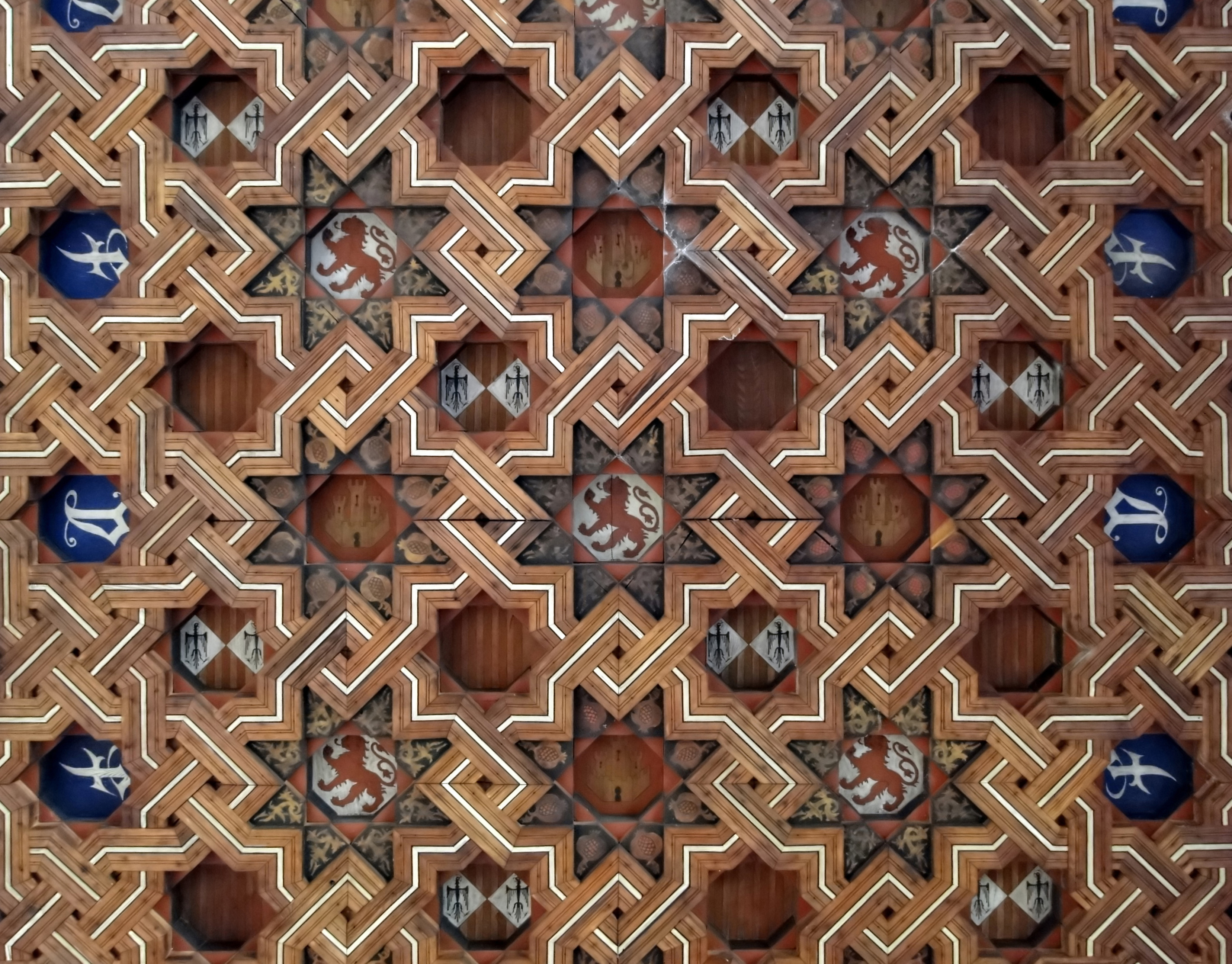
The exterior tells the story most dramatically. Isabella ordered the chains of freed Christian prisoners hung on the granite facade in 1494, two years after the fall of Granada. The shackles are not mounted in neat rows like a museum display; they festoon the walls in dense clusters, each pair representing a specific person who had been held captive. Walk close and you see the individual character of each chain - different thicknesses, different styles of manacle, the physical evidence of years of captivity. Inside, the heraldry is relentless. Reliefs bearing the coats of arms of the Catholic Monarchs cover the church interior, repeated across walls and vaults in a drumbeat of dynastic assertion. The Mudejar ceiling in the cloister adds an intricate layer of Islamic-influenced geometric pattern, a reminder that the craftsmen who built this monument to the Reconquista included the very people whose artistic traditions the Reconquista claimed to supersede.
The Mausoleum They Never Used
San Juan de los Reyes was conceived as the final resting place of Ferdinand and Isabella. The church was designed with this function in mind - spacious, lavishly decorated, positioned in a city freighted with symbolic significance. But the conquest of Granada in 1492 changed the calculus. Burying the Catholic Monarchs in the city they had just conquered from Islam made a more powerful statement than interment in Toledo, however symbolically charged. Ferdinand and Isabella chose the Royal Chapel of Granada instead. San Juan de los Reyes became a monastery without its monarchs, a mausoleum without its dead - which, paradoxically, may have preserved it. Without the ongoing cult of a royal tomb, the monastery settled into a quieter existence as a working Franciscan house. Its cloister, with gargoyles peering from the corners and tracery windows filtering the Castilian light, became a place of contemplation rather than pilgrimage. The chains on the outside still announce what happened. Inside, the silence tells a different story.
From the Air
Located at 39.86N, 4.03W in the western portion of Toledo's historic center, near the San Martin bridge over the Tagus River. The monastery is one of the larger structures in the old city and visible from altitude within the walled perimeter. Toledo is one of Spain's most distinctive aerial landmarks - a fortified medieval city on a granite hill nearly encircled by the Tagus gorge. Nearest major airport is Madrid-Barajas (LEMD), approximately 70 km northeast. The monastery sits on the western edge of the old city, overlooking the river valley. Best viewed at 2,000-5,000 feet.