Monastery of San Martino Pinario
One of the most striking features of San Martino Pinario's main altarpiece is that it has two faces. The double-faced retable-baldachin presents one elaborate composition toward the nave for the public and another toward the choir for the monastic community, as if the building itself could not decide whether to face inward or outward. This duality runs through the monastery's entire history. Founded around 899 as a modest home for Benedictine monks displaced by cathedral construction, it grew into the richest and most powerful religious institution in Galicia, administering control over most of the region's other monasteries. Today it is the second-largest monastery in Spain, surpassed only by the royal complex of El Escorial.
From Chapel to Cathedral's Shadow
The monastery's origins are tangled with those of the Santiago de Compostela Cathedral itself. It began as a chapel dedicated to Santa Maria called the Corticela, which was demolished in the late 9th century when King Alfonso III of Asturias and Bishop Sisnando started building the new cathedral. The Benedictine monks who had served the chapel needed a new home, and around 899 the monastery was built for them nearby. A second monastery replaced it, with a church consecrated in 1102 by Bishop Diego Gelmirez, though little from that era survives. Throughout the Middle Ages, the monastery accumulated wealth and influence until, by the end of the 15th century, it was the richest monastic house in Galicia. This prosperity funded an almost complete reconstruction beginning in the 16th century, producing the baroque complex that stands today.
Stone Altarpieces and Fruit Strings
The current church began construction after Juan de Sanclemente Torquemada was appointed Archbishop of Santiago in 1587. The architect Mateo Lopez designed the building; after his death in 1606, Benito Gonzalez de Araujo continued the work, completing the church in 1652. The western facade is organized like a stone altarpiece, divided into three sections by fluted columns, dedicated to the exaltation of the Virgin Mary and the Benedictine order. At the top, Saint Martin of Tours sits on horseback, dividing his cloak with a beggar, the patron saint's classic gesture. In the 17th century, Pena del Toro added two towers to the sides, deliberately keeping them lower than the church to avoid offending the cathedral chapter, and adorned the windows with fruit-string carvings that became a hallmark of Compostelan baroque. These decorative elements anticipated the style that Domingo de Andrade would later use on the cathedral's Clock Tower.
Gold Leaf and English Exiles
Inside, the church holds some of the finest baroque art on the Iberian Peninsula. The main altarpiece, designed by Fernando de Casas Novoa, the same architect who created the Obradoiro facade of the cathedral, is organized in two bodies of profuse gold-leaf decoration with Solomonic columns, scrolls, and acanthus leaves. The choir stalls, carved by Mateo de Prado between 1639 and 1647, exalt the Virgin Mary in relation to the dogma of the Immaculate Conception, a cause the Benedictines championed. One of the lateral altarpieces is dedicated to the Virgen Inglesa, so named because tradition holds that the carving of the Virgin and Child, dating from around 1500, was brought to Compostela by Catholic exiles fleeing England during the reign of Henry VIII. The dome over the crossing, built by Bartolome Fernandez Lechuga with twelve windows at its base, creates the sensation of floating in air.
From Monastery to Seminary
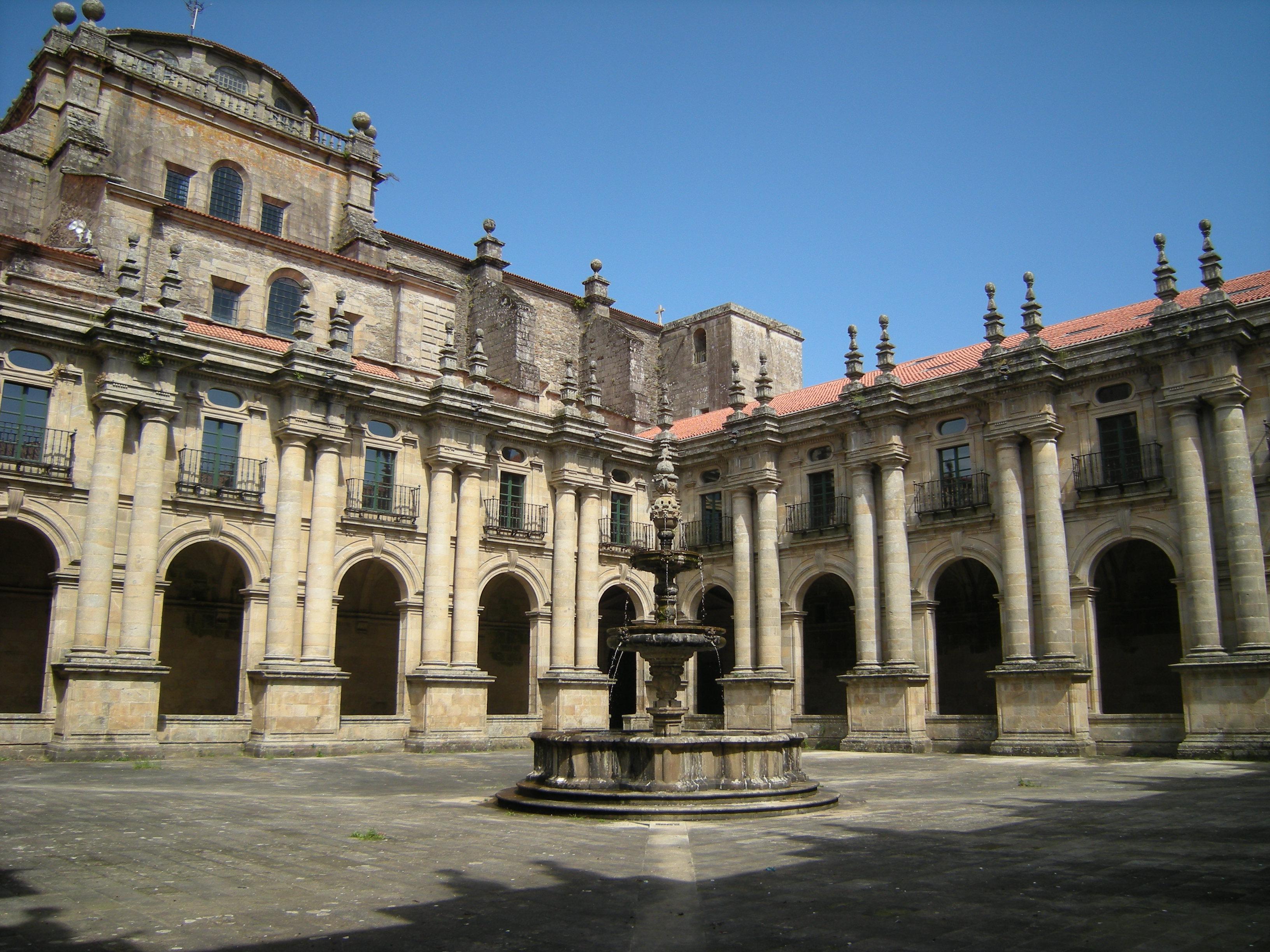
The Ecclesiastical Confiscations of Mendizabal in 1835 ended the monastery's religious life. The buildings were repurposed, and since 1868 they have housed the seminary of the Archdiocese of Santiago. Part of the complex now operates as a museum of religious art, with 12 rooms spanning multiple floors displaying paintings, sculptures, goldwork, liturgical vestments, and archaeological remains. Visitors can see the old printing press, the pharmacy where an apothecary monk once cultivated medicinal herbs, and the chapel of relics. The museum also houses the Renaissance choir of the Cathedral of Santiago, which was dismantled from the cathedral nave, relocated multiple times over the decades, and finally installed in San Martino in 2004 after restoration. The monastery's two cloisters, one begun in 1626 and the other around 1633, are architectural achievements in their own right, though they remain largely inaccessible, occupied by the Social Work School.
From the Air
Located at 42.88N, 8.54W in Santiago de Compostela, Galicia, northwest Spain, immediately adjacent to the Cathedral of Santiago de Compostela. The monastery's large footprint is visible from altitude as a major structure in the city's historic core. Nearest airport is LEST (Santiago de Compostela) approximately 12 km east. The monastery sits on the Plaza de la Inmaculada, directly north of the cathedral. Best viewed from 1,500-2,500 ft AGL.