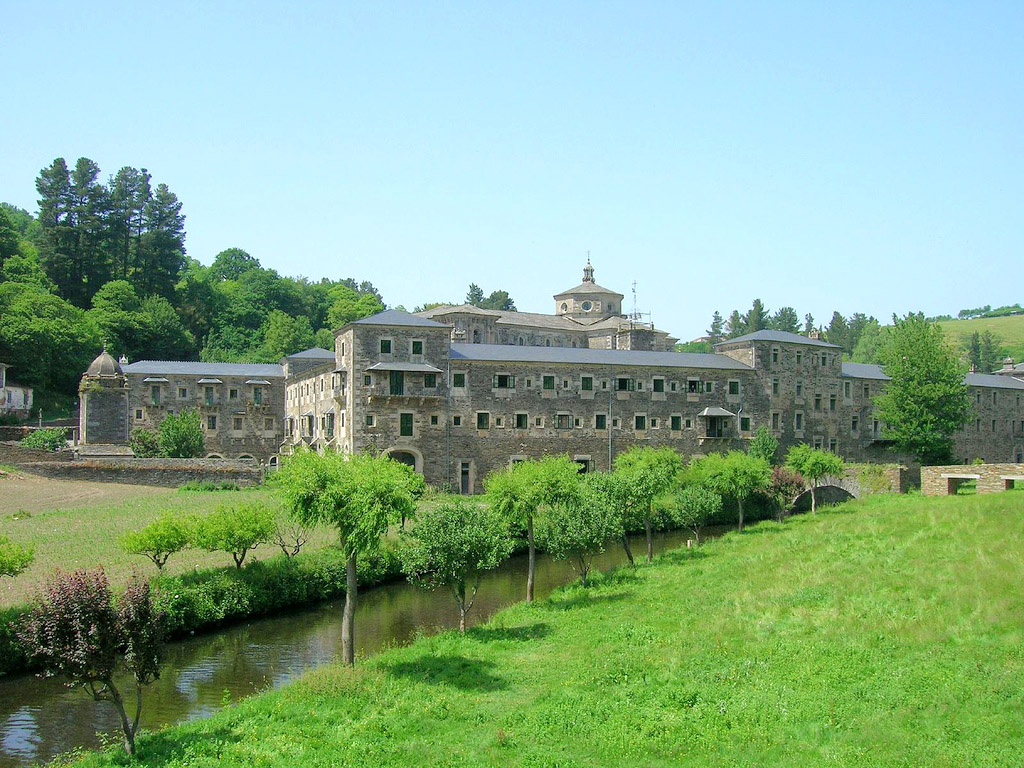
Monastery of San Xulian de Samos
When the assassinated King Fruela I of Asturias left behind a widow and infant son around 768, the family needed a place to hide. They chose the monastery of Samos, already ancient by then, tucked into the green folds of Galicia's interior mountains. The boy who grew up within its walls became Alfonso II, the king who would confirm the discovery of Saint James's tomb and set in motion the pilgrimage that transformed northwestern Spain. Samos has been shaping history from the margins ever since.
Fourteen Centuries of Continuity
The monastery's foundation is attributed to Martin of Braga in the 6th century, making it one of the oldest monastic sites in the Western world. The first written mention dates to 665, when an inscription records that the Bishop of Lugo, Ermefredo, rebuilt the complex. After the Muslim invasion, the monastery was abandoned until King Fruela I reconquered the area around 760. His family's refuge there cemented the monastery's relationship with the Asturian crown, earning it royal protection and properties within a half-mile radius. From 960, the community adopted the Rule of Saint Benedict. By the Middle Ages, Samos had grown enormously wealthy, controlling two hundred villas and five hundred rural sites across the region. It was, in effect, both a spiritual center and an economic power.
Fires and Resurrections
The monastery's history reads like a cycle of destruction and renewal. In 1558, after its incorporation into the Royal San Benito of Valladolid, a devastating fire forced a complete rebuilding. The community was then expelled in 1836 during the Mendizabal confiscation, when the Spanish government dissolved monasteries and seized their properties. Benedictine monks returned in 1880, restoring monastic life after more than four decades of absence. Then, in 1951, another catastrophic fire swept through the buildings, requiring yet another reconstruction. Each time, the monastery has been rebuilt in the architectural idiom of the era -- the result is a complex that layers late Gothic, Renaissance, and Baroque styles into a single sprawling institution. The persistence is remarkable: fire, government seizure, and centuries of political upheaval have not managed to permanently silence the chanting.
Terraces Older Than the Monks
Recent multidisciplinary research has revealed that the landscape around Samos Abbey tells its own long story. Archaeological surveys, pollen analysis, and luminescence dating show that the hillsides were terraced for agriculture as early as the Iron Age, between 364 and 150 BC -- centuries before any monastery existed. The monks did not arrive in a wilderness; they inherited and expanded a working landscape. OSL dating reveals new terraces created in the 8th and 9th centuries, coinciding with the monastery's refoundation under Asturian royal protection. A 13th-century phase of terrace construction aligns with the building of the Romanesque church. The most extensive transformation came in the mid-17th century, when existing terraces were reconfigured and new agricultural spaces carved into the hillsides. The monastery shaped its surroundings as deliberately as it shaped the spiritual lives of its monks.
A Stop on the Way
Samos sits on the Camino Frances, the most traveled route of the Way of Saint James, and for pilgrims walking from eastern Spain toward Santiago de Compostela, the monastery offers both rest and perspective. The complex is vast -- its walls enclose cloisters, a church, and monastic quarters that have housed communities for more than a millennium. Pilgrims who stop here encounter a place where the journey itself is honored. The monastery once served as a School of Theology and Philosophy, training clergy who would serve across Galicia. Today, it remains an active Benedictine community, and visitors can attend services in the church. The architecture tells the full story of Iberian religious art: late Gothic arches, Renaissance proportions, and Baroque ornamentation all coexist within a single compound, each layer a record of a community that kept rebuilding because it believed the place was worth saving.
From the Air
Located at 42.732N, 7.326W in the municipality of Samos, Lugo province, Galicia. The monastery complex is visible from the air as a large rectangular compound in a narrow green valley, surrounded by terraced hillsides. Nearest airports: Lugo does not have a commercial airport; Santiago de Compostela (LEST, ~100 km west) or Asturias Airport (LEAS, ~150 km east). Best viewed at 3,000-5,000 ft AGL. The Camino de Santiago route is sometimes visible as a trail through the landscape.