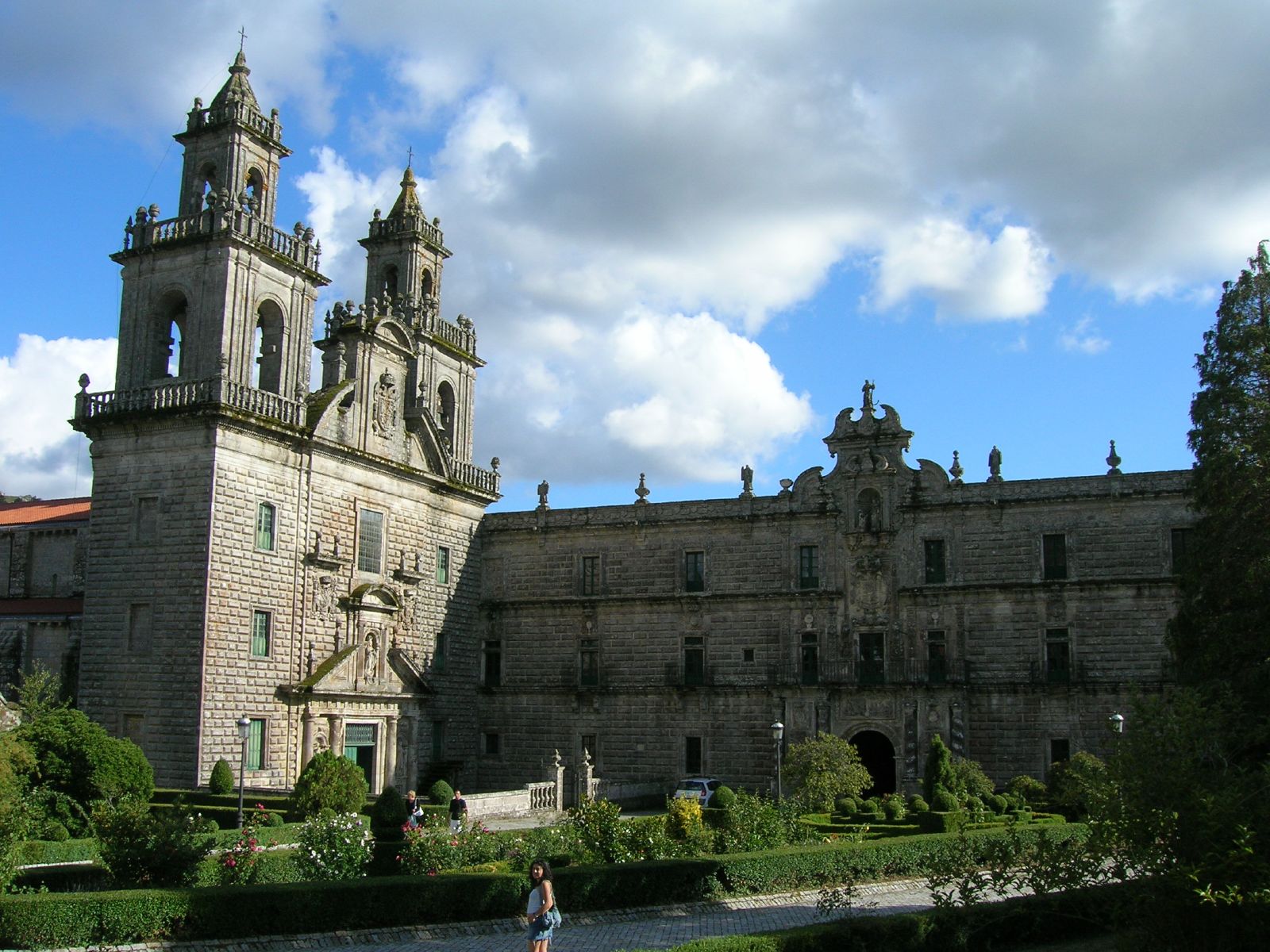
Monastery of Santa Maria de Oseira
The monks call it the Galician Escorial. Nestled in a remote valley in the province of Ourense, the Monastery of Santa Maria de Oseira is enormous for its setting -- a vast complex of stone rising from green hillsides where the nearest neighbors are oak trees and cattle. It has been here since 1137, when it was established as a Cistercian house with monks dispatched from France by Saint Bernard of Clairvaux himself. Nearly nine centuries later, monks still live within these walls, though the order and the world around them have changed profoundly.
French Monks in Galician Hills
The monastery came into being in 1137 and joined the Cistercian order in 1141, when French monks arrived from Clairvaux carrying Bernard's vision of monastic austerity and self-sufficiency. The Cistercians favored remote locations, and Oseira delivered: tucked into the interior hills of Galicia, far from cities and commerce, surrounded by the forests and streams that would sustain the community. The church was built between approximately 1200 and 1239, and it became a landmark of Romanesque architecture on the Iberian Peninsula. Its design drew on the traditions of other pilgrimage churches along the routes to Santiago de Compostela, making Oseira a stopping point for travelers making their way toward the apostle's tomb.
The Palm Tree Room
The monastery's most celebrated space is its main chamber, known as the "palm tree room." Four columns support a soaring dome, their capitals branching outward like the fronds of a palm, creating a canopy of stone that manages to feel both massive and organic. The effect is one of the great spatial surprises in Galician architecture -- entering from the heavy corridors of the monastery, the room opens up and lifts the eye. The name is not metaphorical; the carved capitals genuinely evoke palm fronds, a touch of botanical imagination in a building otherwise defined by the Cistercian commitment to simplicity. The monastery also maintains a Lapidarium, a collection of stone fragments recovered during restorations and excavations, preserving pieces of architectural history that might otherwise have been lost to rubble.
Exile and Return
For nearly a century, the monastery stood empty. In 1835, the Spanish government's ecclesiastical confiscation policies forced the monks to leave, and the buildings began their slow decline into ruin. Roofs collapsed, vegetation invaded the cloisters, and the great church fell silent. The abandonment lasted until 1929, when a community of Cistercians of the Strict Observance -- Trappists -- arrived to begin the work of reclamation. These monks follow a contemplative rule that emphasizes silence, manual labor, and prayer, and the restoration of Oseira became itself a form of devotion. The state joined the effort, recognizing the monastery as a major national monument, and the restoration continues to this day as monks and conservators work side by side to recover what nearly a century of neglect destroyed.
Silence as Practice
Oseira remains an active monastery, and visitors are welcome. But the experience is shaped by the Trappist emphasis on contemplation and quiet. The monks follow the daily rhythm of the Liturgy of the Hours, gathering for prayer seven times between dawn and nightfall. Between services, they work -- maintaining the buildings, tending gardens, producing the goods that support the community. The monastery's remoteness, which the original Cistercians sought deliberately, still defines the experience of arriving. There are no nearby cities to generate noise or traffic. The valley is quiet in a way that feels intentional, as if the landscape itself has been recruited into the monastic project. For pilgrims heading to Santiago de Compostela, Oseira offers a different kind of arrival than the cathedral at journey's end -- not a culmination, but a pause.
From the Air
Located at 42.538N, 7.951W in the hills of inland Galicia, Spain. The monastery complex is large enough to be visible from the air, situated in a green valley surrounded by forested hills. Nearest airports: Vigo-Peinador (LEVX, ~80 km southwest) or Santiago de Compostela (LEST, ~100 km northwest). Best viewed at 3,000-5,000 ft AGL. The remote valley setting with no nearby urban development makes the monastery stand out clearly against the landscape.