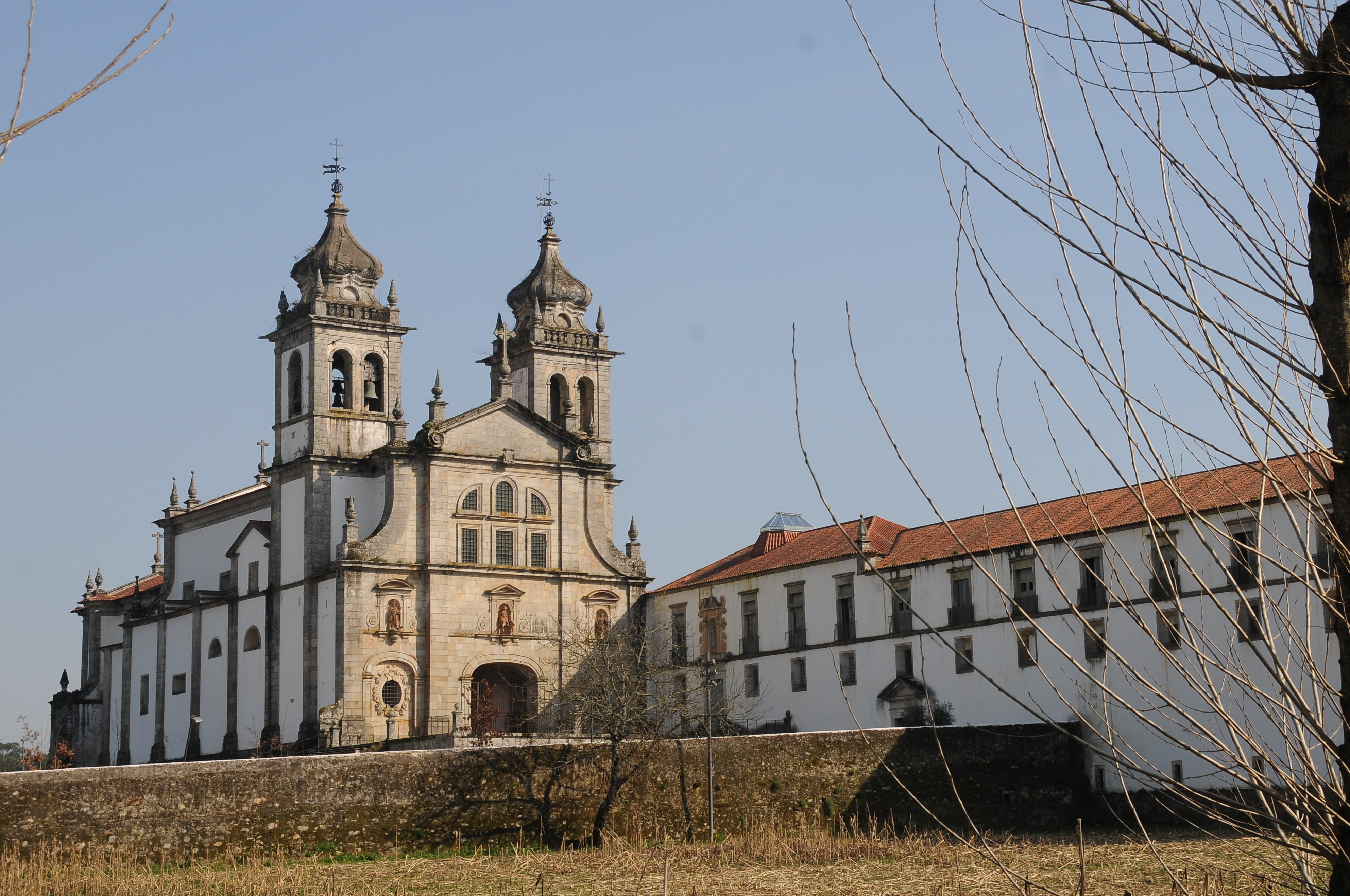
Monastery of São Martinho de Tibães
Step inside the church at Tibaes and the gilding overwhelms. Every surface of the main altarpiece erupts in carved wood layered with gold leaf -- scrolls, angels, columns spiraling upward in a Rococo frenzy that seems designed to make the visitor forget there is a world outside. The architect Andre Soares created this between 1757 and 1760, and the sculptor Jose de Santo Antonio Vilaca carved its intricate forms. It is one of the masterpieces of Portuguese Rococo, and it exists in a monastery that was the spiritual headquarters of the Benedictine order across two continents. That this building survived auction, fire, and decades of ruin to be restored in the modern era is itself a kind of resurrection.
A Thousand Years of Monks
Monastic life near Tibaes predates the monastery itself by centuries. The nearby Monastery of Dumio, founded by Saint Martin of Braga, placed monks in this landscape as early as the 6th century. The Monastery of Tibaes was established around 1060, and Henry of Burgundy, Count of Portugal, granted its feudal rights in 1110. During the Middle Ages, as the Kingdom of Portugal consolidated its independence, vast properties in the country's north came under the monastery's control. By 1567, Tibaes had been designated the mother house of the Order of Saint Benedict for Portugal and its colony of Brazil, hosting the first general gathering of the order in 1570. From this parish near Braga, Benedictine life was administered across two continents and an ocean.
The Great Rebuilding
By the early 17th century, the medieval monastery had fallen into ruin, and the monks who commanded vast resources decided on radical reconstruction rather than repair. The rebuilding began with the refectory and cemetery cloisters, then moved to the church, which rose between 1628 and 1661 in Mannerist style under architects Manuel Alvares and Joao Turriano. Through the following decades, new wings took shape: the Gate House, the Dormitory, the Guest House, the Chapter House, and the Library. By the early 18th century, the monastery presented itself as an entirely new complex, its medieval origins invisible beneath the weight of Baroque and Mannerist architecture. Nothing remained of the original structures. The monks had not restored their monastery -- they had replaced it.
Gold and Gilding
During the 17th and 18th centuries, Tibaes became a center of artistic production that shaped the Baroque and Rococo art of northern Portugal and the overseas colonies. The monastery's influence radiated outward: craftsmen trained here carried techniques and aesthetic sensibilities to churches and monasteries across Brazil. The pinnacle came between 1757 and 1760, when Andre Soares designed the main altarpiece, the woodwork of the triumphal arch, the pulpits, and the lateral altarpieces. The sculptor Vilaca executed the gilded carvings that make the interior shimmer. Many of the church's statues are by Cipriano da Cruz, another celebrated artist whose work found its way into collections across the Iberian Peninsula. Together, these works constitute landmarks of Portuguese Rococo, a style that favored exuberance over restraint and achieved at Tibaes its most concentrated expression.
Auction, Fire, and Recovery
The dissolution of religious orders in Portugal brought the monastery's centuries of Benedictine life to an end. In 1864, Tibaes was sold at auction, and the complex and its surrounding lands began a long slide into decay. A devastating fire in 1894 destroyed the refectory cloister and a great part of the ensemble, leaving sections of the monastery as roofless shells open to the weather. For nearly a century, Tibaes deteriorated -- walls crumbled, vegetation invaded, the gilded interiors darkened under layers of soot and neglect. In 1986, the Portuguese state acquired the property and launched an extensive recovery project that continues today, painstakingly restoring the church, the cloisters, and the surrounding grounds. The monastery now operates as a cultural venue and guesthouse, its gardens open to the public, its church once again lit by the glow of Soares' golden altarpiece.
From the Air
Located at 41.556N, 8.479W in the parish of Mire de Tibaes, approximately 6km northwest of Braga in northern Portugal. The monastery complex is visible from the air as a large cluster of buildings amid agricultural and forested land. Braga Airport (no ICAO commercial code; nearest major airport is Francisco Sa Carneiro LPPR/OPO, 55km southwest). Best viewed at 2,000-4,000 feet where the monastery's scale relative to the surrounding countryside is apparent. The church facade and cloister wings are the most visible elements. Northern Portugal has a green, Atlantic climate with frequent rain.