Monastery of the Holy Cross (Coimbra)
Portugal's founding is buried here. In the Monastery of the Holy Cross in Coimbra, stone tombs sculpted by Nicolau Chanterene hold the remains of Afonso Henriques, who transformed a county into a kingdom, and his son Sancho I, who consolidated what his father had won. The monastery earned its role as a national pantheon not through royal decree but through proximity to power -- Afonso Henriques himself chose to be buried in the scriptorium that had helped legitimize his rule, in the monastery whose scholars had given his ambitions the weight of law and theology. Founded in 1131, a year before the kingdom of Portugal officially existed, the Monastery of the Holy Cross is older than the nation it helped create.
Before the Kingdom
Saint Theotonius founded the community of Canons Regular of the Holy Cross outside the protective walls of Coimbra in 1131, establishing himself as the first prior of what would become Portugal's most politically significant monastery. Construction of the church and monastic buildings began the following year and continued until 1223. The monastery rapidly accumulated wealth through papal privileges and royal grants, becoming not only a center of worship but a center of power. Its school, with its vast library, attracted the intellectual elite of the emerging Portuguese state. Its scriptorium -- the writing workshop where monks copied and composed texts -- served the specific political function of consolidating royal authority. Afonso Henriques used the monastery's scribes to produce documents that buttressed his claims to sovereignty, binding the religious institution to the crown in a partnership that benefited both. When the king died, burial at Santa Cruz was not a gift bestowed on the monastery; it was a debt acknowledged.
A Church Remade in Manueline Stone
Nothing remains of the original Romanesque monastery that Theotonius built. The early structure had a single nave and a tall tower on the facade, typical of Augustinian-Romanesque design, but these elements were swept away during a complete renovation ordered by King Manuel I in the first half of the 16th century. The architect Diogo de Boitaca designed the new Manueline church and chapter house, introducing the basket-handled and ribbed ceilings that became signatures of the style. Marco Pires continued the work, completing the church, the Chapel of Sao Miguel, and the Cloister of Silence -- a name that captures both the architectural calm of the space and the contemplative life it was built to shelter. The main portal, sculpted by Nicolau Chanterene between 1522 and 1525, harmonizes Manueline maritime motifs with Renaissance elements, creating the most celebrated feature of the entire complex.
The Saint Who Walked Away
Among the canons regular who lived at the Monastery of the Holy Cross was a young man from Lisbon named Fernando de Bulhoes -- later known to the world as Saint Anthony of Padua. After his ordination, Fernando was placed in charge of hospitality for the monastery, a modest assignment for someone who would become one of Catholicism's most beloved saints. His transformation began when Franciscan friars arrived at the monastery carrying the remains of five missionaries who had been martyred in Morocco -- the Franciscan protomartyrs, whose deaths in the service of their new order had already made them famous across Christendom. The encounter changed Fernando's life. He left the security and scholarly comfort of the Augustinian canons for the radical poverty of the newly founded Franciscans, took the name Anthony, and eventually settled in Padua, Italy, where his preaching drew crowds by the thousands. The monastery that trained him, with its library and its royal connections, could not have been more different from the life he chose.
Masters of Stone and Paint
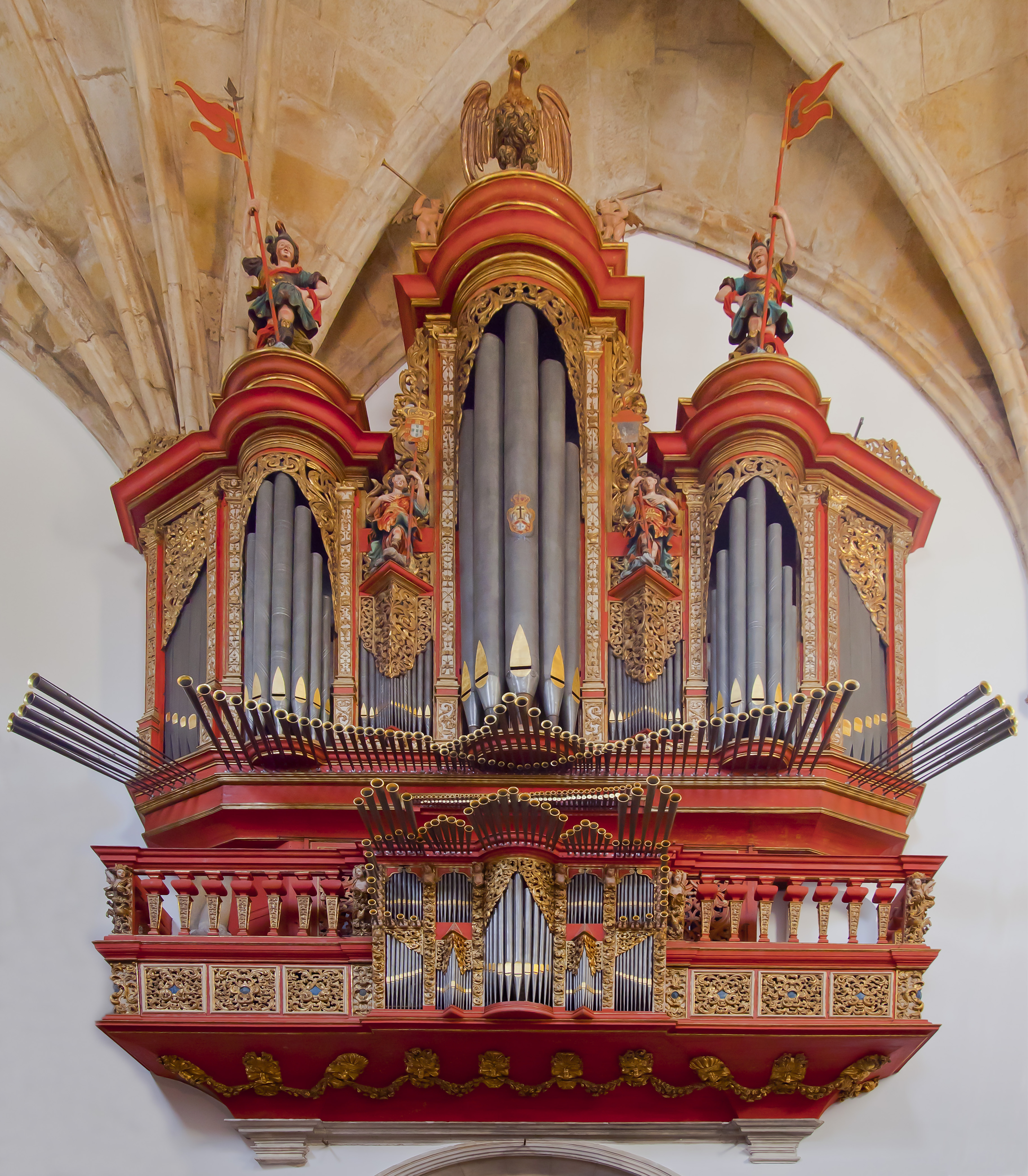
Throughout the 16th century, the most respected architects, sculptors, and painters in Portugal worked at the Monastery of the Holy Cross. Diogo de Castilho contributed structural work. Jean of Rouen -- Joao de Ruao -- carved the detailed stone ornamentation. Cristovao de Figueiredo and Vasco Fernandes, known as Grao Vasco, painted canvases that now rank among the finest examples of Portuguese Renaissance art. Chanterene's sculptural work on the royal tombs, completed in 1530, moved the remains of Afonso Henriques and Sancho I to the main chapel, where they rest in elaborately carved stone sarcophagi. The 17th-century sacristy preserves additional canvases from the 16th century, and a Baroque pipe organ from the 18th century fills the nave with an instrument whose gilded case matches the lavishness of the architecture surrounding it. The monastery is, in the end, a collaborative work -- assembled over centuries by hands that spoke different artistic languages but shared a single ambition: to make stone, paint, and sound honor the dead and inspire the living.
From the Air
Located at 40.21N, 8.43W in central Coimbra, Portugal, near the Praca 8 de Maio in the lower part of the historic city. The monastery is within the dense urban core and may be difficult to distinguish from the air without reference to its position near the Mondego River. Nearest commercial airports are Porto (LPPR) approximately 120 km north and Lisbon (LPPT) about 200 km south. Best viewed at 2,000-3,000 feet for context within Coimbra's historic cityscape.