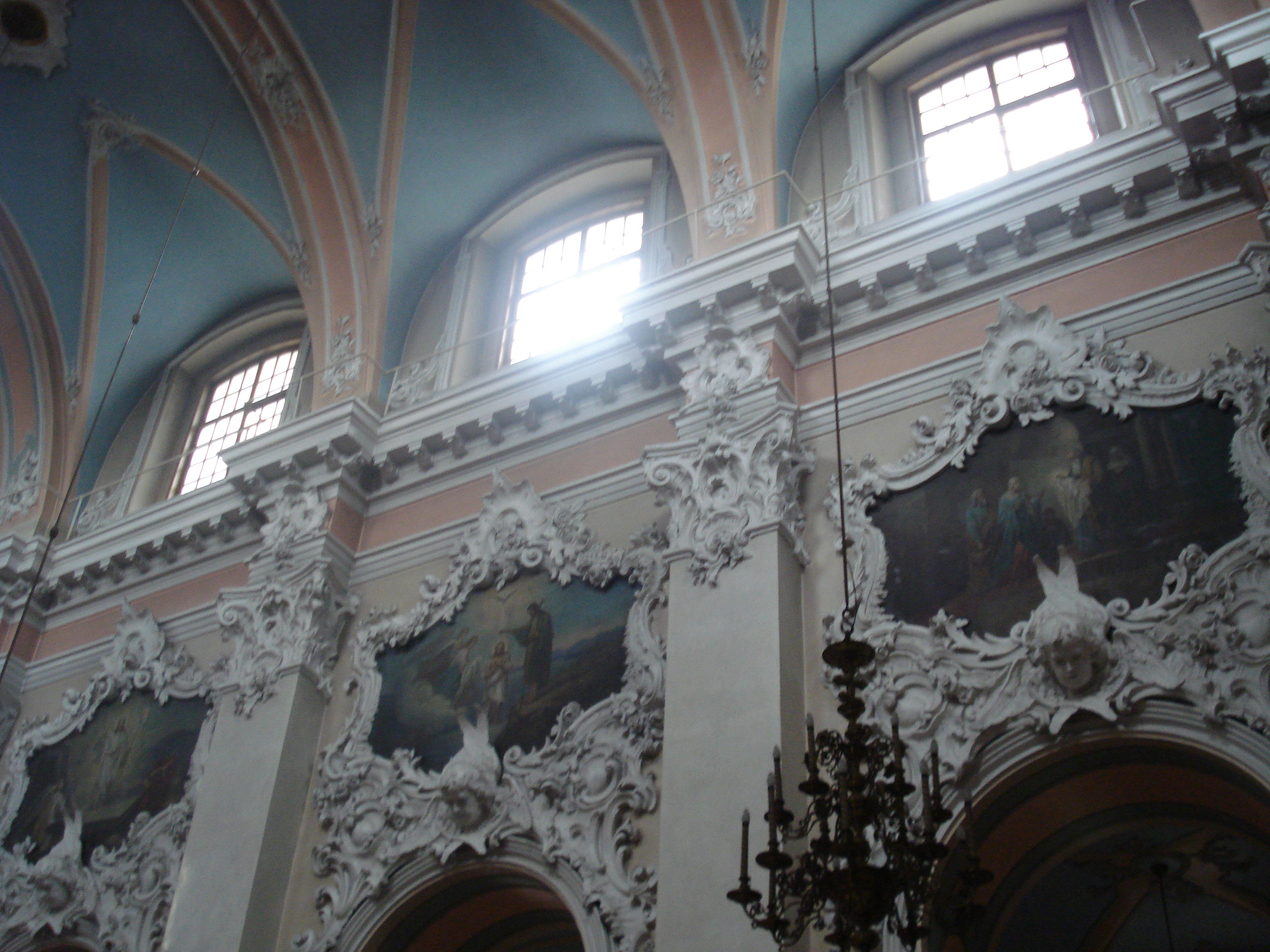
Monastery of the Holy Spirit, Vilnius
Step through the ornate gate at Aušros Vartų 10, and the noise of central Vilnius drops away. A courtyard opens behind walls that look unremarkable from the street, and the twin towers of the Holy Spirit church rise forty-nine meters into the Lithuanian sky. The astonishing thing about this place is not its architecture but its continuity. Since 1609, monks have prayed in this courtyard every day. Polish kings came and went. Napoleon's soldiers desecrated the altar. The Russian Empire absorbed it, then the Second Polish Republic, then the Soviet Union, then independent Lithuania. Through all of it, the bells kept ringing.
A Brotherhood Built on Defiance
The monastery began as an act of organized resistance. In 1596, the Union of Brest brought most of the Orthodox bishops of the Polish-Lithuanian Commonwealth into communion with Rome, and Orthodox property across the Grand Duchy of Lithuania began passing to the new Greek Catholic, or Uniate, church. The Brotherhood of the Holy Spirit, several hundred strong and drawn from both artisans and aristocrats, refused to yield. In 1597 they obtained a royal privilege to build a wooden Orthodox church on land owned by the noble Wołowicz sisters, Theodora and Anna, whose family standing protected it from confiscation. Twelve years later, in 1609, the brotherhood established a male monastery beside the church. Its first superior, Longin Karpowicz, had been a printer in the brotherhood's workshop before he took monastic vows.
Three Saints in the Nave
At the center of the church, beneath a Baroque iconostasis reshaped during a 1750s reconstruction, sits an ornate reliquary that draws Orthodox pilgrims from across Europe. Inside lie the relics of Anthony, John, and Eustathius, three young courtiers of Grand Duke Algirdas who refused to renounce their newly adopted Christian faith and were executed in fourteenth-century Vilnius. The Orthodox Church canonized them as the Vilnius Martyrs, and their presence has made this monastery a pilgrimage destination for centuries. Around the reliquary hang twenty icons by the nineteenth-century Russian painter Ivan Trutnev, including an Annunciation funded by Empress Maria Alexandrovna, wife of Tsar Alexander II. The original Baroque church gave way to something closer to Classicism after the last reconstruction, but inside, the older style still presides.
What Survived
Survival has come at a cost. In 1629 and again in 1637, supporters of the Union attacked the monastery, trying to extinguish the last strong center of Orthodox resistance on Lithuanian lands. In 1812, Napoleonic troops occupied the church, burned the royal doors of the iconostasis, and damaged the altar; only a four-thousand-five-hundred-ruble donation from a merchant named Alexander Slutsky paid for the repairs. By the early nineteenth century only five monks remained, and the monastery brought eleven novices from Kostroma, deep in Russia, just to keep the community alive. In 1925, under Polish rule, much of the monastery's land was confiscated. The Polish state listed it for closure in 1930 and again in 1936, but the orders were never carried out. During the Second World War, the monks ran an orphanage.
The Old Russian Gate
Most of the courtyard buildings are deliberately plain, two-story structures rebuilt after an eighteenth-century fire and shaped by centuries of utility. Only the entrance gate makes a statement, a concentrated burst of Old Russian style that announces the monastery's spiritual loyalties before a visitor takes a step inside. The contrast is the point. Behind the modest walls live monks, the diocesan office, and a library; in the courtyard, parishioners come and go alongside pilgrims who arrive specifically to venerate the martyrs' relics. In Soviet Lithuania, when most religious institutions were closed or repurposed, the Holy Spirit Monastery kept functioning. It is, today, the residence of the Orthodox bishops of Vilnius and Lithuania, a position the building has held since 1845.
From the Air
Located at 54.6752°N, 25.2926°E in central Vilnius, just south of the Old Town's Gate of Dawn. The twin domed towers rise 49 meters and are visible among the spires of the Old Town from the air. Approach from Vilnius International Airport (EYVI), 6 km south. Best viewed at low altitude in clear weather; the dense cluster of Vilnius church spires makes the city skyline a navigation landmark in itself.