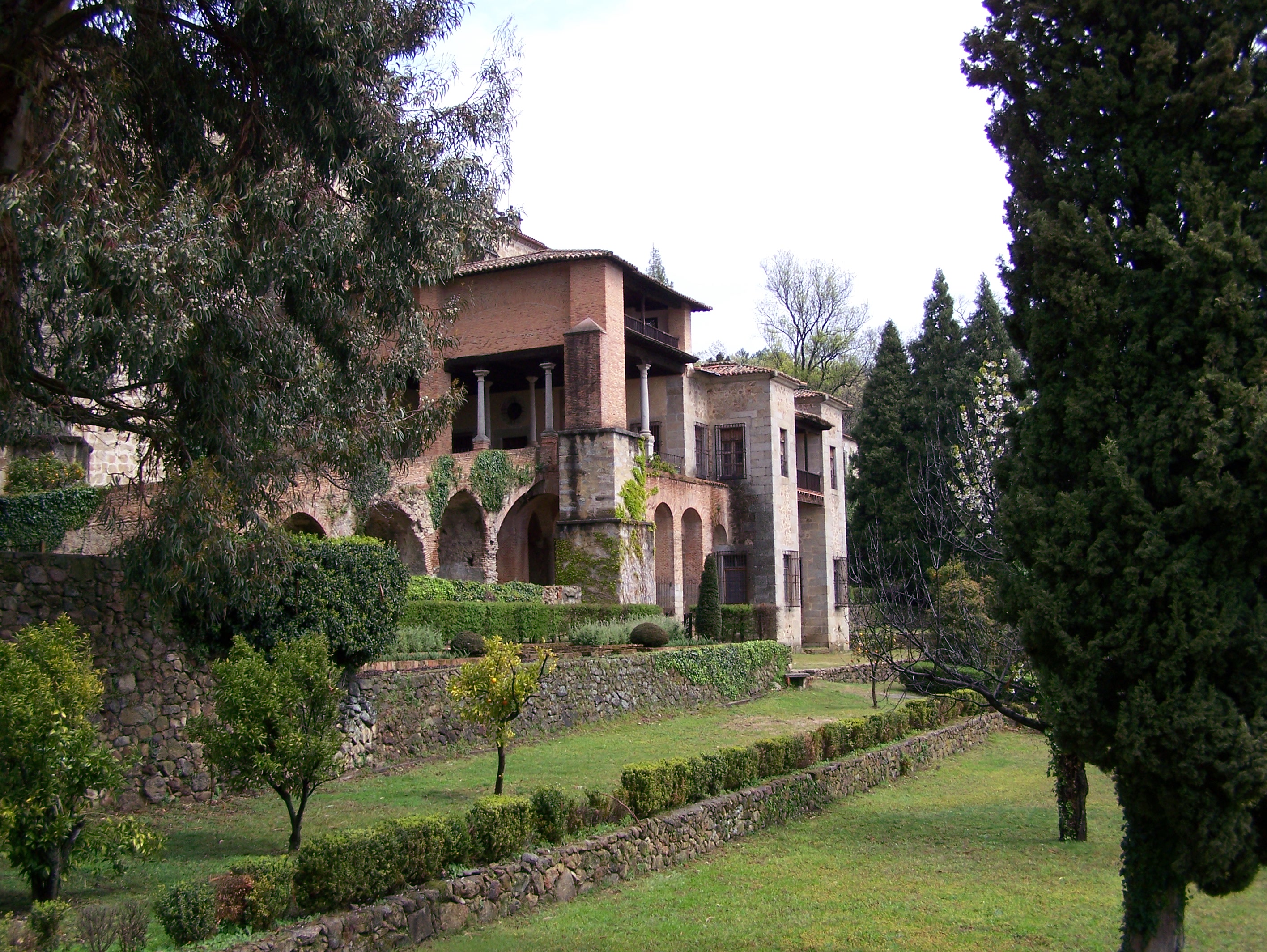
Monastery of Yuste
He ruled half the world, then gave it all away. In 1556, Charles V, Holy Roman Emperor and King of Spain, signed away both crowns -- handing Spain to his son Philip II and the Empire to his brother Ferdinand I -- and traveled to a small Hieronymite monastery tucked into the cherry-blossom valleys of Extremadura. The Monastery of Yuste was remote, obscure, and exactly what the exhausted emperor wanted. He had spent decades waging wars across Europe, managing an empire that stretched from the Netherlands to Peru, and battling the Protestant Reformation. At fifty-six, racked by gout, he wanted nothing more than silence, prayer, and the sound of monks chanting.
A Monk's Cell for a King
The monastery had been founded by the Hieronymite order in 1402, a modest religious house in the village now called Cuacos de Yuste in the province of Caceres. It was never designed for an emperor. When Charles arrived with an entourage of fifty to sixty attendants, the monastery had to be hastily expanded to accommodate a man accustomed to palaces. Yet the new quarters were deliberately simple. Charles wanted proximity to the chapel above all else -- his bedroom was positioned so he could hear Mass from his bed on days when gout left him unable to walk. The contrast between this quiet retreat and the courts of Brussels, Madrid, and Vienna was the whole point. Charles had not been deposed or exiled. He had chosen this, the first voluntary abdication of a major European sovereign in centuries.
The Emperor's Final Court
Retirement did not mean complete isolation. Visitors came to the remote valley, drawn by the extraordinary spectacle of Europe's most powerful monarch living as a near-recluse. Philip II, his heir, made the journey. So did Don Juan de Austria, Charles's illegitimate son, who would later command the Christian fleet at the Battle of Lepanto. The monastery became a peculiar kind of court -- no longer a center of political power, but still a place where the decisions of an era lingered. The setting itself became famous enough that Giuseppe Verdi chose Yuste as the backdrop for his opera Don Carlos, using the moonlit monastery grounds for key scenes. Charles died at Yuste on 21 September 1558, less than two years after his arrival. He was buried in the monastery church, though his remains were later transferred to the Royal Monastery of San Lorenzo del Escorial.
Burned, Looted, and Rebuilt
The monastery's peaceful obscurity did not protect it from history. In 1809, during the Peninsular War, French soldiers burned the complex. The Ecclesiastical Confiscations of Mendizabal in the 1830s stripped it further, and the buildings deteriorated into ruins over the following century. Locals carted away what they could. By the mid-twentieth century, what had been an emperor's retreat was a shell of crumbling walls and empty windows. Restoration came in 1949, ordered by the Franco regime, which saw in Charles V's legacy a symbol of Spanish imperial greatness worth reviving. The 15th-century choir furniture, scattered to other churches during the years of abandonment, was tracked down and returned. The restoration was thorough if politically motivated, and the monastery that visitors see today is largely a mid-century reconstruction built over medieval bones.
Cherry Blossoms and Monks
The Valle del Jerte, the valley surrounding Yuste, has become an eco-tourism destination, and the monastery sits at its heart. Cherry trees blanket the hillsides, erupting in white blossoms each spring in a display that draws visitors from across Spain. The monastery is currently inhabited by monks of the Pauline Order, maintaining a living religious community in a building whose most famous resident was a man who traded an empire for prayer. In 2007, the European Union awarded Yuste its European Heritage Label, recognizing the monastery's significance to the continent's shared history. Visitors can walk through the emperor's apartments, see the bedroom positioned for a view of the altar, and stand in the same cloister where Charles V spent his last days watching the valley's famous cherry trees bloom -- a man who once held the fate of nations deciding, finally, that enough was enough.
From the Air
Located at 40.11N, 5.74W in the Valle del Jerte, Extremadura, western Spain. The monastery sits in a wooded valley at approximately 500 m elevation, surrounded by cherry orchards and forested hills. Nearest airports include Talavera la Real (LEBZ / Badajoz) approximately 200 km south, and Salamanca (LESA) approximately 170 km north. The valley runs roughly east-west and is scenic in spring when cherry trees bloom. Terrain is mountainous with the Sierra de Gredos to the north.