Monigo concentration camp
"They were not normal corpses," the pathologist said. "They looked like mummies or exhumed bodies." Professor Menemio Bortolozzi of Treviso's hospital was describing what he found at the Monigo concentration camp, a facility that Italy's fascist government operated inside a military base on the outskirts of Treviso between July 1942 and September 1943. The camp held mostly Slovenian and Croatian civilians — men, women, and children swept up in the Italian military's campaign to suppress partisan resistance in occupied Yugoslavia. An estimated 10,000 people passed through Monigo, with an average of 2,582 prisoners held at any given time in a facility designed for 2,400.
Behind the Barbed Wire
The camp occupied five brick barracks inside the Cadorin military base, northwest of Treviso's center. A sixth barracks housed the guards. Two small rooms served as bathroom and canteen; a seventh cabin doubled as kitchen and command post. The first prisoners, arriving on July 1, 1942, were Slovenians. By autumn, Croatians followed, many transferred from the notorious Rab concentration camp on the Adriatic island of Rab. General Mario Roatta's "Circolare 3C" had classified prisoners into two categories: repressivi, suspected partisans to be suppressed, and protettivi, civilians theoretically being sheltered from partisan reprisals. In practice, overcrowding erased the distinction. No uniforms were issued. Prisoners wore whatever summer clothing they had arrived in, even as winter set in across the Veneto plain. Each person received three blankets, a spoon, a tin cup, and a handful of straw. They slept two to a bunk.
Nine Hundred Calories
From the start, the diet at Monigo was a slow form of destruction. Prisoners received a cup of tea in the morning, a loaf of bread later, rice at lunch, and a slice of cheese in the late afternoon — roughly 911 calories a day, less than half what a sedentary adult needs to survive. Inflation through late 1942 shrank the already meager food budget further. Guards stole supplies to sell on the black market, making what reached the prisoners even less. By November 1942, the camp held 3,122 people: 1,058 men, 1,085 women, and 466 children, including 42 infants. When winter arrived, the unheated barracks became incubators for disease. Tuberculosis, pneumonia, scabies, muscular atrophy, and dysentery spread through the weakened population. Women and children transferred from Rab suffered the most. Casualty lists compiled after the war record between 187 and 225 deaths. Fifty-three of the dead were children under ten. The infant mortality rate reached approximately 300 per thousand — nearly one in three.
News from Behind the Wire
Even within these conditions, prisoners organized a life that their captors had not planned for. Slovenian internees formed a choir. They held chess tournaments. Most remarkably, they produced a handwritten newspaper they called Novice izza žice — "News from Behind the Barbed Wire." These acts of cultural resistance were not diversions from suffering; they were responses to it, assertions of identity and community by people whom the state had reduced to categories on a memo. Vladimir Lamut, a Slovenian prisoner, made drawings documenting daily life in the camp — maintenance work that contradicted the official claim that no forced labor was imposed. The Carabinieri commander, Lieutenant Colonel Alfredo Anceschi, was remembered by survivors for his severity. One prisoner recalled a woman tied to a post in the middle of the camp grounds for an entire day. Beginning in March 1943, the camp also held prisoners of war from South Africa and New Zealand, roughly 600 men housed in a subsection called Camp 103.
What the Walls Remember
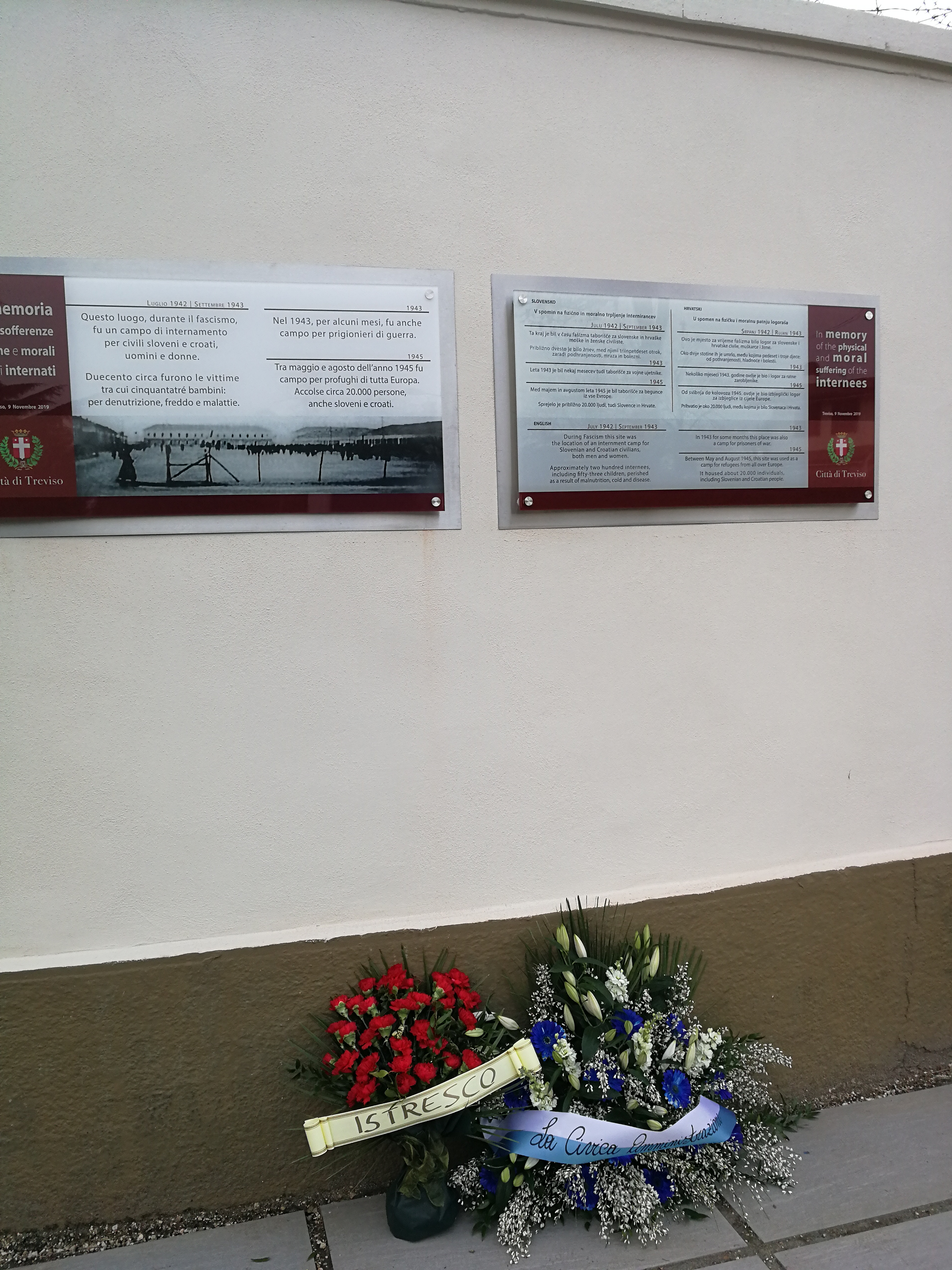
The camp closed after Italy's armistice with the Allies in September 1943. The barracks returned to their original military function, and today the site houses the Italian Army's 33rd Electronic Warfare Regiment. For decades, the camp's history received little public attention — part of a broader silence around Italy's wartime internment system, which has long been overshadowed in public memory by the larger German concentration camp network. That silence began to break in 2003 with the publication of dedicated research by the Istituto per la Storia della Resistenza e della Società Contemporanea della Marca Trevigiana. On November 9, 2019, civil and religious authorities from Italy, Croatia, and Slovenia gathered at the military base for a memorial ceremony. Two plaques were unveiled on the boundary walls beside the base gates, marking the place where thousands of civilian men, women, and children were imprisoned. The speakers emphasized tolerance, human dignity, and international cooperation — principles that the camp's existence had violated, and that its remembrance now serves.
From the Air
Located at 45.666°N, 12.242°E, in the Monigo suburb northwest of Treviso, Veneto, Italy. The site is within an active Italian Army base (33rd EW Regiment) and not visible as a distinct historical site from the air. From 3,000–5,000 feet AGL, the military compound is identifiable northwest of Treviso's city center. Treviso Airport (LIPH/Sant'Angelo) is approximately 2 miles southwest. Venice Marco Polo Airport (LIPZ) is about 15 miles south. The flat Veneto plain offers clear visibility in good weather.