Monitor National Marine Sanctuary
She was built in 110 days, fought the most famous naval duel in American history, and sank before the year was out. USS Monitor -- the strange, flat-decked warship with a single revolving gun turret that a newspaper mocked as a 'tin can on a shingle' -- changed everything about how nations built and fought with ships. And she lies on the floor of the Atlantic Ocean, sixteen miles south-southeast of Cape Hatteras, North Carolina, at the center of the nation's first national marine sanctuary. Designated on January 30, 1975, the Monitor National Marine Sanctuary was created not to protect coral reefs or whale migration routes, but to preserve a single cultural artifact: the remains of the vessel that gave an entire class of warships its name.
The Ship That Changed Everything
Designed by Swedish engineer John Ericsson, USS Monitor was the prototype for a class of ironclad, turreted warships that fundamentally altered naval technology in the nineteenth century. Every emerging innovation in maritime warfare was packed into her low-slung hull: iron armor plating, a revolving gun turret, a screw propeller. She was purpose-built for river combat, with a freeboard so low that waves washed over her deck in anything rougher than calm water. That same design feature made her lethal in the shallows of Hampton Roads, where she fought CSS Virginia to a draw on March 9, 1862, in the first battle between ironclad warships. But it also sealed her fate. On December 31, 1862, while being towed south by the sidewheel steamer Rhode Island through heavy seas off Cape Hatteras, Monitor was swamped by high waves. She foundered and sank, carrying sixteen of her 62 crewmen to the bottom.
Lost and Found
For more than a century, Monitor's resting place was unknown. Then, in 1973, an interdisciplinary team of scientists from Duke University's Marine Laboratory set out to find her. Working from extensive historical research and probability maps of where the ironclad likely went down, the team swept the ocean floor with side-scan sonar and remotely operated cameras. They found a shape on the seabed that matched. The following year, the United States Navy and the National Geographic Society launched a second expedition that confirmed the wreck's identity and produced detailed photographic documentation. The distinctive profile was unmistakable: the flat hull, the cylindrical turret lying upside-down on the sand where it had fallen as the ship flipped during her descent. On February 5, 1975 -- barely two years after discovery -- the site was designated as America's first national marine sanctuary.
Raising the Icons
Divers who explored the wreck in the 1970s and again in the early 1990s brought back troubling news: Monitor's iron hull, saturated with salt water for over a century, was deteriorating at an accelerating rate. In 1998, NOAA developed a plan to recover the most significant sections before they were lost forever. The propeller came up first, in 1998. On July 16, 2001, Navy divers using surface-supplied breathing equipment with heliox gas brought the steam engine to the surface. Then came the most ambitious recovery of all. In 2002, after 41 days of painstaking underwater work, NOAA and U.S. Navy divers raised Monitor's revolutionary revolving gun turret -- the single feature that had made her the most recognized warship of the Civil War. Inside the turret, divers had discovered the remains of two crew members, trapped when the ship went down 140 years earlier. Their remains were sent to the Joint POW-MIA Accounting Command in Hawaii for identification.
From Warship to Living Reef
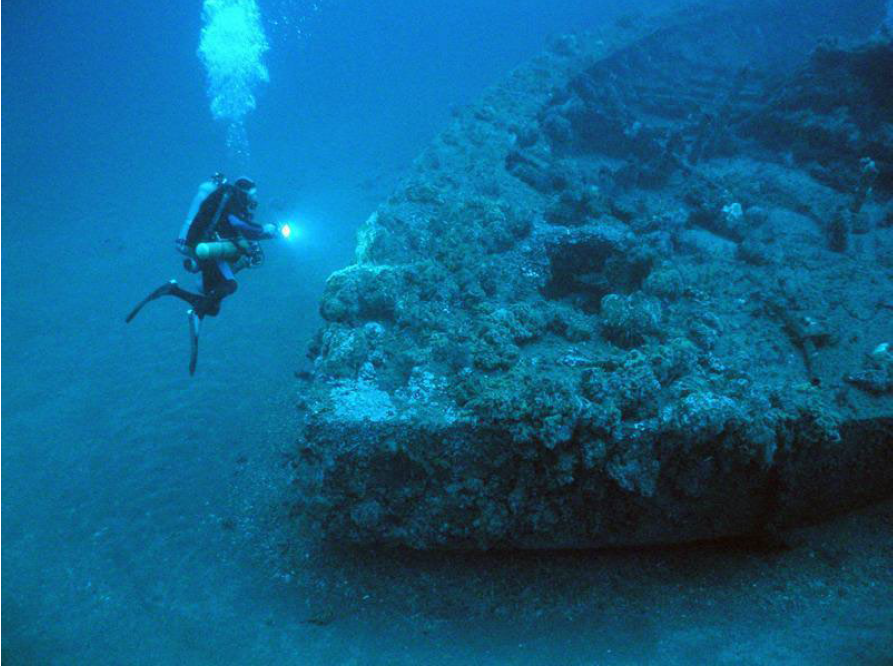
What remains on the ocean floor has become something Ericsson never intended: an artificial reef. Amberjack circle the wreck. Black sea bass shelter in the hull's crevices. Oyster toadfish and great barracuda patrol the structure. The sanctuary itself is modest in size -- a column of water one mile in diameter, extending from the surface to the seabed -- but its significance is outsized. It is one of only two of the nation's seventeen national marine sanctuaries created to protect a cultural resource rather than a natural one. The wreck is also one of only three accessible monitor-class warship wrecks in the world, alongside HMVS Cerberus in Victoria, Australia, and KNM Thor off Vestfold, Norway.
Artifacts Ashore
Monitor's recovered artifacts tell the intimate story of life aboard a cramped, experimental warship. Glass bottles, lumps of coal, wood paneling, a leather book cover, and even walnut halves have been conserved alongside the massive turret, propeller, anchor, and steam engine. The majority of these artifacts are on display at the Mariners' Museum in Newport News, Virginia, where ongoing conservation work continues to stabilize objects that spent more than a century in salt water. Additional artifacts can be seen at the Richmond National Battlefield Park, the Civil War Naval Museum in Columbus, Georgia, Nauticus in Norfolk, Virginia, and the Graveyard of the Atlantic Museum in Hatteras, North Carolina. Each piece recovered from the sanctuary floor is a fragment of the ship that launched a revolution -- proof that 110 days of construction produced something that endured far longer than anyone expected.
From the Air
Monitor National Marine Sanctuary lies at approximately 35.002N, 75.406W, about 16 miles south-southeast of Cape Hatteras, North Carolina. The sanctuary is a one-mile diameter circle of ocean -- not visible from the air as a distinct feature, but the Cape Hatteras area is unmistakable with its sharp bend in the Outer Banks barrier islands. Diamond Shoals, the shallow water graveyard that has claimed hundreds of ships, extends offshore from the cape. Nearest airport is Billy Mitchell Airport (KHSE) on Hatteras Island, though it has limited services. Norfolk International (KORF) is the nearest major airport. Fly at 2,000-3,000 feet along the Outer Banks to appreciate the treacherous geography that claimed Monitor and so many other vessels.