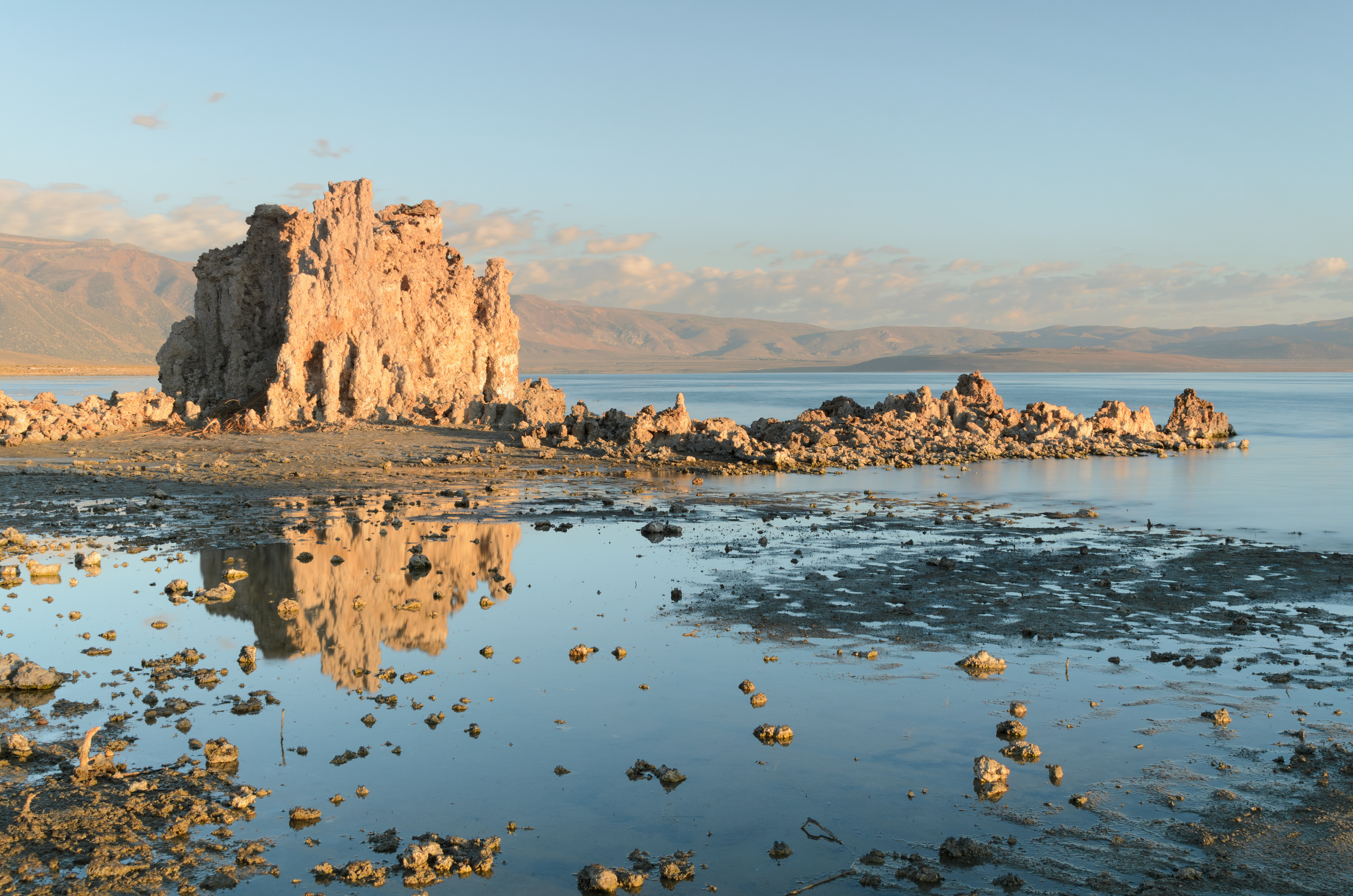
Mono Lake
Mono Lake has existed for at least 760,000 years, making it one of the oldest lakes in North America. Its saline waters, nearly three times saltier than the ocean, support a unique ecosystem of brine shrimp and alkali flies that feed millions of migratory birds. Bizarre calcium carbonate formations called tufa towers rise from the water like ghostly sculptures. But by the 1980s, Mono Lake was dying. Since 1941, the Los Angeles Department of Water and Power had been diverting the streams that fed the lake, sending the water 350 miles south through aqueducts to supply the growing city. The lake level dropped 45 feet, doubling salinity and exposing the tufa towers. Then environmentalists sued, and in a landmark 1983 decision, California courts ruled that the public trust doctrine protected Mono Lake. Los Angeles had to let the lake recover. It's still recovering today.
The Lake
Mono Lake sits in a closed basin on the eastern slope of the Sierra Nevada, at an elevation of 6,400 feet. It has no outlet; water leaves only through evaporation, concentrating salts and minerals over the eons. The result is highly alkaline water - pH around 10 - that supports no fish but sustains trillions of brine shrimp and alkali flies. The flies' pupae form a crunchy layer along the shore that the Kutzadika'a Paiute people harvested for food. Mark Twain, visiting in the 1860s, found the water so buoyant that 'you could not sink if you tried.' The tufa towers formed underwater when calcium-rich freshwater springs encountered the lake's carbonate-rich water; they became exposed as the lake dropped.
The Diversion
Los Angeles's thirst was insatiable. By 1913, the city had already drained the Owens Valley, 100 miles south. In 1941, it extended its aqueduct north to the Mono Basin, capturing the streams that fed Mono Lake. Over the following decades, the lake dropped 45 feet and lost half its volume. Islands that had provided nesting habitat for California gulls became peninsulas, accessible to coyotes. The exposed lake bed released arsenic-laden dust. The lake's salinity doubled, threatening the brine shrimp that fed the birds. Los Angeles received 17% of its water from Mono Basin diversions. Environmental groups argued the city was killing one of California's most unique ecosystems for water it didn't need.
The Lawsuit
In 1979, the Mono Lake Committee was formed to save the lake. In 1983, the California Supreme Court ruled in National Audubon Society v. Superior Court that the public trust doctrine - an ancient legal principle protecting navigable waters and tidelands for public use - applied to Mono Lake. The state had an obligation to consider the lake's ecological value, not just Los Angeles's water rights. The decision was revolutionary, establishing that environmental values could trump prior appropriations of water. Further litigation and negotiations followed. In 1994, the State Water Resources Control Board ordered Los Angeles to allow the lake to rise to 6,392 feet - still below historical levels but sufficient to protect the ecosystem.
The Recovery
Mono Lake is slowly recovering. The level has risen about 15 feet since its 1982 low, though it remains below the target. Tufa towers that were fully exposed now stand in shallow water. The bird populations have stabilized. Los Angeles has found alternative water sources through conservation and recycling. The recovery will take decades more - the target level may not be reached until 2050 or later. Mono Lake's survival demonstrates that environmental protection is possible when communities choose it, but also how long recovery takes once damage is done.
Visiting Mono Lake
Mono Lake is located on the eastern Sierra, along Highway 395, about 13 miles east of Yosemite's Tioga Pass entrance. The Mono Lake Committee Information Center in Lee Vining provides orientation. The South Tufa area, accessible via a short trail, offers the best views of tufa towers and opportunities to walk to the lakeshore. Navy Beach allows swimming in the buoyant alkaline water (avoid cuts - it stings). The lake is spectacular at sunrise and sunset when the tufa glow golden and pink. Panum Crater, a 640-year-old volcanic dome, is nearby. The town of Lee Vining has basic services. Mammoth Yosemite Airport (MMH) is 30 miles south; Reno-Tahoe International (RNO) is 110 miles north. The high elevation (6,400 feet) means cold temperatures even in summer.
From the Air
Located at 38.01°N, 119.00°W on the eastern slope of the Sierra Nevada, about 13 miles east of Yosemite National Park. From altitude, Mono Lake appears as a silver-blue expanse surrounded by volcanic craters and the sharp eastern escarpment of the Sierra. The tufa towers are visible along the southern shore as irregular white formations. Paoha and Negit islands are visible in the lake. The contrast between the lake's blue water and the surrounding brown volcanic terrain is striking.