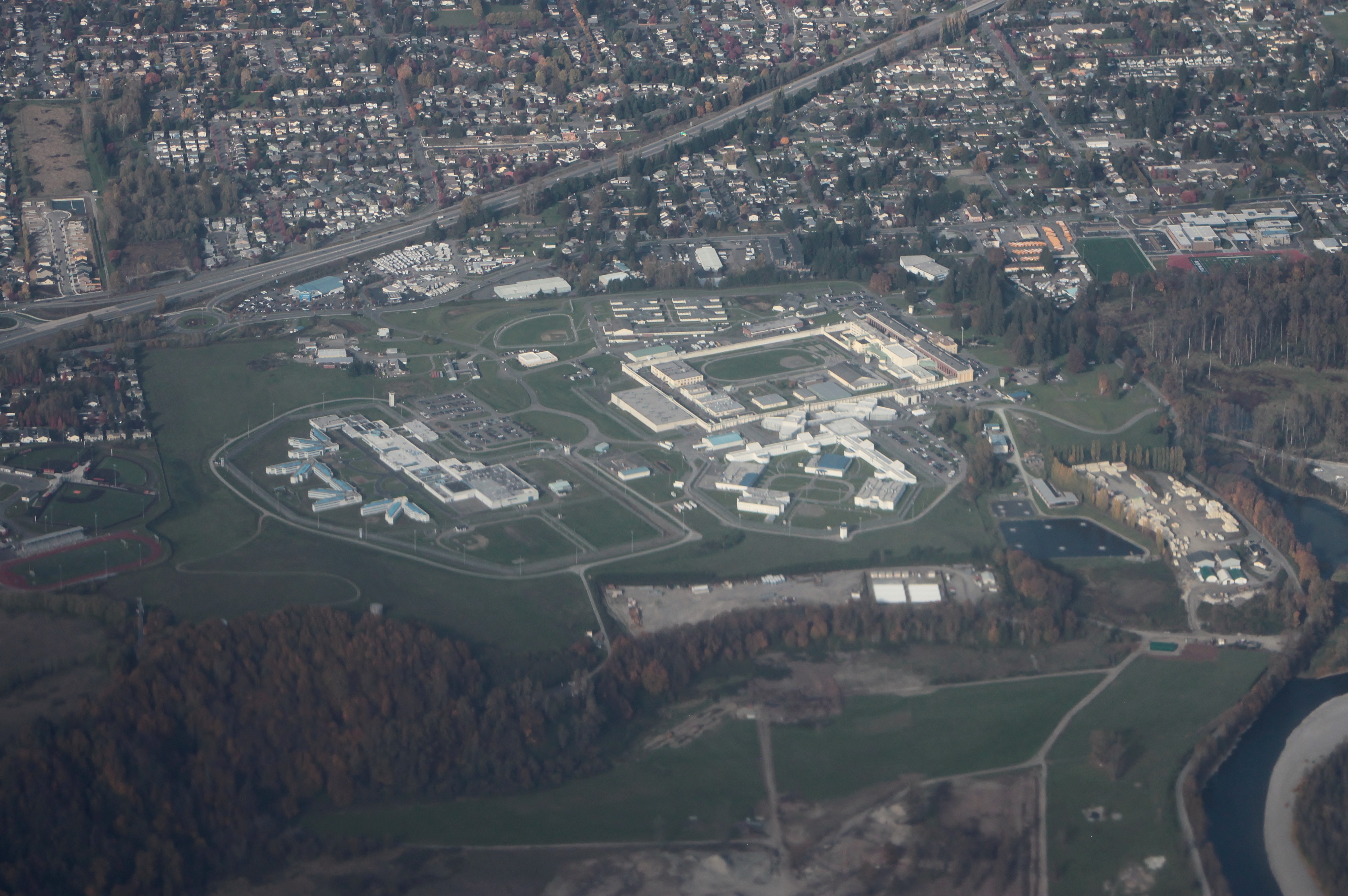
Monroe Correctional Complex
Christopher Havens was serving a twenty-five-year sentence at Monroe Correctional Complex when he taught himself advanced mathematics. Working from a prison cell with limited access to textbooks, he eventually founded the Prison Mathematics Project and published original research in number theory. His story is one thread in a fabric that stretches back to 1910, when the Washington State Reformatory first opened its doors in the small Skykomish Valley town of Monroe. The complex is now the largest prison in Washington state, holding over 3,100 people across four distinct units -- and its history reflects both the ambitions and the failures of American corrections.
A Reformatory Rises
Construction began in 1907, using labor from inmates transferred from the Washington State Penitentiary in Walla Walla. The reformatory opened in 1910, making it the second oldest operational prison in Washington state. The original Washington State Reformatory Unit still stands, its capacity roughly 720 beds housing minimum, medium, and maximum custody inmates. The fourth floor holds an inpatient hospital classified as maximum security -- one that serves not just Monroe but correctional facilities across the state, performing daily dialysis, X-rays, and medical procedures that would otherwise require transport to community hospitals. For over a century, the reformatory has anchored the eastern edge of Monroe, a town of about 20,000 that grew up around logging, agriculture, and -- inescapably -- the prison.
Four Units, One Complex
The complex expanded in waves. The Twin Rivers Corrections Center opened in 1984 with capacity for 800 inmates at minimum and medium security levels. It now houses the Washington State Sex Offender Treatment and Assessment Program. The Minimum Security Unit followed in 1997, adding 470 beds and a unique program for mentally ill offenders that allows transfers from higher security levels -- the only such program in the state. The Sky River Treatment Center, formerly the Special Offender Unit, is designated for incarcerated individuals with serious mental health needs. Critics have raised concerns that the unit's conditions more closely resemble long-term isolation than the therapeutic care its name implies, with limited access to educational and vocational programs available elsewhere in the complex.
Behind the Walls
Life inside Monroe operates on a hierarchy of labor and education. Inmates can earn GEDs, and the nonprofit University Beyond Bars offers college courses -- some people have earned associate degrees despite a state prohibition on public funding for prisoners' post-secondary education. Work assignments range from kitchen and maintenance duties to a print shop and license tab production. Until 2004, private enterprises employed inmates through Class I industries, but a Washington Supreme Court decision ended the practice, ruling that incarcerated people could not work for private commercial companies. The decision reshaped the economics of the facility, eliminating revenue streams while reinforcing the legal boundary between punishment and exploitation.
Riots, Disease, and Escape
The COVID-19 pandemic hit Monroe hard. On April 8, 2020, over 100 prisoners rioted in response to the outbreak. Corrections officers used crowd control tactics and evacuated housing units to restore order. The next day, Governor Jay Inslee announced plans to release nonviolent offenders and at-risk inmates. One corrections officer died from COVID-19 complications in May 2020 after contact with an infected inmate -- only the third line-of-duty death in the facility's 110-year history. The Twin Rivers Unit endured repeated quarantines, with a 2021 report noting that window coverings in sunlight reached temperatures of 98 degrees inside the concrete walls. In April 2024, 59-year-old inmate Patrick Clay broke into an office, stole truck keys, and drove away. He was apprehended in Seattle four days later.
What the Walls Have Witnessed
Monroe has housed some of Washington's most notorious inmates, from Isaac Zamora, who committed the 2008 Skagit County shootings, to James Fogle, whose novel Drugstore Cowboy became a celebrated 1989 film starring Matt Dillon. The prison's Washington State Reformatory building doubled as a film set itself -- the prison scenes in The Butterfly Effect were shot there. But the more telling stories may be quieter ones: the University Beyond Bars students earning degrees with no public funding, the mental health patients in Sky River whose treatment remains largely out of public view, and Christopher Havens, who turned a prison cell into a mathematics laboratory. Monroe contains multitudes, and not all of them are visible from outside the walls.
From the Air
Located at 47.845N, 121.999W, in the Skykomish River valley east of Monroe, Washington. The complex is a large institutional footprint visible on the eastern edge of town, adjacent to farmland and forest. Best viewed at 3,000-5,000 feet. Harvey Field (S43), a general aviation airport, is approximately 7 miles to the west. Paine Field (KPAE) is about 20 miles to the west-southwest. The Cascade foothills rise to the east.