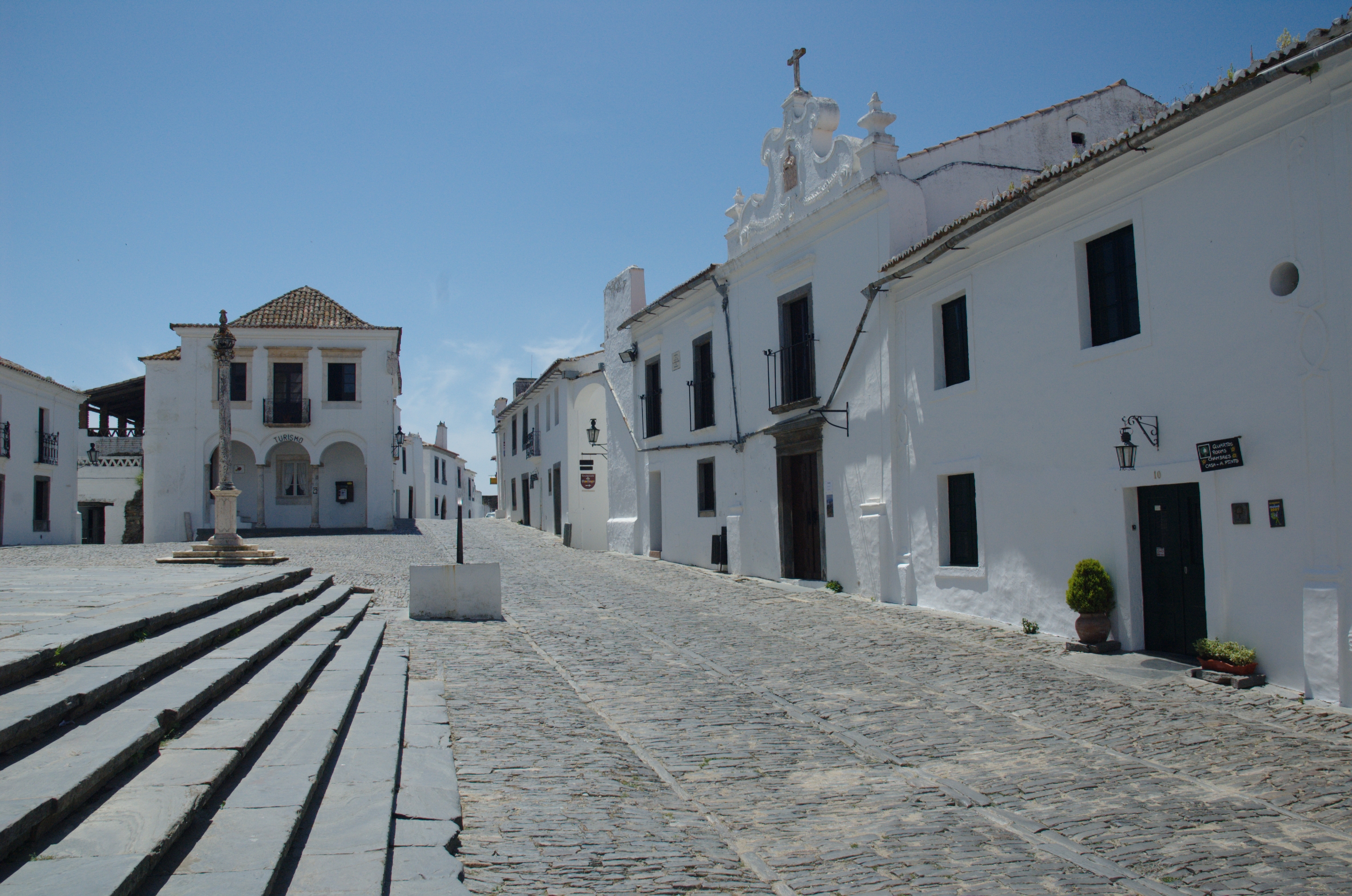
Monsaraz
From the ramparts of Monsaraz, you can see Spain. The hilltop village perches above the Guadiana River in the Portuguese Alentejo, its whitewashed houses contained within medieval walls that have looked out over the same border landscape for seven centuries. Below the castle, the reservoir of the Alqueva Dam has flooded the valley floor, turning the river into a vast artificial lake. But the hill itself has been occupied far longer than the walls suggest. Hundreds of megalithic monuments dot the surrounding countryside, and the hilltop was a fortified settlement -- a castro -- long before the Romans arrived.
Stones Before History
Monsaraz sits at the center of one of the densest concentrations of prehistoric monuments in southern Portugal. The Neolithic remains in the surrounding parish include the Megalithic Monuments of Herdade de Xerez, a cromlech of standing stones arranged in a circle; the Olival da Pega Dolmens, burial chambers roofed with massive capstones; and solitary menhirs like the Menhir of Bulhoa, the Rocha dos Namorados, and the Outeiro Menhir -- upright stones whose purpose, whether territorial marker, astronomical reference, or sacred symbol, remains debated. The hill on which the village sits was itself a prehistoric fortification, a castro carved from local rock that served as a center for pre-Roman occupation and funerary ceremonies. People have lived on this particular hilltop for at least five thousand years.
Occupied by Everyone
The list of peoples who have held Monsaraz reads like a compressed history of the Iberian Peninsula. Romans reorganized the settlement and built roads through the region. Visigoths followed. In the 8th century, Arab forces conquered the hilltop, and it became known as Saris or Sharish, falling under the control of the Taifa of Badajoz. Mozarabs -- Christians living under Muslim rule -- and Jews made their homes here. After the Reconquista, the hill passed to Christians loyal to Afonso Henriques, Portugal's first king. Each culture left traces, though many are now visible only to archaeologists. What the visitor sees today is predominantly medieval: the castle, the walls, the narrow streets of whitewashed houses, and the churches that accumulated over the centuries.
Churches and Earthquakes
For a village of fewer than 800 people, Monsaraz has an astonishing number of religious buildings. The Church of Nossa Senhora de Lagoa, the Church of Santiago Maior, the Church of the Misericordia, and multiple hermitages dedicated to various saints crowd the hilltop and the surrounding countryside. The Chapel of Sao Bento, a rural chapel built in the late 16th or early 17th century with contributions from local residents, contains frescos on its vaulted ceiling. It was seriously damaged by the 1755 Lisbon earthquake -- the same catastrophe that reshaped cities across Portugal and Spain. The earthquake's reach into the deep Alentejo countryside, hundreds of kilometers from the epicenter, is a reminder of how violently the ground shook that November morning.
The View from the Walls
Today Monsaraz is one of those places that exists on two registers: a living village with a permanent population in the low hundreds, and a destination that draws visitors to its medieval atmosphere and panoramic views. The Alqueva Dam, completed in 2002, transformed the valley below into the largest artificial lake in Western Europe, and the village now overlooks a landscape that is simultaneously ancient and engineered. From the castle walls, the eye travels across water, olive groves, and cork oak forests toward the Spanish border. The megalithic monuments are out there in the fields, invisible from this height but close enough to walk to. Monsaraz compresses more layers of human presence into a smaller space than almost any settlement in Portugal -- prehistoric, Roman, Visigothic, Arab, Jewish, Christian -- all of them balanced on a single rocky hilltop above a river that became a lake.
From the Air
Located at 38.43N, 7.38W on a prominent hilltop above the Guadiana River and the Alqueva reservoir in Portugal's Alentejo region, near the Spanish border. The walled village and castle are clearly visible from altitude, and the contrast between the white buildings and the surrounding landscape makes it easy to identify. Nearest airports: Evora (military, LPEV), approximately 55 km west-northwest; Badajoz (LEBZ) in Spain, approximately 80 km north. Best viewed at 2,000-4,000 ft AGL. The Alqueva reservoir stretches below the hilltop.