Monserrate Palace
William Thomas Beckford arrived at this hillside estate near Sintra in 1793, already notorious across Europe as the author of the Gothic novel Vathek and as a man whose fortune and scandals preceded him in equal measure. He found a neo-Gothic house built four years earlier by an English merchant named Gerard de Visme over the ruins of a chapel dedicated to Our Lady of Monserrate. Beckford did what Beckford did: he began designing elaborate landscaped gardens, then left. The estate passed through other hands, fell into ruin, was reborn, and fell again. Monserrate Palace as it stands today — a confection of Moorish arches, Romantic turrets, and botanical extravagance — is a testament to the restless dreamers who kept reshaping this hilltop according to their own visions of paradise.
From Chapel to Ruin to Fantasy
The site's history reaches back to the Christian reconquest. According to legend, a chapel dedicated to the Virgin Mary stood here after Afonso Henriques recaptured Sintra around 1093. By 1540, a new chapel dedicated to Our Lady of Monserrate crowned the hilltop, owned by the Hospital Real de Todos os Santos in Lisbon. The Mello e Castro family took possession in the 17th century, but the 1755 Lisbon earthquake left the farmhouse uninhabitable. When de Visme built his neo-Gothic retreat over the ruins in 1789, he was the first in a line of English eccentrics drawn to Sintra's misty hills and ruined grandeur. Beckford's landscaping ambitions planted the seed — literally — for what would become one of Portugal's most celebrated gardens.
Where East Meets West in Stone
The palace's architecture is a deliberate collision of influences. Romanticism provides the emotional framework, but the details draw from Mudéjar and Moorish Revival traditions — pointed arches, intricate geometric patterns, ornamental domes — referencing the centuries when this region belonged to Muslim Gharb Al-Andalus. Neo-Gothic elements persist from de Visme's original structure, while the overall eclecticism places Monserrate firmly within Sintra's Romantic tradition alongside the Pena Palace and the Quinta do Relógio. The result is a building that feels imported from several centuries and continents simultaneously, its hallways opening onto vistas of Atlantic light filtered through subtropical vegetation. The central dome's interior, richly decorated with carved plasterwork, demonstrates a level of craftsmanship that makes the architectural eclecticism feel intentional rather than confused.
A Garden of Continents
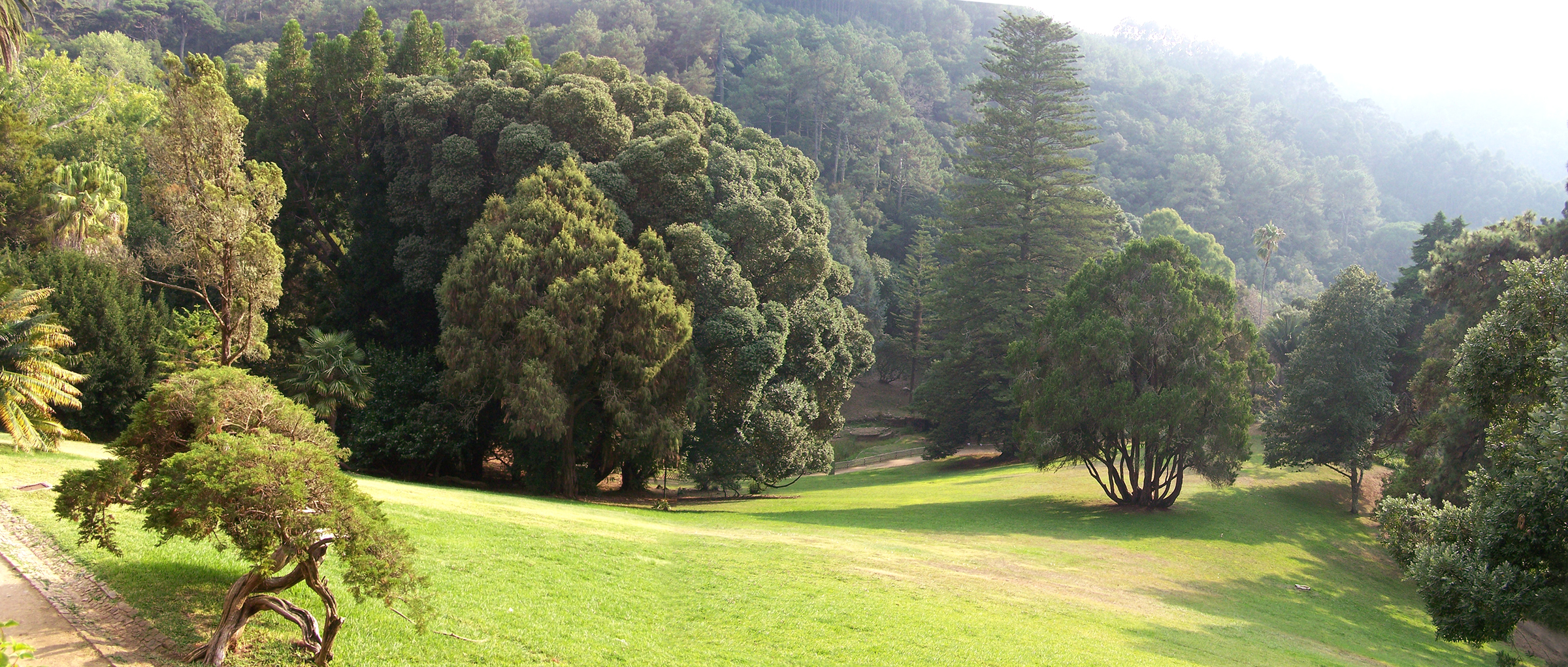
The grounds surrounding the palace are as significant as the building itself. What Beckford began, subsequent owners expanded into a botanical collection spanning multiple continents, with species arranged to create distinct landscape experiences as visitors move through the park. Tree ferns from the southern hemisphere grow alongside Mediterranean pines; paths wind through ravines where water features create microhabitats for shade-loving plants. The Portuguese state acquired the property and hunting grounds in 1949, and restoration has continued in phases since. A carved wooden totem by Welsh artist Nansi Hemming now catalogues the estate's wildlife — Bonelli's eagle, Egyptian mongoose, fire salamander, Eurasian eagle owl — a menagerie that speaks to the ecological richness the gardens have fostered over two centuries of careful cultivation.
Old Walls, New Energy
The estate's most recent chapter involves a different kind of power. In 2012, the farmyard became a renewable energy demonstration site under the BIO+Sintra project, financed by the European Commission's LIFE programme. Wind, water, and solar systems now generate electricity for the farm buildings — an off-grid operation that would have delighted Beckford, a man perpetually interested in the newest and most ambitious technologies of his era. The juxtaposition is pure Monserrate: a Romantic-era palace powered by 21st-century sustainability, a site whose history is defined by the collision of old and new, local and imported, ruin and reinvention.
From the Air
Located at 38.794°N, 9.421°W in the Sintra hills, approximately 25 km northwest of Lisbon. The palace sits amid dense vegetation on a hillside, making it harder to spot from altitude than the nearby Pena Palace. Look for the pale façade with distinctive Moorish arches amid the green canopy. Recommended viewing altitude: 2,000-3,000 ft. Nearest airport: Lisbon/Humberto Delgado (LPPT) approximately 30 km southeast. The Sintra Mountains create local turbulence and orographic cloud; approach from the south for best visibility.