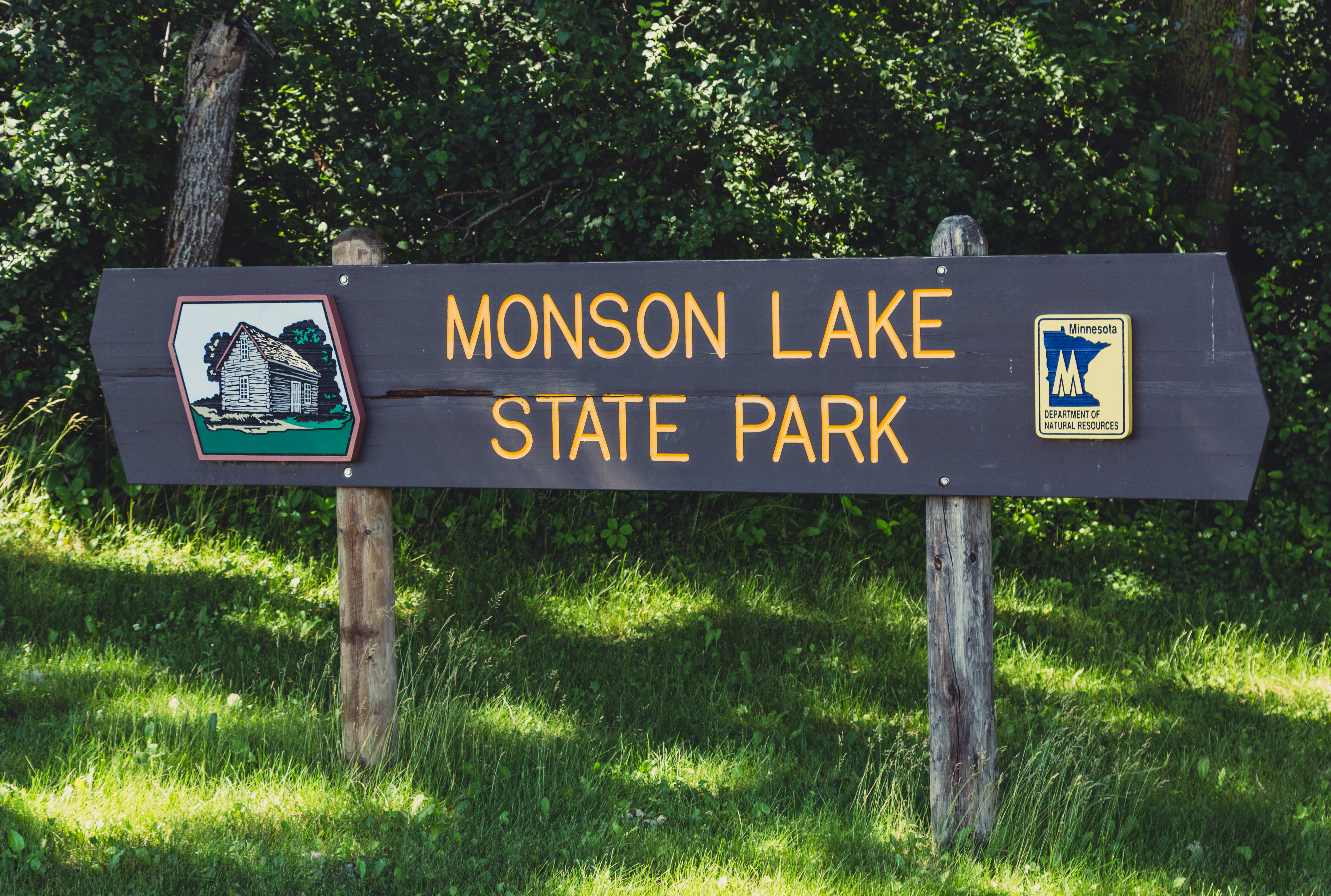
Monson Lake State Park
Seven-year-old Peter Broberg ran two miles through the August heat. It was Wednesday, August 20, 1862, and a group of Dakota warriors in war regalia had arrived at his family's cabin near West Sunburg Lake in Swift County, Minnesota. Peter's job was to fetch the adults, who were attending a church service at the neighboring Lundborg cabin. He did not know that violence between Dakota and white settlers had erupted three days earlier at Acton, or that Pastor Jackson -- who did know -- had told the Lundborg men to leave their guns at home to avoid provoking a conflict. By the time the unarmed men reached the Broberg cabin, it was too late. Thirteen members of the small Swedish immigrant community known as the West Lake Settlement were killed that morning. Peter survived by hiding in a neighbor's cellar. Today the site of those cabins lies within Monson Lake State Park, one of Minnesota's smallest and least-visited state parks, where the landscape holds both the beauty of glacial prairie lakes and the weight of what happened beside them.
Strangers on a Prairie
The West Lake Settlement formed in the early 1860s when Swedish immigrant brothers Anders and Daniel Broberg purchased 160 acres near the shores of what is now Monson Lake. Along with the neighboring families of Swen Oman and Johannes Lundborg, they carved homesteads from the Minnesota prairie. The land was thick with glacial till, the soil deposited by retreating ice sheets thousands of years earlier. The lakes -- Monson, West Sunburg, East Sunburg -- dotted the rolling terrain, connected by the watershed of the Chippewa River, a tributary of the Minnesota River. It was productive country, but it was also Dakota homeland. The growing Euro-American population was making it increasingly difficult for the native Dakota people to pursue their traditional way of life. Broken treaties, forced resettlement onto reservations, and chronically late or unfair annuity payments by Indian agents had brought hunger and deepening resentment. By the summer of 1862, the Dakota War had begun.
The Morning of August 20
The attack at the Broberg cabin unfolded with devastating speed. Among the thirteen killed were Anders Broberg, his wife Christiana, and their children Johannes, Andreas, and Christiana; Daniel Broberg, his wife Anna Stina, four-year-old Alfred, and ten-month-old John; and three Lundborg sons in their twenties -- Gustaf, Lars, and Andreas. Daniel Broberg's family was overtaken while fleeing in an oxen-drawn wagon. Sam Lundborg, age nine, was shot and left for dead but survived his wounds. Peter Broberg and the younger Anna Stina Broberg were the only members of their respective families to survive. Lena Lundborg fled alone and reached the town of Paynesville after several days of walking. The violence at West Lake was one episode in a wider conflict that engulfed southwestern Minnesota that summer, eventually claiming hundreds of lives on both sides before federal forces suppressed the Dakota resistance.
A Memorial Takes Root
In 1927, the Monson Lake Memorial Association formed and raised $225 to purchase two acres from landowner Albert Monson. A dedication ceremony on August 21, 1927, drew an astonishing 10,000 attendees -- a measure of how deeply the events of 1862 still resonated in the region's Swedish American communities. In 1935, the Minnesota Emergency Relief Agency purchased and expanded the site, and a Veterans Conservation Corps side camp was established at Monson Lake in 1936. The VCC crews constructed a Sanitation Building and a Combination Building in the National Park Service rustic style, using local granite and white oak. Works Progress Administration crews built the gravel entrance road and parking lot. These 1930s New Deal structures were added to the National Register of Historic Places in 1989. Because low visitation has spared the park from significant alteration, it remains nearly unchanged from its original development -- the only Minnesota state park that can make that claim.
Quiet Water, Long Memory
Monson Lake State Park remained 187 acres for decades, its eastern border including only a sliver of West Sunburg Lake. In June 2009, a $395,000 purchase nearly doubled the park's size, adding land and water that included most of the rest of West Sunburg Lake and some of East Sunburg Lake. The acquisition was unusual: Minnesota lakes are normally public property, but the Sunburg Lakes had gone dry in the 1930s and their ownership rights were bought and sold as dry land. Today the park offers a boat ramp on Monson Lake, where anglers find walleye, northern pike, largemouth bass, black crappie, yellow perch, and bluegill. A canoe route crosses Monson Lake and traverses a portage into West Sunburg Lake. In winter, snowshoeing is allowed anywhere in the park. The seasonally staffed park is managed from nearby Sibley State Park. It remains a quiet place, visited more by memory than by crowds.
From the Air
Located at 45.321°N, 95.270°W in Swift County, Minnesota, amid rolling glacial prairie dotted with small lakes. Monson Lake and the adjacent Sunburg Lakes are visible as blue patches in the agricultural landscape. Benson Municipal Airport (KBBB) is approximately 22 miles to the northwest; Willmar Municipal Airport (KBDH) is roughly 21 miles to the southeast. The park is small and surrounded by farmland, so the lakes themselves are the primary visual reference. The Chippewa River watershed drains southward through the area toward the Minnesota River. Best viewed at 2,000-4,000 feet AGL, where the cluster of lakes stands out against the surrounding cropland. The terrain is flat to gently rolling with no significant obstructions.