Monsopiad Heritage Village
Two or three centuries ago, depending on who tells the story, a Kadazan-Dusun boy was born in the village of Kuai. His father Dunggou noticed birds nesting nearby at the moment of birth and took it as an omen, a sign that the child would possess extraordinary abilities. He named the boy Monsopiad and, with a tenderness that feels almost mythic, carried the nestlings down to bathe alongside his infant son each day, returning them carefully to their nest afterward. Monsopiad grew into a warrior whose name became synonymous with fearlessness. Today, along the banks of the Moyog River in Sabah's Penampang District, his legacy occupies a living museum that operates on entrance fees and public goodwill alone.
A Warrior's Lineage
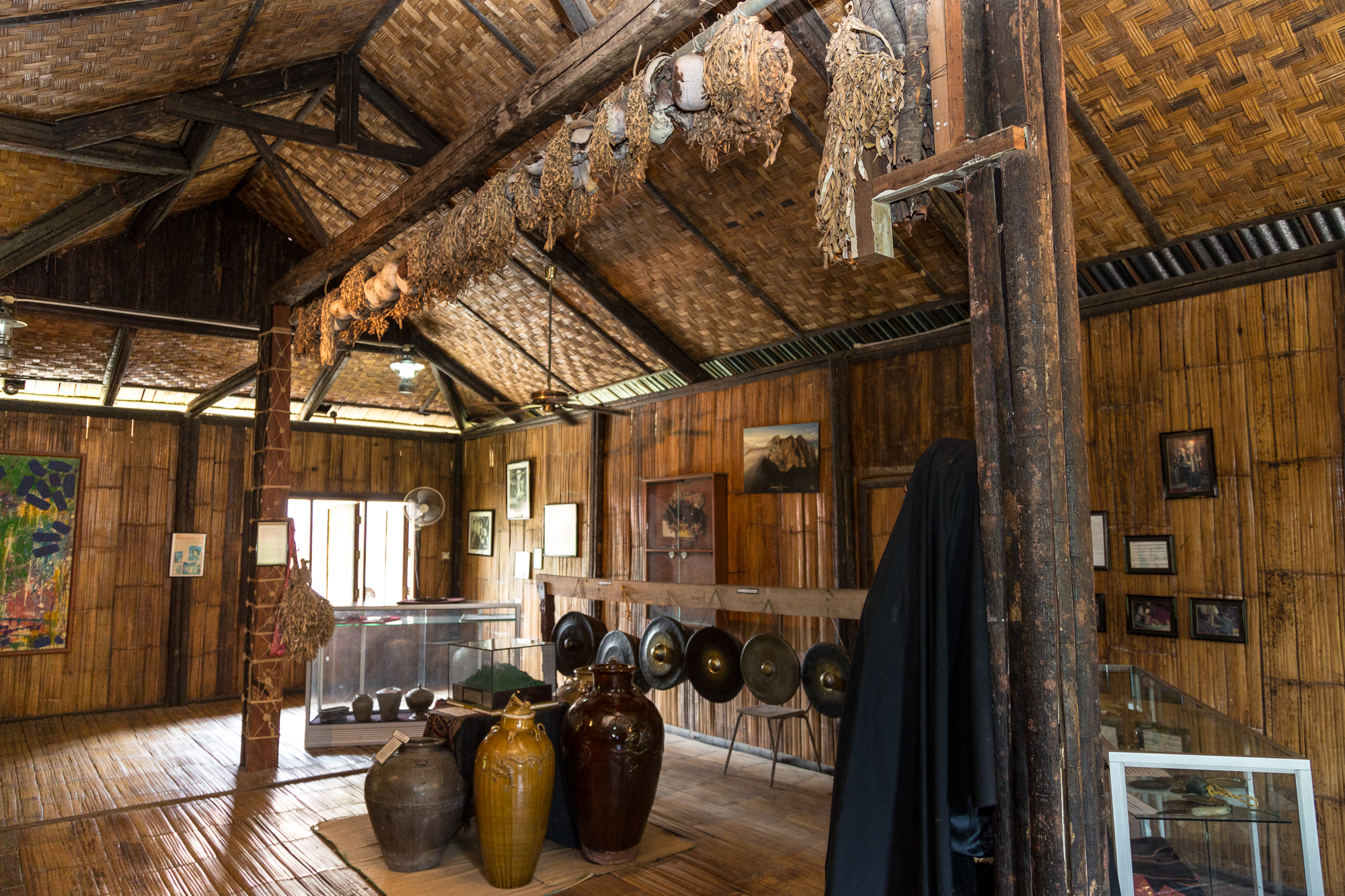
Monsopiad Heritage Village sits about 16 kilometers from Kota Kinabalu in Kuai Kandazon village, where the Moyog River curves through lowland forest and rice paddies. The heritage village preserves not just the warrior's memory but his entire genealogical and spiritual world. Among the most striking displays is the costume of Bobohizan Inai Bianti, a direct descendant of Monsopiad who served as a high priestess in the Kadazan-Dusun tradition. The Bobohizan held an extraordinary role in indigenous society, serving as intermediary between the human and spirit worlds, healer, and keeper of oral history. That her garments survive here is a testament to the family's determination to preserve what modernization threatened to erase.
The Sound of Gongs and Rice Wine
Walking through the village, you encounter the material culture of the Kadazan-Dusun people in its fullness. Ceramic jars that once stored rice and ritual offerings line the display areas. Traditional paddy grinders show the labor behind every meal. At one station, a Kadazan man explains the different varieties of rice used to produce lihing, talak, and sikat, the traditional rice liqueurs of Sabah, each with its own fermentation process and ceremonial purpose. Gong performances fill the open-sided halls with resonant, overlapping tones that seem to vibrate in the chest rather than the ears. A wooden suspension bridge spans the Moyog River behind the village, swaying gently underfoot and offering a view upstream where the water runs clear over a gravel bed.
The Journey of Monsopiad
The "Kotos di Monsopiad" exhibit traces the warrior's life journey and the lineage of his descendants across the centuries. What makes this exhibit unusual is its intimacy. This is not a distant historical figure claimed by a nation; Monsopiad belongs to a specific family in a specific village, and his descendants are the ones who built and maintain this place. The heritage village operates entirely on private funding, without government grants or subsidies. Every element of its survival depends on public interest and visitor support. That precariousness gives the place an urgency that government-funded museums rarely possess. The artifacts on display, from sago grinders to ceremonial headgear, are not reproductions but family heirlooms, entrusted to the museum by the community that created them.
Where the River Remembers
The Moyog River defines the character of the village. Its sound is constant, a low murmur beneath the gongs and voices. The surrounding landscape of rice paddies and coconut palms has changed less than you might expect in two centuries. The Kadazan-Dusun remain the largest indigenous group in Sabah, and while urbanization has pulled many into Kota Kinabalu's orbit, places like Monsopiad Heritage Village serve as anchors, reminders that identity is not only a matter of language and dress but of place. The village is modest in scale but uncompromising in purpose. It does not exist to entertain tourists, though it does that well enough. It exists because a family decided that the story of a warrior born under an omen of birds was worth keeping alive.
From the Air
Located at 5.89°N, 116.08°E in Penampang District, about 16 km south of Kota Kinabalu. The village sits along the Moyog River amid rice paddies and lowland forest. Nearest airport is Kota Kinabalu International Airport (WBKK), approximately 10 km to the northwest. From the air, look for the river bend and the cluster of traditional longhouse structures. Best viewed at 2,000-4,000 feet AGL on approach from the coast.