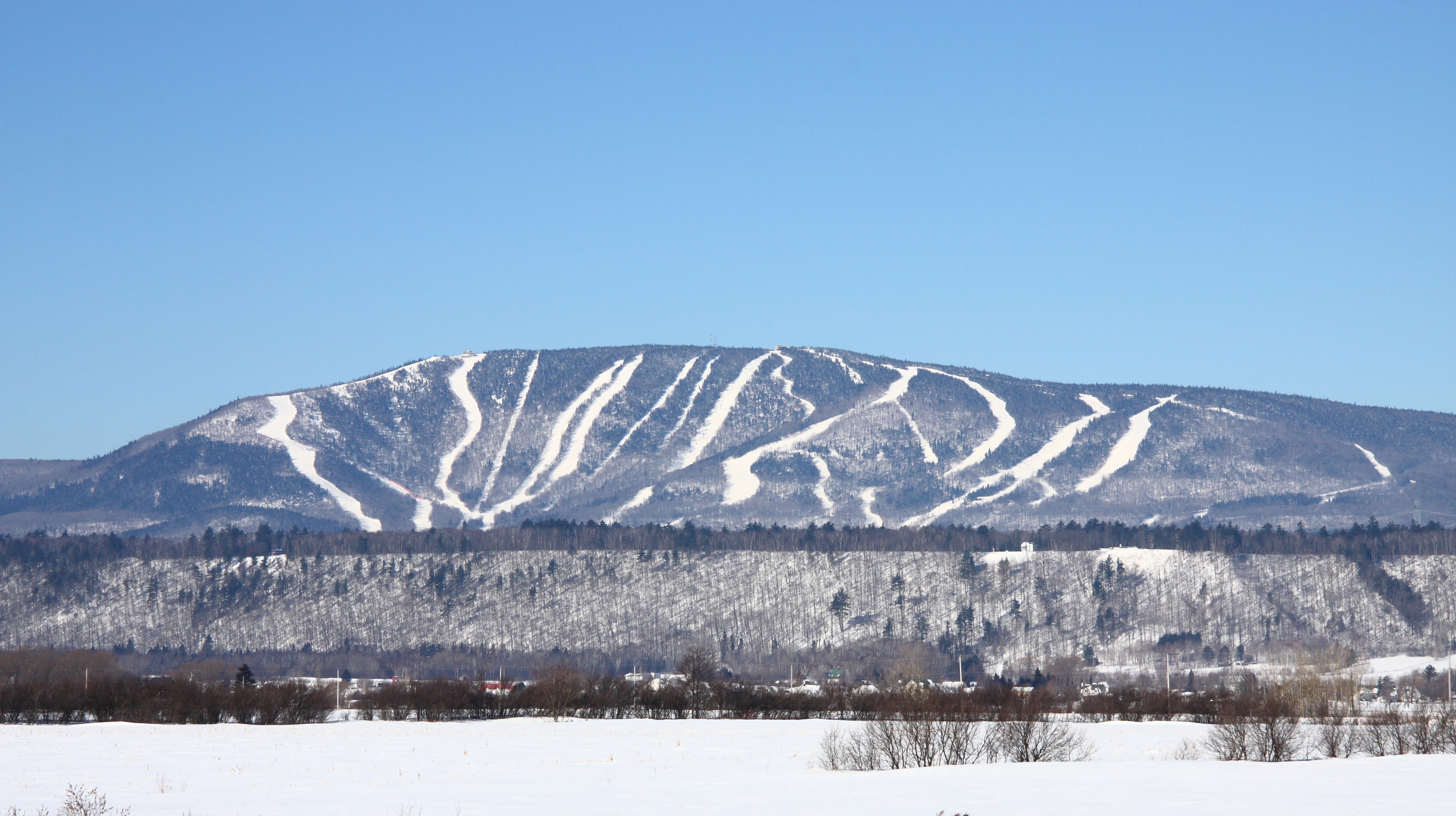
Mont-Sainte-Anne
In the fall of 1943, a group of volunteers from Beaupre and Quebec City hiked into the Laurentian forest with axes and saws. There was no chairlift, no lodge, no grooming equipment. They were cutting a ski trail by hand on a mountain that had no name in the sport, carving a single run through spruce and birch on sheer determination. Three years later, the first competition was held on that trail, competitors climbing the mountain on foot carrying all their gear, the only grooming done by volunteers sidestepping uphill on their skis. Mont-Sainte-Anne opened as a proper resort on January 16, 1966, with ten trails, four lifts, and a gondola. It has never stopped growing since. Today it stands as one of eastern Canada's premier ski destinations, a mountain that earned its reputation the hard way: one hand-cut trail at a time.
Seventy-One Ways Down
Mont-Sainte-Anne spreads its 71 downhill trails across three faces of the mountain: south, north, and west. The southern face catches the most sun and hosts the night skiing operation, 19 illuminated trails that give Mont-Sainte-Anne the highest vertical drop for night skiing anywhere in Canada. The northern exposure holds the cold snow longer, offering some of the most consistent conditions in Quebec. The western face adds variety and escape from crowds. The mountain is part of the Laurentian chain, with a summit that looks out over the St. Lawrence River and the Beaupre Coast. The vertical drop, combined with reliable natural snowfall at the summit, keeps conditions strong through the season. Since Resorts of the Canadian Rockies took over operations (the resort was privatized in 1994 and later acquired by RCR), investment has focused on expanding gladed tree skiing and upgrading the snowmaking system, adding resilience to seasons when nature provides less.
A World Cup Stage
Mont-Sainte-Anne entered the international spotlight almost immediately. In its opening year of 1966, the Du Maurier International brought world-class competitors to the mountain. The following year, the resort hosted events during the first Canadian Winter Games. Numerous FIS Alpine Ski World Cup races followed over the decades, the last held in December 1989. The mountain co-hosted the World Junior Alpine Skiing Championships three times: with Stoneham Mountain Resort in 2000, and with Le Massif in both 2006 and 2013. In 2023, Mont-Sainte-Anne hosted the Snowboard Cross FIS World Cup, an event dubbed Battle Royale that featured both individual and team competitions. But the mountain's international reputation extends beyond winter. The final round of the UCI Mountain Bike World Cup has been held at Mont-Sainte-Anne in 2023, 2024, and 2025, making it a recurring fixture on the global mountain biking calendar.
The Cross-Country Kingdom
While the downhill trails draw the headlines, Mont-Sainte-Anne's Cross-Country Ski Centre holds a quieter distinction: it is the largest cross-country ski network in Canada and the second largest in North America, behind only Royal Gorge in California. The trail system includes a dedicated network for skating stride, the faster technique that transformed Nordic skiing in the 1980s. The trails wind through the Laurentian forest at the base and flanks of the mountain, offering everything from gentle loops for beginners to punishing climbs for racers. Cross-country skiing is a different relationship with a mountain. There is no lift to carry you up. You earn every meter of elevation with your own effort, and the silence of the forest replaces the social bustle of the lodge. Mont-Sainte-Anne understood early that a great ski destination serves both temperaments: the adrenaline seekers on the downhill runs and the endurance athletes on the cross-country trails.
Four Seasons on the Laurentians
Mont-Sainte-Anne refuses to be a one-season mountain. When the snow melts, the ski trails transform into a network of hiking paths and one of North America's most respected mountain biking venues, its technical descents challenging enough to host the UCI World Cup finale. Paragliders launch from the summit, catching thermals above the St. Lawrence. A campground operates at the base. A golf course occupies the gentler terrain nearby. Dog sledding, snowshoeing, sleigh rides, ice skating, and tubing fill the winter calendar for those who do not ski. The mountain sits in a corridor of destinations along the Beaupre Coast: Canyon Sainte-Anne and its billion-year-old gorge lies six kilometers to the east, the Basilica of Sainte-Anne-de-Beaupre draws pilgrims just down the road, Montmorency Falls thunders to the west, and Quebec City itself is only a short drive southwest. Mont-Sainte-Anne is both a destination and a basecamp, a mountain that those volunteers in 1943 could never have imagined but would certainly recognize.
From the Air
Mont-Sainte-Anne is located at 47.074N, 70.908W, approximately 40 km northeast of Quebec City in the Laurentian Mountains along the Beaupre Coast. The mountain is readily identifiable from the air by its ski runs, which appear as cleared strips on the forested mountainside, visible on the southern, northern, and western faces. The summit stands prominently above the surrounding terrain near the St. Lawrence River shoreline. Quebec City Jean Lesage International Airport (CYQB) is the nearest major airport, about 40 km to the southwest. The Beaupre Coast stretches northeast along the river from Montmorency Falls to Cap Tourmente, with Mont-Sainte-Anne roughly midway along this scenic corridor. From altitude, the cleared ski terrain contrasts sharply with the surrounding dark Laurentian forest. Best viewed at 3,000-6,000 ft where individual runs and the gondola line are visible. In summer, mountain bike trails and the golf course are visible at the base.