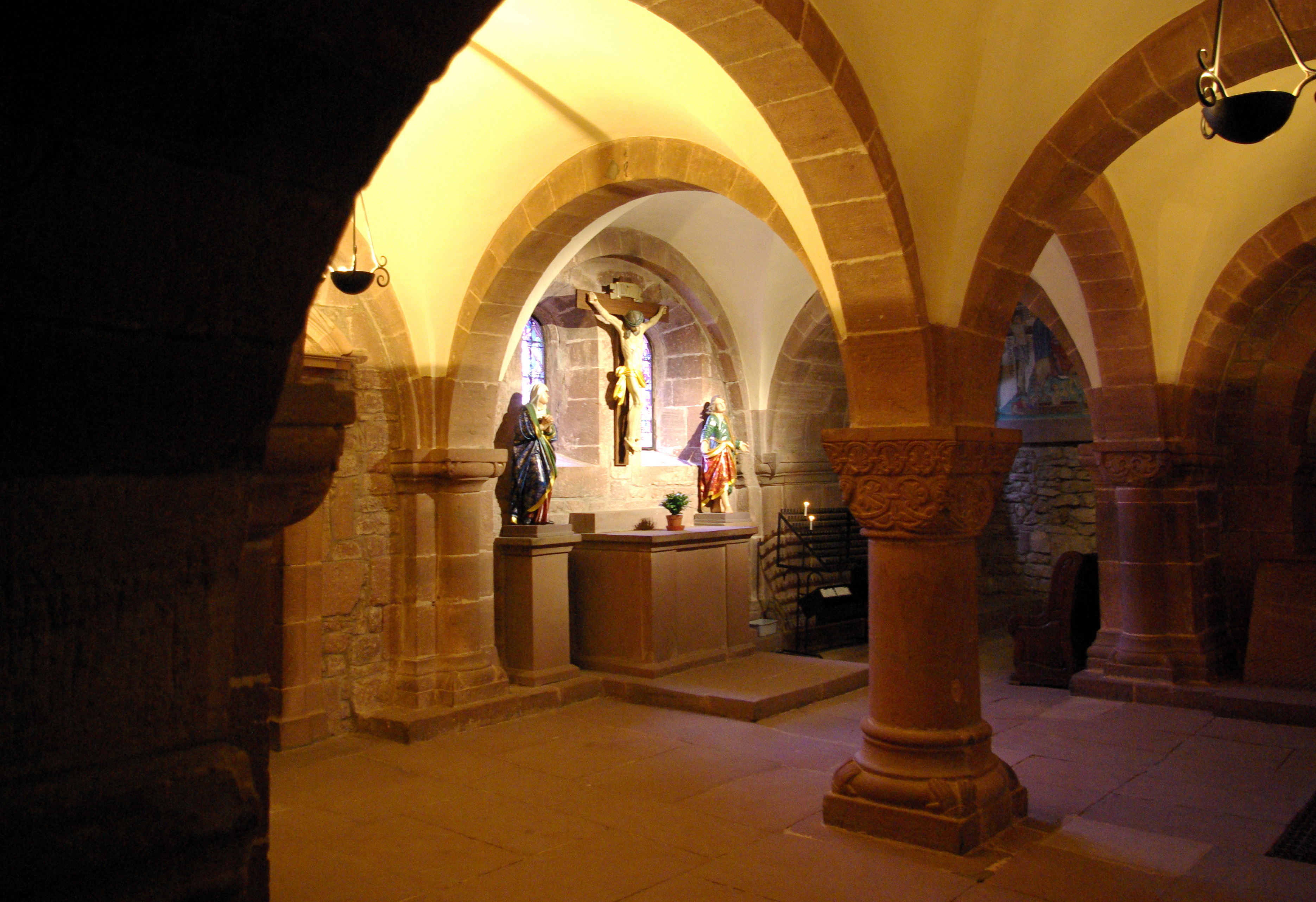
Mont Sainte-Odile Abbey
Between August 2000 and May 2002, more than a thousand ancient books vanished from the library of Mont Sainte-Odile Abbey. No one could explain it. The doors were locked, the windows secured, the monks bewildered. When police finally caught the thief -- a local teacher named Stanislas Gosse -- he revealed how he had done it: an old map found in the city archives showed a secret entrance involving exterior walls, a steep hidden staircase, a concealed chamber, and a mechanism that swung open the back of one of five cupboards directly into the library. The story is irresistible, the kind of thing that sounds invented. But the abbey on this Vosges mountaintop has been generating improbable stories since the 7th century, beginning with the blind girl for whom it was built.
The Blind Daughter of a Duke
According to tradition, Odile was born around 662, the daughter of Adalrich, Duke of Alsace. She was born blind, and her father -- wanting a son, or at least a capable heir -- rejected her. Her mother Bethswinda secretly sent the infant to a monastery, possibly at Baume-les-Dames in Burgundy, where she was raised by peasants and nuns far from the ducal court. When Odile was twelve, the itinerant bishop Erhard of Regensburg arrived at the monastery and baptized her. The legend holds that as the holy oil touched her eyes, her sight was restored. She took the name Odile, meaning "Light of God." Her father eventually relented and gave her the mountaintop of Hohenburg, where around 690 she founded the abbey that still bears her name. On the eastern slope, she built a hospice called Niedermunster for pilgrims and the sick. Odile died around 720 and was later declared the patron saint of Alsace and of good eyesight -- an appropriate patronage for a woman whose story began in darkness.
Scholars, Fire, and a Garden of Delights
The abbey's golden age came under two remarkable abbesses. Relindis of Bergen arrived around 1140 to restore discipline to a declining community, and under her leadership Hohenburg became renowned for the learning and rigor of its nuns. Her successor, Herrade of Landsberg, pushed the abbey's reputation higher still. Herrade authored the Hortus deliciarum -- the Garden of Delights -- a lavishly illustrated encyclopedia that gathered treatises on theology, astronomy, philosophy, and natural science alongside original Latin poems set to music. It was one of the great intellectual achievements of the 12th century, produced not in a university but in a convent on a mountain. The Hortus deliciarum survived for seven centuries before being destroyed in the bombardment of the Strasbourg library in 1870, during the Franco-Prussian War. Meanwhile, Herrade had also founded two additional monasteries on the mountain's slopes: a Premonstratensian house dedicated to Saint Gorgo in 1178, and an Augustinian monastery called Truttenhausen at the mountain's foot.
Destruction and Resurrection
Fire destroyed Hohenburg Abbey in 1546. The Reformation scattered the community -- some nuns returned to their families, others converted to Protestantism and married. For over a century the mountaintop stood empty, its ruins gradually claimed by forest. Premonstratensian monks rebuilt the abbey in 1661, giving the complex a new lease on religious life. But the French Revolution ended that chapter too. The government confiscated the property in 1791 and sold it as national goods. The abbey might have disappeared entirely had Andreas Rass, Bishop of Strasbourg, not purchased the buildings for his diocese in 1853. Perpetual adoration has been practiced at the restored convent since 1931, an unbroken devotional tradition spanning nearly a century. The abbey also became one of the most visited pilgrimage sites in Alsace, drawing visitors who come as much for the panoramic views across the Rhine plain as for the spiritual atmosphere.
The Thief Behind the Cupboard
Stanislas Gosse was a book collector and a teacher who knew how to read old maps. The one he found in the municipal archives of a nearby city revealed something remarkable: a forgotten secret passage leading directly into the abbey's library. The route demanded commitment. Gosse had to scale exterior walls, navigate a steep hidden staircase, pass through a concealed chamber, and trigger a mechanism that opened the back panel of one of five library cupboards. Over nearly two years, he made the trip repeatedly, carrying away more than a thousand ancient volumes. The monks, the librarian, and the police were baffled. Books simply kept disappearing. Closed-circuit cameras, installed in desperation, finally captured Gosse in 2003. His sentence was as fitting as it was French: a fine, a suspended prison sentence, and community service consisting of helping to catalog the very books he had stolen from the library at Sainte-Odile.
From the Air
Located at 48.438N, 7.405E atop Mont Sainte-Odile in the Vosges mountains of Alsace, at an elevation of approximately 764 meters. The abbey is dramatically situated on a sandstone cliff with sweeping views eastward over the Rhine plain toward the Black Forest. From altitude, the mountaintop complex is visible as a cluster of buildings on a prominent forested peak. Strasbourg Airport (SXB/LFST) is approximately 35 km northeast. Colmar-Houssen Airport (CMR) lies about 35 km south. The nearby town of Obernai sits at the mountain's base. The Vosges ridgeline running north-south provides a clear visual reference. In clear weather, the Rhine River and German territory are visible from the abbey itself.