Mont-Tremblant National Park
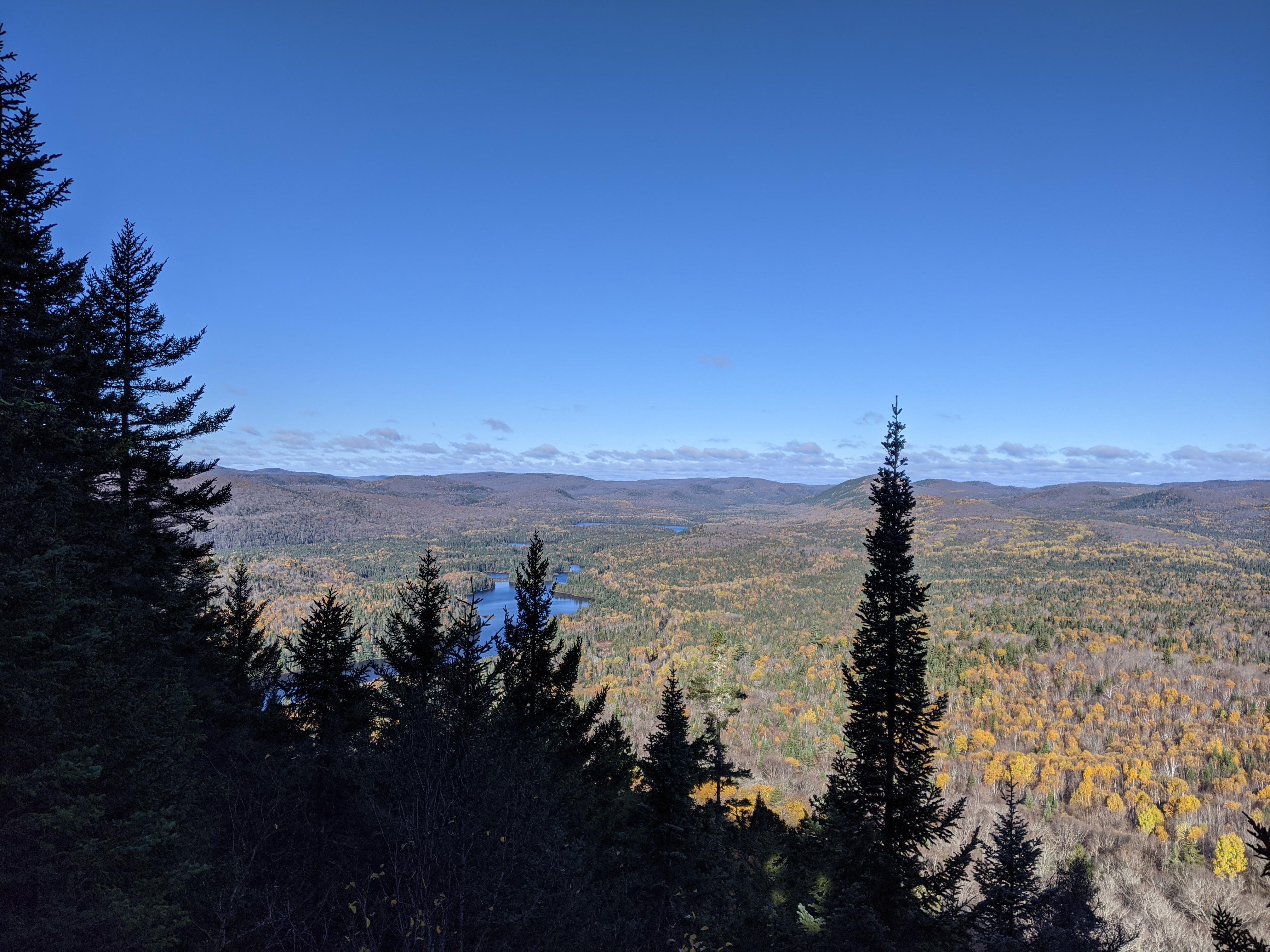
The plan was a sanatorium. On January 12, 1895, Quebec officials set aside a vast tract of the Laurentian Mountains for a tuberculosis retreat that would never be built. The sanatorium vanished into bureaucratic oblivion, but the park endured, becoming Quebec's first and eventually one of its largest protected areas. Mont-Tremblant National Park now stretches across 1,510 square kilometers of boreal-hardwood transition forest, its territory carved by glaciers into over 400 lakes, three river valleys, and rounded hilltops of billion-year-old gneiss. The name itself trembles with legend - Mont Tremblant, the trembling mountain, named by Indigenous peoples who believed the spirits within made it shake.
Billion-Year Bedrock
The entire park sits on the Grenville Province, the youngest geological formation of the Canadian Shield, though 'youngest' here means roughly a billion years old. The rock beneath every trail and lakeshore is composed of gneiss and granulites, ancient metamorphic stone that has been compressed, heated, and twisted deep within the Earth before being pushed to the surface. The Ice Age sculpted what geology had laid down, rounding the hilltops, gouging out the valleys, and leaving behind a layer of glacial till of variable thickness. The soils that formed atop this legacy are thin, acidic, and nutrient-poor - leached of humus by relentless rain and snowmelt. This infertility is precisely what shapes the park's character: forests that grow slowly and burn spectacularly in autumn, lakes so clear you can count the pebbles on the bottom.
Three Valleys, Four Hundred Lakes
The park divides naturally into three watersheds: the Diable River, Pimbina Creek, and the Assomption River, each carving its own valley through the Laurentian highlands. More than 400 lakes fill the glacial depressions scattered across the territory, with Lake Cypress - the largest - anchoring the northern reaches. Most of these lakes cluster in the park's northern half, while the southern portion presents a more rugged, stream-cut landscape. The position of the park at the headwaters of several major drainage systems ensures remarkably clean water flowing through its streams. Four rivers feed outward from here, their currents running toward Montreal, toward the St. Lawrence, carrying water that began as snow on these ancient rounded summits.
The Wolves' Emblem
The eastern wolf is the park's official emblem, and unlike many institutional mascots, this one actually lives here. Four or five packs roam the park's interior, a total population of roughly 35 animals that hunt beaver, moose, and deer across territories they have patrolled for generations. The wolves share this landscape with 194 bird species - including 25 species of warblers, along with bald eagles, ospreys, great horned owls, and barred owls. Seven species of reptiles and fourteen species of amphibians inhabit the waterways, including the vulnerable wood turtle and the bullfrog whose deep-throated call carries across the summer lakes. Brook trout thrive in the cold, oxygenated headwater lakes while pike cruise the warmer shallows - 29 fish species in all, sustaining a food web that runs from aquatic insects to apex predators.
From Logging Roads to Ski Runs
Logging arrived in the 1850s and stayed for over a century. Unlike the preservationist approach favored in the United States, Quebec embraced a conservationist philosophy that permitted 'reasonable use' of natural resources within its parks. Axes and saws worked the forests of Mont-Tremblant until 1981. In 1938, an American entrepreneur named Joe Ryan transformed the equation entirely by establishing a ski resort on Mont Tremblant itself and successfully lobbying to change provincial law to permit recreational use of parkland. A research station opened at Lake Monroe in 1948, and the first public campground appeared at Lake Chat in 1958, launching a wave of recreational development through the Diable valley and beyond. Today, the park draws visitors year-round - canoeists and hikers in summer, cross-country skiers and snowshoers in winter, and leaf-peepers every autumn when the sugar maples, red maples, yellow birches, and beeches ignite the hillsides in a blaze of amber, scarlet, and gold.
Where Boreal Meets Broadleaf
Mont-Tremblant sits precisely on the ecological boundary where the eastern hardwood forest gives way to the boreal north. Sugar maples and beeches dominate the lower slopes, but climb any hill and the forest transitions through yellow birch into balsam fir and spruce - a vertical journey through climate zones that elsewhere would require hundreds of kilometers of northward travel. The park holds species at the very edge of their range: hemlock, basswood, and red oak push to their northern limits here, while black spruce and balsam fir mark the southern advance of the boreal. Nine plant species within the park are considered likely to be designated threatened or vulnerable. This intersection of two great forest biomes, visible from above as a patchwork of dark conifer stands and bright deciduous canopy, is what makes Mont-Tremblant one of the most ecologically rich parks in eastern Canada.
From the Air
Located at 46.43N, 74.35W in the Laurentian Mountains north of Montreal. The park covers 1,510 square kilometers of forested highlands with over 400 lakes visible from altitude. Look for the rounded hilltops characteristic of the Canadian Shield and the patchwork of coniferous and deciduous forest - especially dramatic in autumn when the hardwoods turn. The Diable River valley cuts through the southern portion. Nearest major airport: Montreal-Trudeau International (CYUL), approximately 130 km south. Regional airports include Mont-Tremblant International (CYFJ) just southwest of the park, and La Macaza/Mont-Tremblant (CYTM). Recommended viewing altitude: 3,000-5,000 feet AGL for lake detail, higher for the full extent of the park. Weather can shift rapidly in the Laurentians; expect turbulence over the ridgelines.