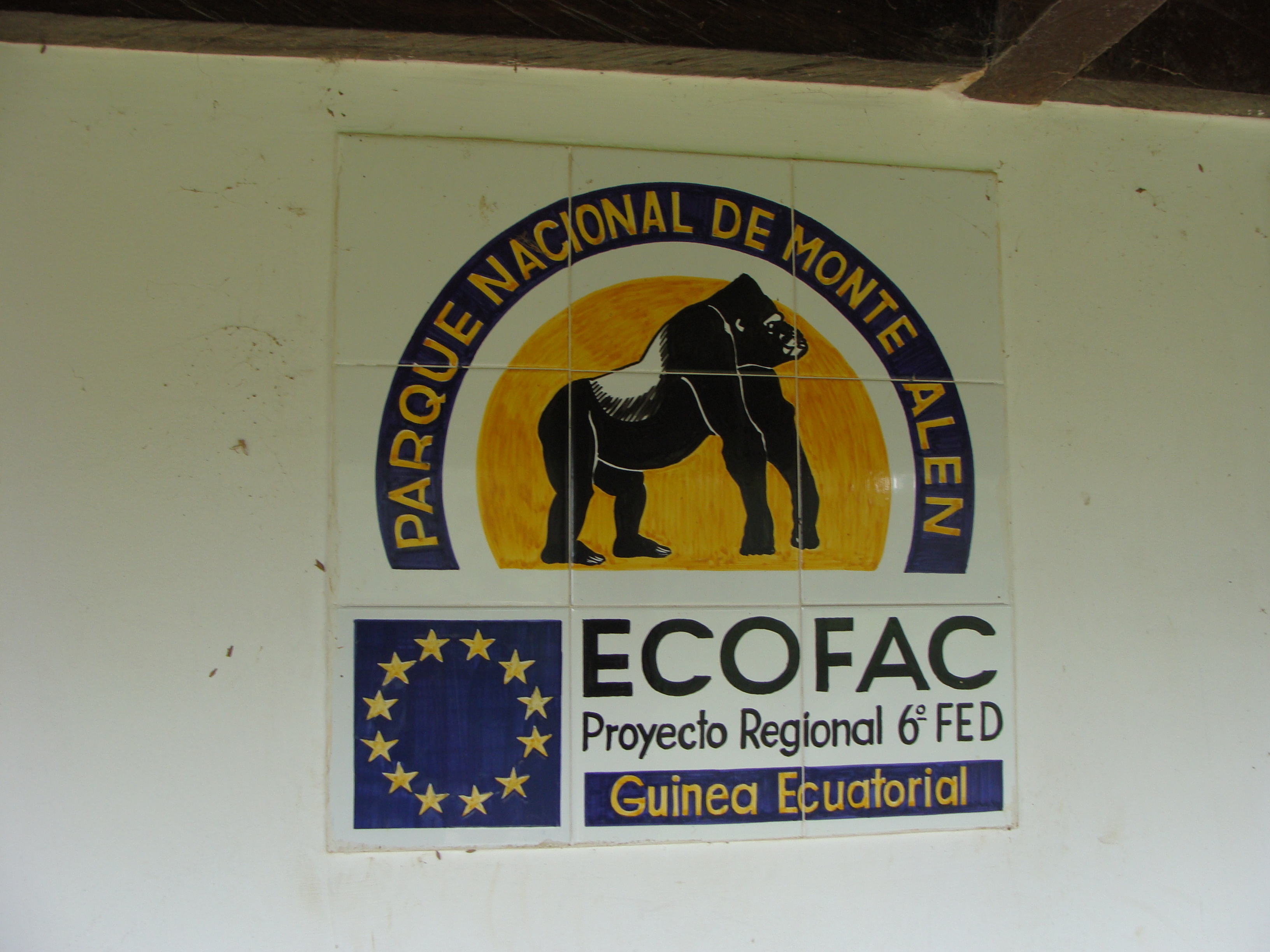
Monte Alén National Park
Somewhere in the southern reaches of this park, a frog the size of a house cat sits on a mossy boulder beside a fast-flowing stream. The goliath frog can weigh over three kilograms and stretch thirty centimeters from snout to rump, making it the largest frog species on the planet. That such an animal exists at all feels improbable. That it survives here, in 2,000 square kilometers of largely undisturbed equatorial forest at the heart of one of Africa's smallest nations, is the kind of fact that makes Monte Alén National Park worth knowing about.
A Country's Green Heart
Monte Alén sits near the geographic center of Equatorial Guinea, a country most people would struggle to place on a map. Established in 1990 and formally declared a national park under presidential decree in 2000, it is the largest protected area in a nation roughly the size of Maryland. The park spans elevations from 300 meters to the summits of Monte Alén and Monte Mitra, its two highest peaks. The Uoro River traces its western boundary, while the Niefang-Gabon road marks the eastern edge. Lake Atoc, tucked within the interior, sits surrounded by unbroken forest canopy across its entire catchment -- a rarity anywhere in Central Africa. The climate is equatorial in the truest sense: hot, humid, and drenched by over 3,000 millimeters of annual rainfall, with temperatures averaging 25 degrees Celsius in the lowlands and dropping to around 20 degrees in the highlands.
Primates and Pachyderms
The species roster at Monte Alén reads like an inventory of West and Central African biodiversity at its most concentrated. Gorillas and chimpanzees move through the upper and middle canopy. Black colobus monkeys leap between branches while collared mangabeys forage below. Mandrills, with their striking blue and red faces, patrol the forest floor. Both African bush elephants and the rarer, smaller forest elephants inhabit the park, sharing the understory with Grasse's shrews -- tiny mammals found in only a handful of locations. The birdlife draws specialists from around the world: grey-necked rockfowl, Zenker's honeyguide, Tessmann's flycatcher, and three montane species -- the grey cuckooshrike, pink-footed puffback, and black-capped woodland warbler -- that thrive in the cooler highland zones. Several amphibian species found here, including Leptodactylodon stevarti, carry IUCN Red List designations.
From Logging Concessions to Protected Ground
Monte Alén's path to protection was not straightforward. In 1989, the forest was zoned for logging concessions and agroforestry, a common trajectory for tropical forests across the continent. Conservation followed commerce, not the other way around. A USAID-funded biodiversity assessment of the Monte Mitra area sounded an alarm: hunting of mammals within the park had become a serious problem requiring urgent action. The report catalyzed a shift in policy. By 2005, agriculture, hunting, and logging had all been formally prohibited within park boundaries. Logging operations that do occur are now fully controlled. Trekking paths have been laid out, suggesting a tentative turn toward ecotourism, though infrastructure remains minimal. The park's story is one of a forest that came close to being parceled out and instead became the country's most significant act of conservation.
The Silence of the Canopy
What makes Monte Alén remarkable is less any single species than the completeness of what survives here. This is not a degraded fragment clinging to existence between palm oil plantations and logging roads. The canopy is largely intact. Rock outcrops punctuate the green in scattered patches, and the streams that feed into the Uoro carry tannin-stained water through ravines that have looked much the same for millennia. Equatorial Guinea's oil wealth has historically drawn attention away from its forests, which has paradoxically helped preserve them. Few roads penetrate the interior. Few tourists arrive. The goliath frogs sit on their boulders in the south of the park, undisturbed by everything except the roar of the water beside them.
From the Air
Located at 1.53°N, 10.11°E in central Equatorial Guinea, on the African mainland (Río Muni region). The park appears as an unbroken expanse of dense tropical forest canopy with no visible clearings or development from cruising altitude. Nearest airport is Bata Airport (FGBT) approximately 80 kilometers to the west. Malabo International Airport (FGSL) on Bioko Island is the country's main international gateway. Visibility often limited by equatorial cloud cover and haze; best views in the dry season (December through February). Recommended viewing altitude: 5,000-10,000 feet AGL for canopy detail.