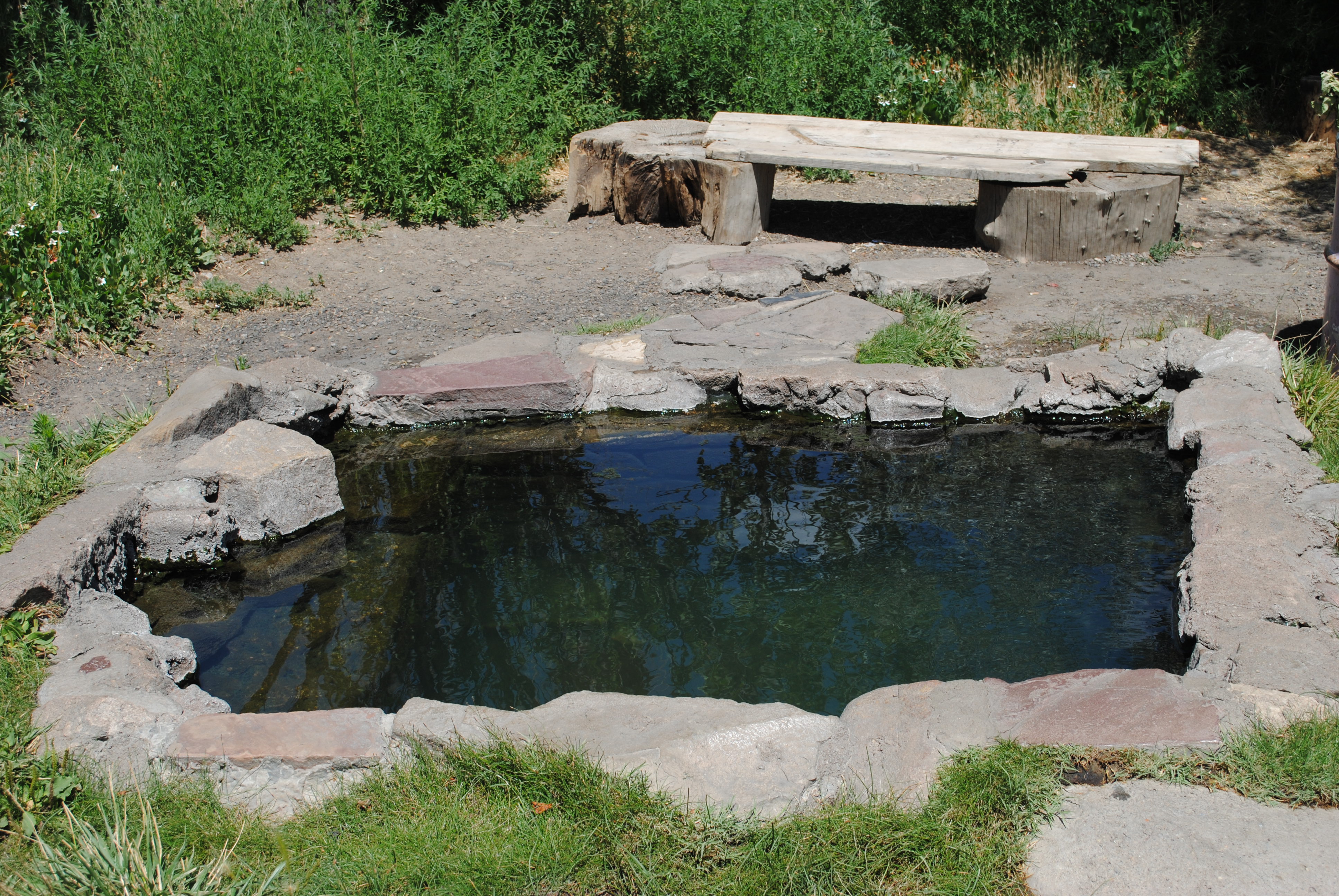
Montezuma Hot Springs
The hotel burned down three times. That fact alone tells you something about the grip Montezuma Hot Springs held on the ambitions of 19th-century entrepreneurs. Where 20 to 30 thermal springs bubble up from the earth along the Gallinas River near Las Vegas, New Mexico, indigenous peoples had soaked for centuries before anyone thought to build anything grander than a campfire beside the pools. But when the Santa Fe Railroad arrived in 1880, the springs became the site of one of the most spectacularly cursed luxury resorts in American history -- a Queen Anne palace with 270 steam-heated rooms that kept catching fire and kept getting rebuilt, because nobody could bear to abandon water that emerges from the ground at 138 degrees Fahrenheit.
Healing Waters, Ancient Claims
Long before railroad tracks reached northern New Mexico, local indigenous peoples recognized the therapeutic properties of the springs clustered along the Gallinas River. The water temperatures of the soaking pools range from 94 to 120 degrees Fahrenheit, fed by sources that push water to the surface at 138 degrees. The mineral profile is distinctive: relatively dilute solutions of sodium-chloride-bicarbonate-sulfate with moderate silica levels and notably high fluoride concentrations reaching up to 23 parts per million. Compared to other hot springs in the region, the Montezuma waters contain less natural chloride and higher levels of bicarbonate and sulfate. Spanish ranchers used the area in the early 19th century but saw no reason to develop what nature had already perfected. The springs simply existed, doing what they had done for millennia -- steaming quietly in the high desert, waiting for someone ambitious enough to try to improve upon them.
The Hotel That Refused to Stay Dead
The Santa Fe Railroad changed everything. In 1880, the railroad created the Las Vegas Hot Springs Company, purchasing the existing Hot Springs Hotel and surrounding property, including its bathhouses for hot mineral soaking and mud baths. By April 1882, a standard-gauge track connected Las Vegas to the springs, with the first train completing the journey on April 5. That same year, the company opened the three-story Queen Anne-styled Montezuma Hotel, an extravagant affair featuring 270 steam-heated rooms. In January 1884, the hotel and bathhouses burned to the ground. Within weeks, the Santa Fe Railroad enlisted the Chicago architectural firm of Daniel Burnham and John Root to design something even grander. The second Montezuma Hotel was completed in 1885. It burned within four months of opening, leaving only the stone walls of the lower two floors. Rebuilt a third time and reopening in August 1886, it was formally renamed the Phoenix Hotel -- a name that acknowledged the obvious pattern -- though everyone continued calling it the Montezuma Hotel.
Outlaws and Legends
The springs attracted more than health-seekers and railroad magnates. Local folklore holds that Billy the Kid and Jesse James soaked in the hot pools after playing cards nearby. Whether or not the claim is true, it captures the character of a place that sat at the crossroads of the 19th-century West -- a spot where the comforts of Victorian civilization, represented by the grand hotel, brushed against the rougher edges of frontier life. The springs drew people from across the social spectrum, from wealthy Easterners seeking the cure to working cowboys looking to ease trail-worn muscles. That democratic quality of hot water -- it does not ask who you are before it warms your bones -- gave Montezuma a reputation that outlasted any single building erected beside it.
From Grand Hotel to World College
The Victorian hotel known as Montezuma's Castle still stands today, though its purpose has transformed completely. The building now serves as the administration center for the Armand Hammer United World College of the American West, one of an international network of schools bringing together students from around the globe. The hot springs themselves remain accessible across from the Gallinas River on the college property, still steaming, still drawing visitors who come for the same reason people have always come -- the simple, irreducible pleasure of lowering yourself into naturally heated mineral water while the New Mexico sky stretches overhead. The pools range from barely warm to scalding, and the etiquette is informal. No grand hotel looms over the bathers anymore, and that may be the springs' final lesson: the water was always the point, not the architecture built around it.
From the Air
Located at 35.65N, 105.28W, the hot springs sit along the Gallinas River approximately 6 miles northwest of Las Vegas, New Mexico. The Victorian-era Montezuma Castle building is visible from low altitude as a large stone structure among the river valley. Las Vegas Municipal Airport (KLVS) is roughly 8 miles to the southeast. At 3,000 to 5,000 feet AGL, the river corridor and college campus provide clear visual references. The surrounding terrain is high plains transitioning to foothills of the Sangre de Cristo Mountains to the west.