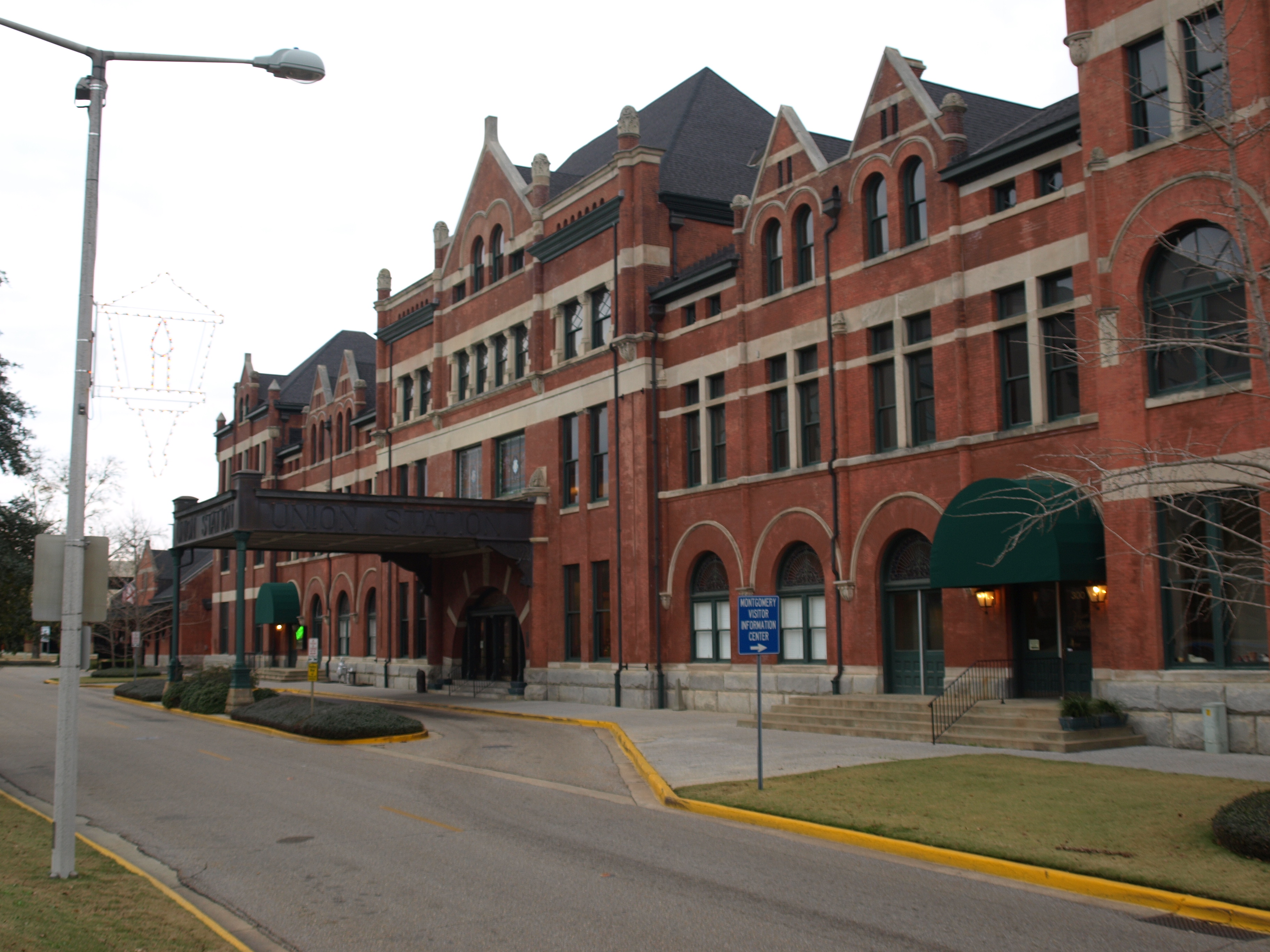
Montgomery Union Station: When Six Railroads Met on a Bluff
Six railroads once funneled into a single brick-and-limestone station perched on a bluff above the Alabama River. The Louisville and Nashville, the Atlantic Coast Line, the Seaboard Air Line, the Western Railway of Alabama, the Central of Georgia, the Gulf, Mobile and Ohio -- their names read like poetry now, but in 1898, when Montgomery Union Station opened, they were the arteries of the South. Passengers boarded the Humming Bird, the Pan-American, and the Crescent under a vast gable-roofed train shed that sheltered six tracks. Today that shed is one of the rarest surviving examples of 19th-century railroad architecture in the United States, its tracks replaced by asphalt, its platforms silent.
Brick, Limestone, and Jim Crow
The Louisville and Nashville Railroad built Union Station in 1898, erecting it of brick and limestone in the Romanesque Revival style on a high bluff along the Alabama River. The station was designed to serve as a hub for multiple rail lines converging on the capital of Alabama. Six tracks ran beneath the long gable-roofed shed, with a coach yard on the south end and a Railway Express Agency facility handling freight and parcels. Like nearly every public building in the Jim Crow South, the station's design segregated passengers by race -- separate waiting rooms, separate entrances, separate lives under the same grand roof. The architecture was handsome. The system it served was not.
The Named Trains
For more than half a century, Union Station hummed with traffic bearing some of American railroading's most evocative names. The L&N ran the Azalean, the Florida Arrow, the Humming Bird, the Pan-American, and the South Wind through Montgomery. The Southern Railway's Crescent and Piedmont Limited connected the city to the broader national network. These were not just transportation -- they were events. Passengers dressed for travel, porters loaded steamer trunks, and the platform filled with the hiss of steam and the smell of coal smoke. Montgomery sat at a crossroads: north to Birmingham and Nashville, south to Mobile and the Gulf, east to Atlanta, west to New Orleans. The station was where those routes converged.
A Long Goodbye
The decline came slowly, then all at once. Passenger counts fell through the 1950s and 1960s as automobiles and airlines drained riders from the rails. In 1970, the Southern Railway rerouted the Crescent north through Birmingham, bypassing Montgomery entirely. The L&N yielded its passenger operations to Amtrak in 1971, and Amtrak kept a single train running through the station -- the South Wind, later renamed the Floridian, operating between Chicago and Miami. That last lifeline was cut in 1979. Union Station closed. The building sat empty until it was renovated for commercial use, eventually housing the Montgomery Area Visitor Center and other tenants. Amtrak briefly returned to Montgomery in 1989, but not to Union Station -- the railroad contracted with a travel agent operating out of a converted grain silo nearby. That service, too, ended in 1995. Montgomery has had no passenger rail since.
The Shed That Survived
What makes Union Station exceptional is not just the station building but the train shed behind it. When the station was designated a National Historic Landmark in 1976, the citation singled out the shed as a rare surviving example of a 19th-century gable-roofed structure. Most train sheds of this era were demolished or replaced by balloon sheds as railroads modernized. Montgomery's shed endured. The tracks that once ran beneath it are gone, replaced by parking, but the iron framework and roofline remain intact -- a cathedral of transportation from an age when arriving by train was the way Americans moved. The station had already been added to the National Register of Historic Places in 1973, recognizing its importance to Alabama's railroad history and to the broader story of how the South was knit together by rail.
From the Air
Located at 32.3806N, 86.3142W on a prominent bluff above the Alabama River in downtown Montgomery, Alabama. The station and its long train shed are visible from the air along the river's edge, south of the downtown commercial grid. The Alabama State Capitol dome sits several blocks to the east. Nearest airport: Montgomery Regional Airport (KMGM), approximately 7 nm southwest. Maxwell Air Force Base (KMXF) is approximately 4 nm west. Best viewed at 1,500-2,500 feet AGL on a river-following approach from the south or east, where the train shed's distinctive roofline is most apparent.