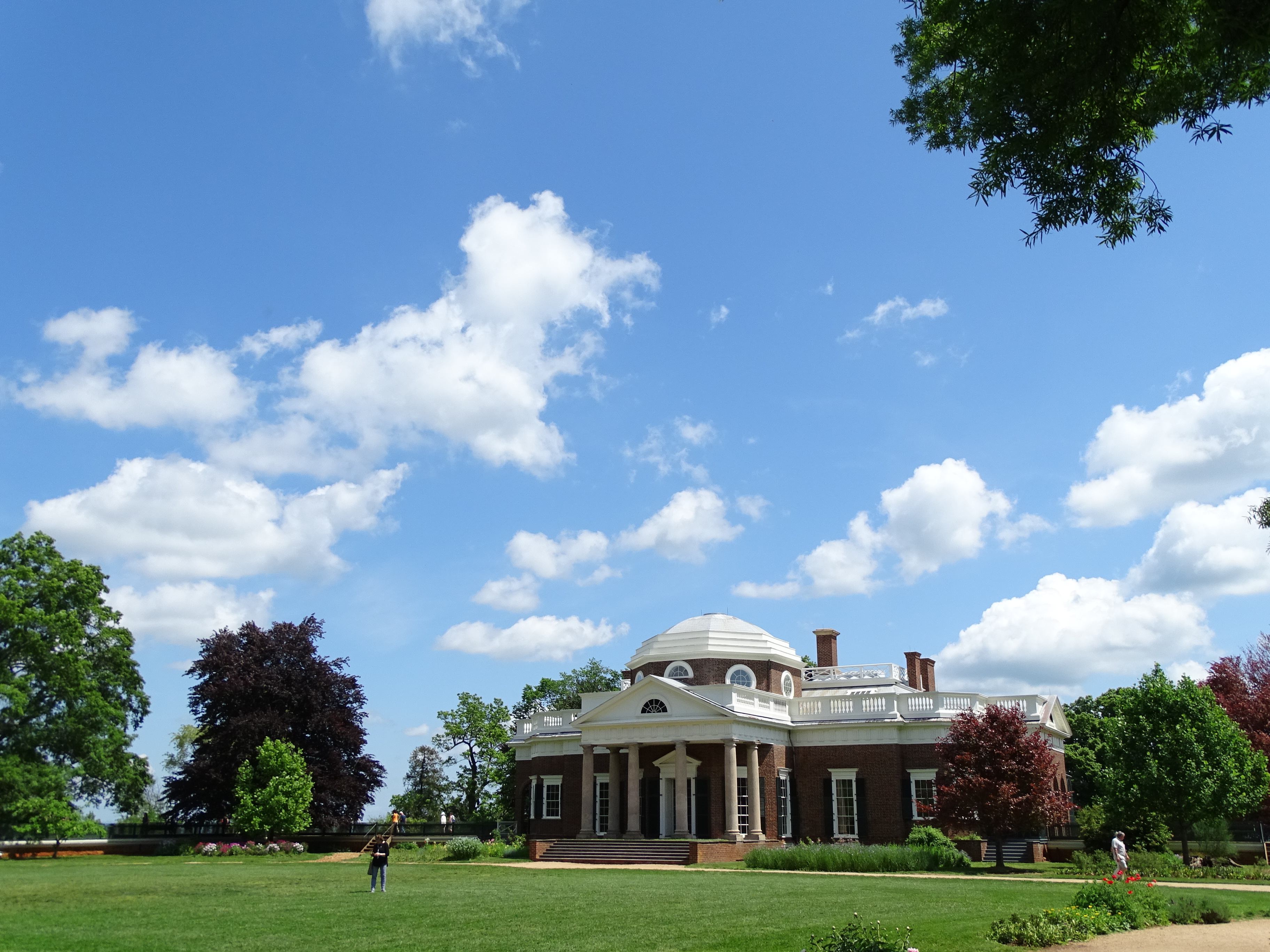
Monticello: The Genius Estate Built on Contradiction
Thomas Jefferson designed everything. The hilltop plantation house with its distinctive dome. The clever gadgets - a polygraph copying machine, a revolving bookstand, a great clock with cannonball weights marking days. The landscape terraced into gardens. The burial ground where he wished to rest. Jefferson's vision for his 'little mountain' consumed decades and fortunes. What he didn't design was the moral architecture: the enslaved people who built his vision, worked his fields, and attended his person. Over 600 people lived in bondage at Monticello. Among them was Sally Hemings, who bore Jefferson six children. The house celebrates genius; the story complicates celebration. Monticello is America in miniature - brilliant achievement resting on fundamental injustice.
The House
Jefferson began Monticello in 1768 and continued building, demolishing, and rebuilding until his death in 1826. The architecture reflects his time in France: neoclassical forms, the distinctive dome inspired by Paris's Hôtel de Salm. The house contains 33 rooms, many with innovative features - the alcove bed that opens to two rooms, the dumbwaiters hidden in fireplace mantels, the clock that required interior weights to extend into the basement. Jefferson designed every detail; construction was performed by enslaved craftsmen, particularly members of the Hemings family. The house is monument to a controlling intelligence; the labor that realized that intelligence was coerced.
The Enslaved
Over 400 people were enslaved at Monticello during Jefferson's lifetime. The population varied as people were bought, sold, born, or died; Jefferson sold enslaved people to manage his chronic debts. Enslaved workers performed every function: field labor, skilled trades, domestic service. The Hemings family occupied a complex position - several were skilled craftsmen, some traveled with Jefferson to Philadelphia and Paris, and Sally Hemings was Jefferson's concubine for decades. The relationship began when she was approximately 14, enslaved and in Paris where she could have claimed freedom. She returned to Virginia pregnant with Jefferson's child. He freed none of the Hemings during his lifetime.
The Contradiction
Jefferson wrote that 'all men are created equal' while owning human beings. He understood slavery was wrong - he wrote of it trembling for his country when he reflected that 'God is just' - yet freed only a handful of people in his will, leaving the rest to be sold for his debts. He fathered children with an enslaved woman and never publicly acknowledged them. He lived in debt partly from the expense of maintaining his version of refinement. The contradictions weren't hidden; they were foundational. Monticello cannot be understood without understanding that Jefferson's ideals and his practices were at permanent war. The house is beautiful; the beauty was built by people who couldn't leave.
The Interpretation
For most of its history as a museum, Monticello minimized slavery. Tours focused on Jefferson's genius; enslaved people were mentioned as background. Since the 1990s, interpretation has transformed. The Hemings relationship is explicitly discussed. Tours include the dependencies where enslaved people worked and lived. Mulberry Row, the plantation 'main street' where enslaved craftsmen labored, is interpreted as comprehensively as the main house. The change reflects broader historical reckoning: Americans can no longer separate founding ideals from founding crimes. Monticello now attempts to present Jefferson complete - the genius and the slaveholder, the idealist and the hypocrite.
Visiting Monticello
Monticello is located in Charlottesville, Virginia, approximately 120 miles southwest of Washington, D.C., via Interstate 64. Multiple tour options are available, from house tours to comprehensive explorations of enslaved life. Advance reservations are strongly recommended. The house tour covers the main floors; separate tours access the dome room. The grounds, gardens, and Mulberry Row are accessible with general admission. The visitor center offers exhibits on Jefferson's life and the enslaved community. Allow 3-4 hours for comprehensive visit. Charlottesville offers restaurants, lodging, and the University of Virginia campus (also designed by Jefferson). The experience is more meaningful for acknowledging complexity - come prepared to think about what the beautiful house meant and cost.
From the Air
Located at 38.01°N, 78.45°W on a hilltop outside Charlottesville, Virginia. From altitude, Monticello appears as a large house atop a cleared mountain, the distinctive dome visible from certain angles. The University of Virginia is visible in Charlottesville to the northwest - another Jefferson design. The Blue Ridge Mountains rise to the west. The agricultural land that enslaved people worked surrounded the house; today the grounds are maintained as museum. The Virginia Piedmont extends in all directions, rolling terrain that Jefferson surveyed and described. The hilltop position that Jefferson chose for commanding views is obvious from altitude - this was always meant to dominate its landscape.