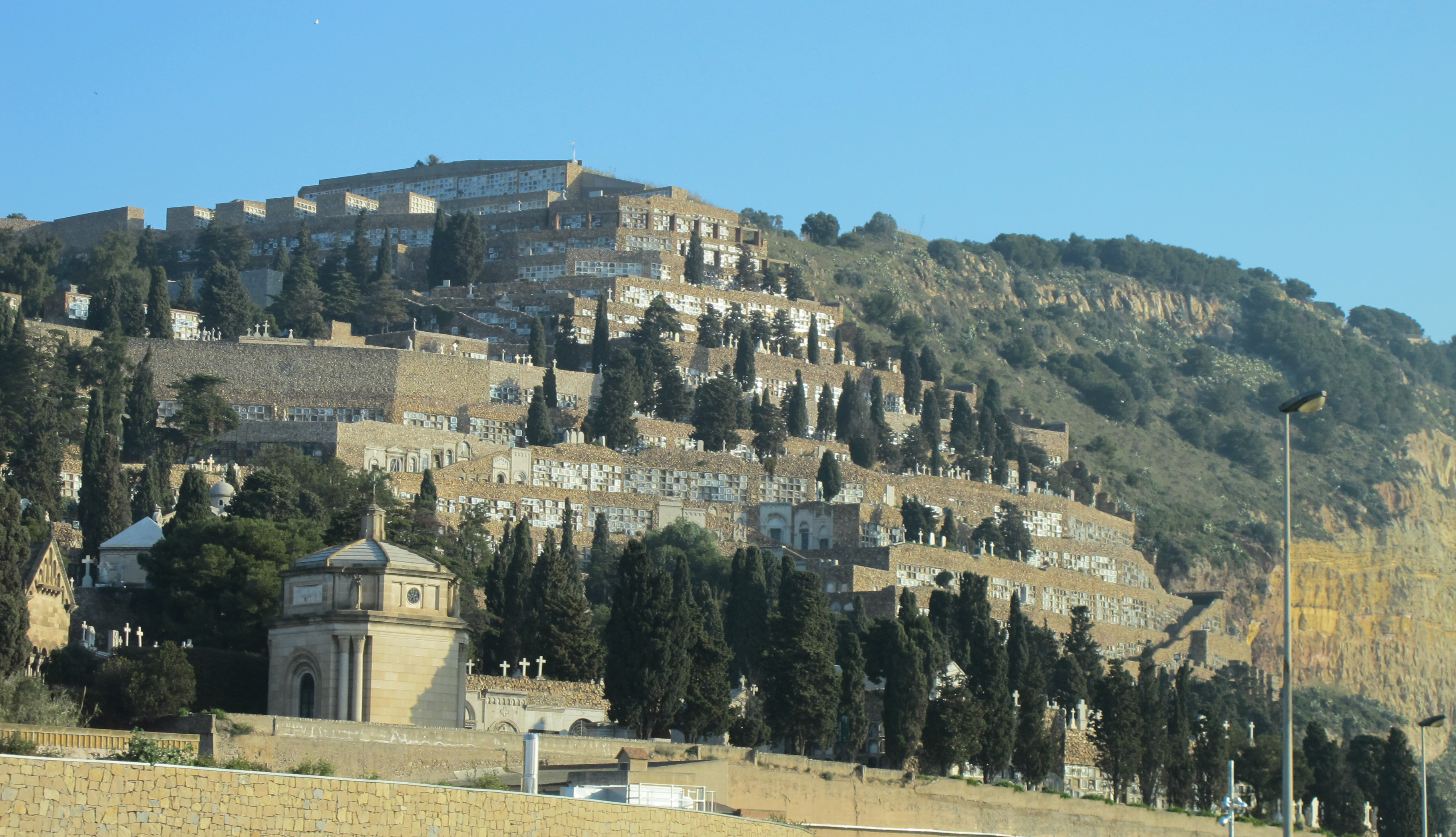
Montjuic Cemetery
Joan Miro is buried here. So is Isaac Albeniz, the virtuoso pianist whose Iberia suite captured the rhythms of Spain in twelve movements of staggering difficulty. Lluis Companys, the president of Catalonia executed by Franco's regime in 1940, rests on these slopes alongside Buenaventura Durruti, the anarchist revolutionary who fought on the opposite side of Spain's political convulsions. In most cemeteries, such neighbors would be remarkable. At Montjuic, they are the expected company -- because this hillside has spent nearly a century and a half gathering the most consequential figures in Catalan life and arranging them, tier by terraced tier, facing the Mediterranean.
A Hillside for the Dead
Barcelona opened the Cementiri del Sud-oest on March 17, 1883, choosing the steep western slopes of Montjuic hill as the site for a new main cemetery to replace the overcrowded grounds at Poblenou in the east. The 19th century had transformed Barcelona into an industrial powerhouse, the economic center of Catalonia and one of Spain's largest cities, and the living were running out of room for the dead. Montjuic's rocky terrain, set apart from the pressures of housing development, offered both space and character. The hillside's steep grades forced an unconventional layout: winding paths thread between terraced rows of niches that step down toward the harbor, each level offering wider views of the sea. The effect is less a flat field of graves than a vertical city, its architecture responding to the same topography that shaped the neighborhoods below.
Art Among the Tombs
The cemetery's founding coincided with a sequence of artistic movements that left their mark on its monuments. The earliest memorials draw on classical and Gothic revival styles -- formal columns, pointed arches, weeping angels carved in marble. As the century turned, the influence of Art Nouveau reshaped the stone. In Catalonia, this aesthetic took on its own character as Modernisme, the same movement that was filling Barcelona's streets with the fantastical buildings of Gaudi and Domenech i Montaner. The cemetery became an open-air gallery of this evolution, its mausolea and funerary sculptures tracking changing tastes in real time. Walking among the graves is like walking through a textbook of decorative arts, from neoclassical restraint to the sinuous organic lines that define the Catalan fin de siecle.
The Names on the Hill
The list of notable interments reads like a compressed history of modern Catalonia. Ildefonso Cerda, the urban planner who designed the Eixample -- Barcelona's signature grid of chamfered city blocks -- lies near Francesc Macia, the first president of the restored Generalitat. Joan Gamper, the Swiss-born founder of FC Barcelona, is here, as is Juan Antonio Samaranch, who led the International Olympic Committee from 1980 to 2001. Among the writers: Carlos Ruiz Zafon, whose novels turned Barcelona itself into a character; Jacint Verdaguer, the poet laureate of the Catalan cultural revival known as the Renaixenca; and Ana Maria Matute, one of Spain's most honored novelists. The cemetery holds revolutionaries and reactionaries, composers and footballers, a child serial killer named Enriqueta Marti and a Filipino independence hero, Marcelo H. del Pilar, whose remains were exhumed and returned to the Philippines in 1920.
The View They All Share
What unites the more than one million burials and cremation ashes in Montjuic's 150,000 plots, niches, and mausolea is the view. The terraced rows face south and east, looking out over Barcelona's harbor and the open Mediterranean beyond. Even the single Commonwealth war grave -- that of Private Charles Hill of the Queen's Own Cameron Highlanders, who died in 1941 during World War II -- shares this orientation. On clear days, the light off the water reaches deep into the cemetery's upper terraces, warming stone that has absorbed more than a century of sun and grief. The cemetery remains operational, managed by Cementiris de Barcelona, and new burials continue to join the old. Montjuic hill holds a castle, an Olympic stadium, botanical gardens, and a magic fountain, but this slope -- quiet, terraced, facing the sea -- may be its most honest monument to the city it overlooks.
From the Air
Located at 41.352N, 2.154E on the southwestern slopes of Montjuic hill, below the castle. The cemetery's terraced layout is visible from the air as a series of stepped white and gray tiers on the hillside facing the sea. Nearest airport: Barcelona-El Prat (LEBL), approximately 10 km southwest. From approach paths to LEBL, the cemetery is visible on the left side of Montjuic, below the summit fortress. The adjacent harbor and port facilities provide orientation. Best viewed at 2,000-4,000 feet.