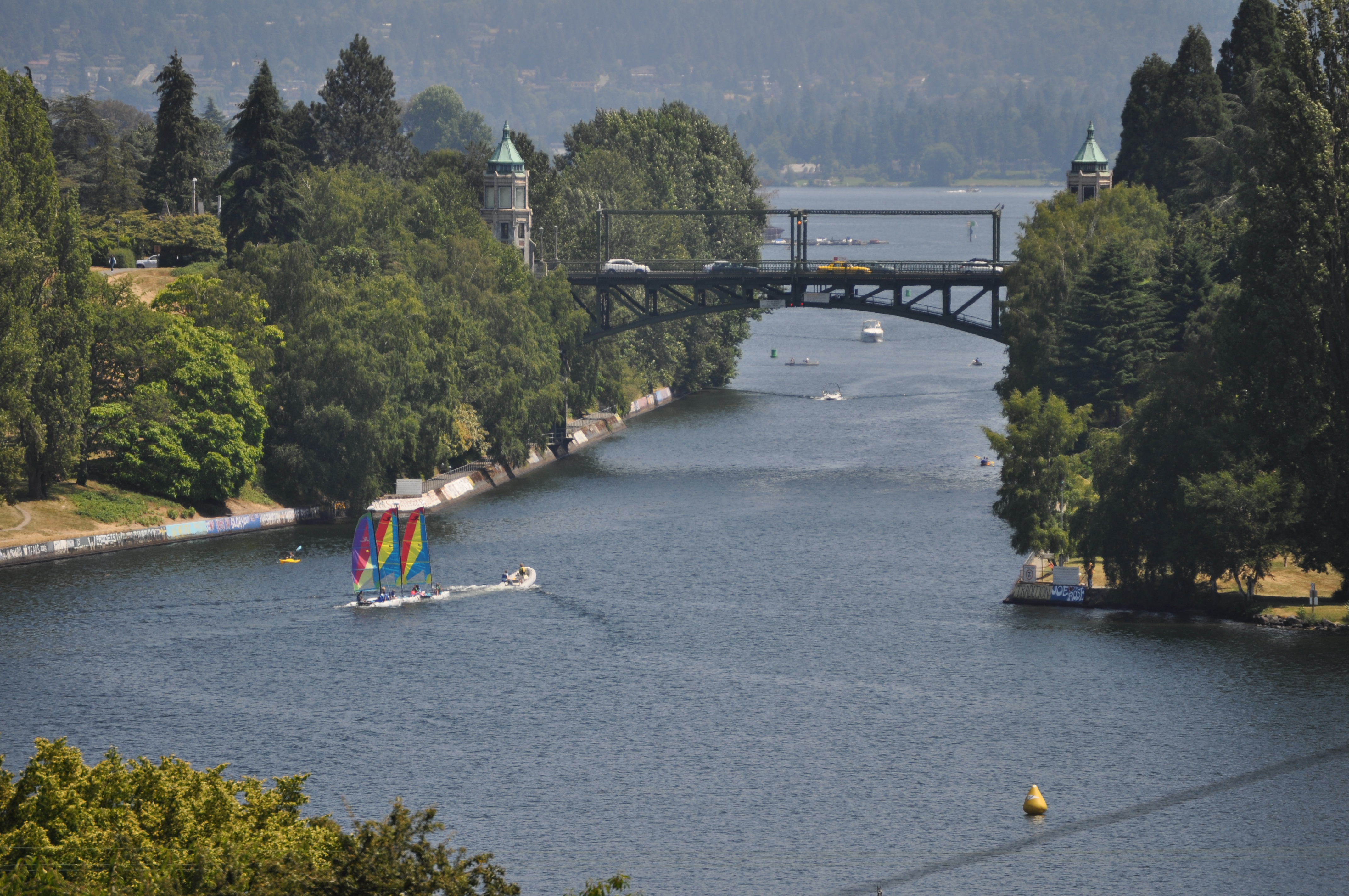
Montlake Bridge
It started with a football game. In 1920, graduate manager Dar Meisnest needed to get Washington Huskies fans across the Montlake Cut for a game against Dartmouth, so he lashed together a series of barges and laid planks over them. The makeshift walkway was so heavily traveled that afternoon that it proved, more effectively than any engineering report could have, that the city needed a permanent bridge at this crossing. Five years later, on June 27, 1925, thousands of Seattleites gathered for a parade to celebrate the opening of a structure that would become one of the most recognized -- and most cursed during rush hour -- bridges in the Pacific Northwest. The Montlake Bridge is a double-leaf bascule drawbridge, 344 feet long, designed in Collegiate Gothic style to match the University of Washington campus it connects to. It is also, since 1984, one of only two movable bridges in the entire Western Hemisphere still crossed by trolleybuses.
The Portage That Became a Canal
Long before the bridge or the cut it spans, this narrow isthmus between Lake Union and Lake Washington served as a portage for the Coast Salish people who traveled these waters. In Lushootseed, the indigenous language of the region, the place was called stexwugwil -- "carry a canoe." Plans to dig a canal here surfaced as early as the 1860s, and a north-south road crossed the portage by 1879. A narrow canal was excavated perpendicular to that road, fitted with a set of locks, and bridged. When the University of Washington needed streetcar access to its north-side campus in time for the 1909 Alaska-Yukon-Pacific Exposition, a temporary bridge was thrown up. That structure gave way to a pedestrian suspension bridge in 1910, as work on the wider and deeper Montlake Cut began in earnest. Piers and abutments for a permanent bridge were poured in 1914 as part of the Lake Washington Ship Canal construction, but a serious proposal for the bridge itself did not materialize until 1916.
Gothic Towers over Tidal Water
The architects made a deliberate choice. Edgar Blair, Harlan Thomas, and A. H. Albertson designed the Montlake Bridge and its control towers in the Collegiate Gothic style that Carl F. Gould had established across the University of Washington campus. The bridge was meant to look like it belonged to the university, and it does -- its stone-clad towers echo the campus buildings visible just north of the crossing. Beneath the ornamental surface, the engineering is distinctive for different reasons. The bridge is one of six bascule designs derived from the Chicago model, but it alone uses trunnion supports, a workaround adopted specifically to avoid a patent infringement lawsuit by the Strauss Bascule Bridge Company. At 46 feet of clearance, the Montlake Bridge has the highest of Seattle's four original Ship Canal drawbridges, which also include the Ballard, Fremont, and University bridges. It was the last of the four to be completed, and the only one on the state highway system. The city built it at a cost of $670,000, with steel fabricated and erected by the Wallace Equipment Company.
Bottleneck and Beloved Landmark
The bridge that football fans demanded in 1920 now carries roughly 60,000 vehicles on a typical weekday, funneling traffic to and from State Route 520 through a single chokepoint that has frustrated commuters for decades. When the bascule leaves rise for a passing sailboat -- most openings are for pleasure craft, since commercial tugs can usually clear the 46-foot span -- traffic backs up for more than a mile in both directions. Proposals for alternate routes and additional crossings have surfaced repeatedly. Plans for the SR-520 replacement project include a second bascule bridge alongside the existing one. Yet the Montlake Bridge is also deeply loved. It was listed on the National Register of Historic Places in 1982 and designated a City of Seattle Landmark alongside the Montlake Cut itself. Every first Saturday in May, the bridge serves as the ceremonial gateway for Opening Day of boating season, when decorated vessels parade through the cut while spectators crowd the bridge deck and shoreline.
Trolleybuses and Living History
From 1940 to 1970, and again since 1981, the electric trolleybuses of Seattle's transit system have rolled across the Montlake Bridge, their overhead wires strung along a route that few other movable bridges in the world still accommodate. When Vancouver's 1911 Cambie Street Bridge closed in 1984, the Montlake Bridge and the nearby University Bridge became the last two movable bridges in the Western Hemisphere with active trolleybus service -- a distinction they hold to this day. The bridge operates on channel 13 for marine traffic, and its opening restrictions are more complex than any other drawbridge on the Ship Canal, reflecting the volume of both vehicle and boat traffic it must balance. One long blast and one short on the horn signals a request to raise the leaves. Commuters grind their teeth. Sailors glide through. The Gothic towers watch both with equal indifference, as they have since 1925.
From the Air
The Montlake Bridge spans the Montlake Cut at 47.648N, 122.304W, the narrow channel connecting Lake Union (west) and Lake Washington (east) as part of the Lake Washington Ship Canal. The bridge and cut are visible from altitude as a thin water line between the two lakes, with the University of Washington campus immediately to the north and the Montlake neighborhood to the south. The Collegiate Gothic control towers are small but distinctive. Husky Stadium sits 0.3nm northeast, another prominent landmark. Nearest airports: Boeing Field (KBFI) 6nm south, Kenmore Air Harbor (S60) 7nm north, Renton Municipal (KRNT) 10nm southeast. Best viewed at 2,000-3,000 feet from the east, where the canal alignment, the bridge, and both lakes are visible in a single frame.