Montmorency Falls
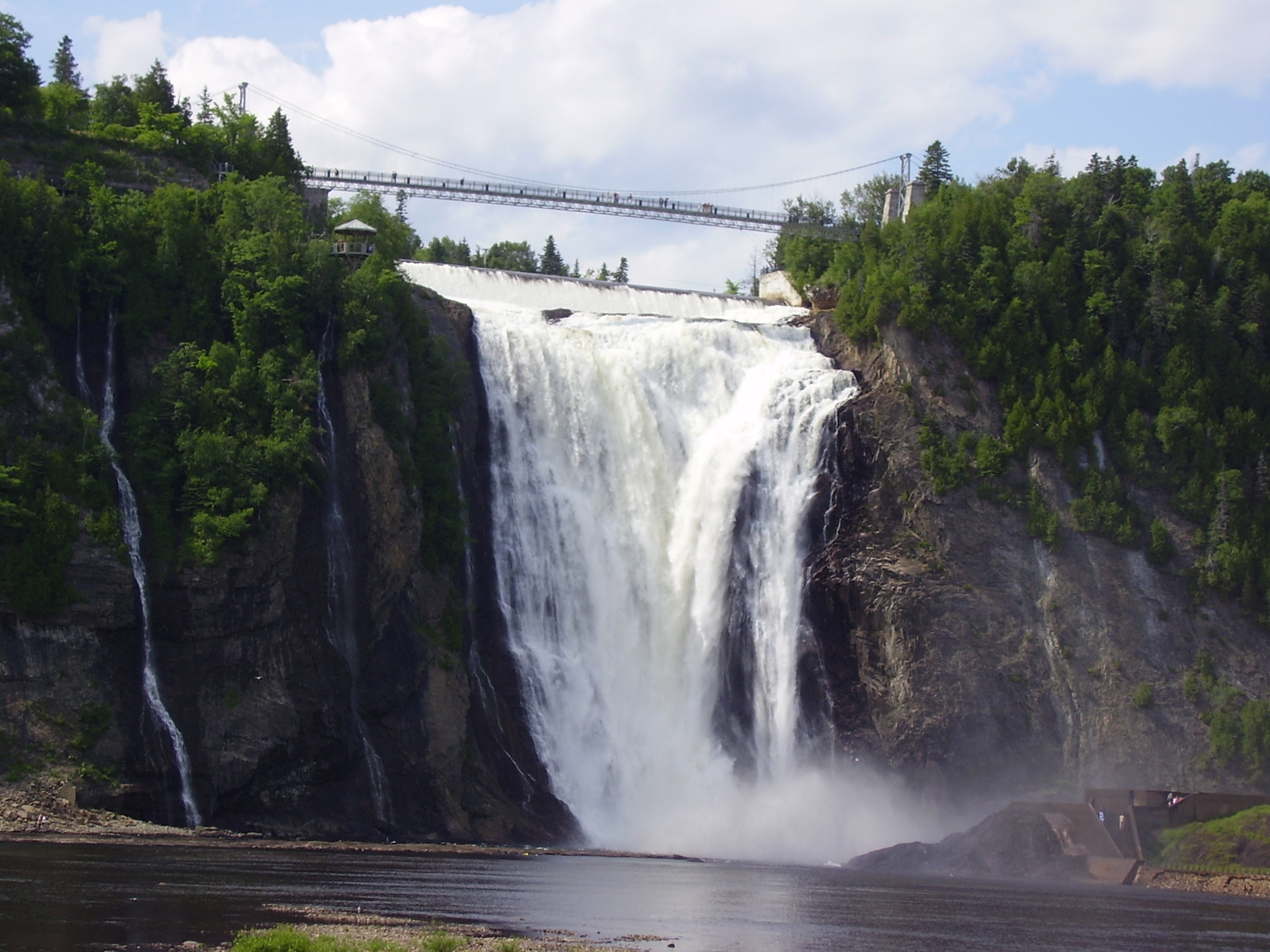
John Keats never visited North America, yet in 1816 he reached for a single image to capture the terrifying momentum of human life: a sleeper drifting toward "the monstrous steep of Montmorency." The reputation of this waterfall traveled that far, that fast. Where the Montmorency River tips over a limestone cliff and plunges 83 meters into the Saint Lawrence, the drop is a full 30 meters higher than Niagara Falls. But Montmorency has never been about mere measurement. Positioned just minutes from the heart of Old Quebec City, at the boundary between the borough of Beauport and the municipality of Boischatel, it is a place where geological violence and urban life exist in startling proximity -- a curtain of white water visible from church steeples and highway overpasses alike.
The Battleground at the Cliff's Edge
Long before tourists lined up for the funitel, Montmorency Falls was a theater of war. On July 31, 1759, British General James Wolfe launched an assault on French entrenchments near Beauport, using the falls as a landmark and staging point. His aide-de-camp, Captain Hervey Smythe, sketched the scene -- the thundering water, the grenadiers advancing below -- and that drawing became one of the earliest European depictions of the falls, engraved by William Elliott in the early 1760s. Wolfe's attack failed that day, but two months later his forces took the Plains of Abraham and changed the course of North American history. The falls themselves stood indifferent to empire, as they always have, the river pouring over the cliff edge at the exact spot where it meets the Saint Lawrence, directly opposite the western tip of the Ile d'Orleans.
Iron Water and Summer Gold
During summer months, the cascade takes on an unexpected amber glow. High iron content in the riverbed stains the water, turning the falls a burnished yellow-gold when sunlight strikes at the right angle. Nearly 970,000 visitors a year come to see this spectacle and walk the staircases that cling to the rock face, offering views from below, beside, and above the torrent. A suspension bridge stretches across the crest, letting visitors stand directly over the point where the river launches into open air. In warmer months, the park hosts an international fireworks competition, and the explosions of color above the falls create a double spectacle -- fire reflected in the mist rising from 83 meters of vertical water. The surrounding area is protected within Montmorency Falls Park, managed by Sepaq, Quebec's outdoor recreation authority.
The Sugar Loaf of Winter
When temperatures drop, the spray at the base of the falls freezes into a massive cone of ice known as the sugar loaf -- a formation so distinctive that it was painted by Robert Clow Todd in 1845 and Joseph Legare in 1850, their canvases capturing tiny figures sleighing down its slopes. The poet Letitia Elizabeth Landon described the scene in Fisher's Drawing Room Scrap Book in 1836, turning the frozen cone into a subject of literary fascination in drawing rooms across England. That tradition of winter recreation continues today. The ice cone builds throughout the cold months, growing into a white dome at the foot of the cliff that visitors photograph from every angle. Quebec's first Ice Hotel was erected at Montmorency Falls in 2001, an entire structure carved from frozen water beside a waterfall that had itself turned to ice -- a nesting doll of winter engineering.
Poets, Films, and Reality Television
Montmorency Falls has drawn storytellers across centuries and media. Keats invoked its name without ever seeing it. The 1947 film Whispering City used the falls as a dramatic backdrop, filming key scenes on location. In 2017, The Amazing Race Canada chose the falls for its fifth-season finale, sending competitors scaling a cargo net suspended over the cascade. Between these marquee moments, generations of painters and engravers documented the falls with obsessive devotion -- James Peachey etched it in 1781, British military artists captured it during the Seven Years' War, and James Pattison Cockburn painted the winter ice cone around 1830. The work now hangs in the Musee national des beaux-arts du Quebec, just a few kilometers away. In 2019, the Quebec government announced a 33-million-dollar makeover of the tourist facilities, a recognition that the falls remain one of the province's most visited natural landmarks and that the infrastructure needed to match the spectacle.
From the Air
Montmorency Falls is located at 46.891N, 71.148W, on the north shore of the Saint Lawrence River about 12 km east-northeast of downtown Quebec City. From the air, look for the dramatic white ribbon of water plunging off the cliff face where the Montmorency River meets the Saint Lawrence, directly opposite the western end of Ile d'Orleans. The falls and surrounding park are clearly visible at altitudes above 3,000 feet. Nearest airports: Quebec City Jean Lesage International (CYQB) approximately 15 nm west-southwest, Quebec/Neuville (CNV9) 30 nm west. The area is within Quebec City's Class C airspace.