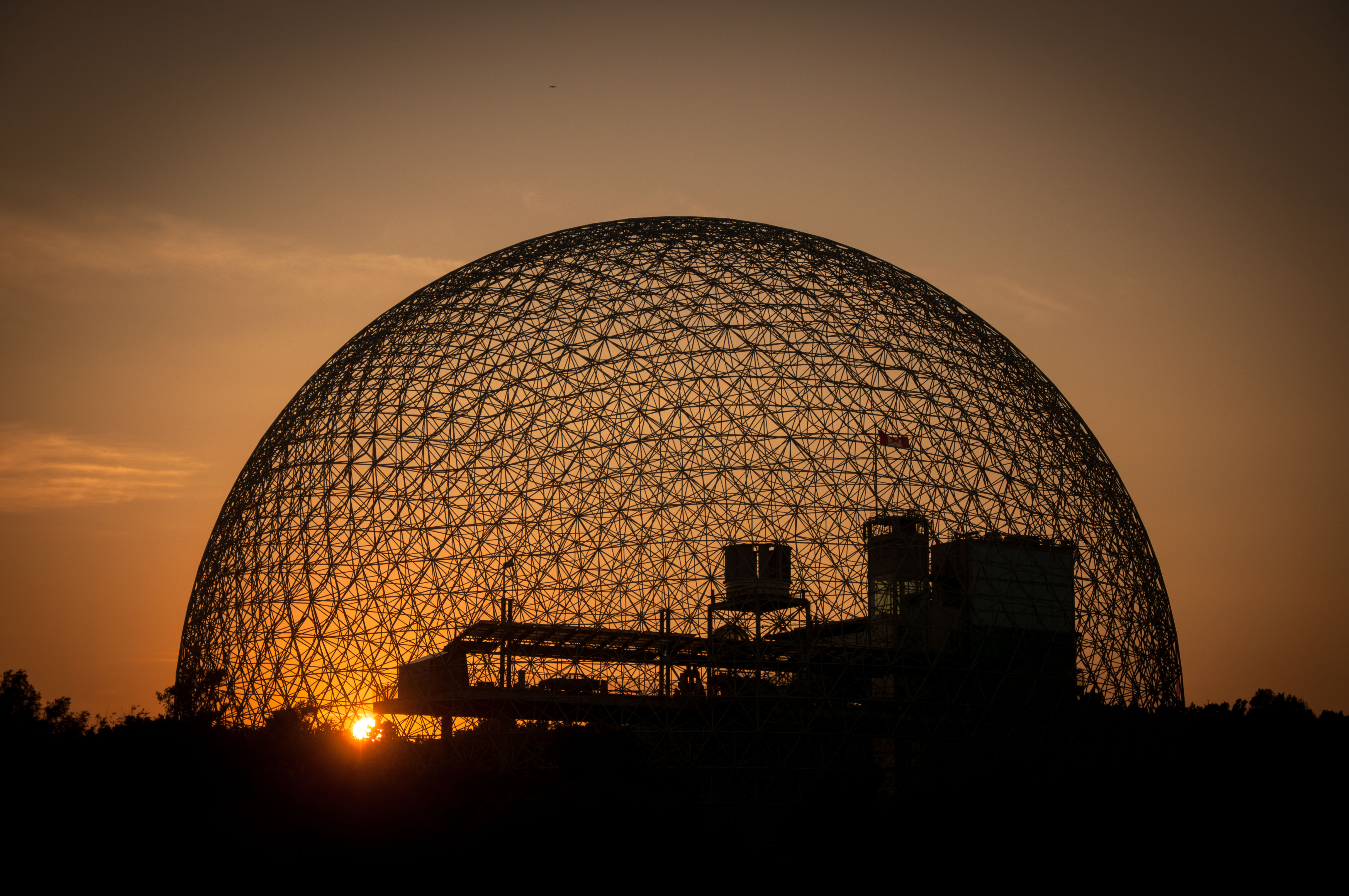
Montreal Biosphere: The Dome That Inspired a Molecule
The carbon molecule buckminsterfullerene got its name because Nobel laureate Harold Kroto looked at its structure and thought of this building. When a shape is so perfect that scientists see it reflected at the molecular level, something extraordinary is at work. The Montreal Biosphere sits on Saint Helen's Island in the middle of the Saint Lawrence River, a skeletal steel sphere that has been a Cold War showcase, an aviary, a fire-ravaged ruin, and an environment museum -- each chapter more improbable than the last. Designed by R. Buckminster Fuller with Shoji Sadao and Geometrics Inc. for the 1967 World's Fair, the geodesic dome was picked by The New York Times in 2021 as one of the 25 most significant works of postwar architecture. It earned that distinction not through preservation, but through transformation.
America Under Glass
Fuller's original vision was grander than what was built. He proposed a much larger dome with a suspended geodesic sphere inside it, serving as an interactive world map for his "World Game" project -- a simulation where players would make resource decisions for the entire planet. The version that opened on April 27, 1967, was still spectacular. Visitors ascended what was reported to be the longest unsupported escalator in the world to reach exhibit platforms where NASA spacecraft hung from the steel frame -- the Freedom 7, Gemini 7, and Apollo AS-202 capsules suspended in the dome's interior like ornaments. The mezzanine held the "American Spirit" exhibit: Indigenous crafts, guitars owned by famous musicians, folk art, a collection of dolls, and an array of nearly 300 hats representing different American regions and occupations. A gallery of Hollywood memorabilia and 22 large-scale works by contemporary American artists completed the picture. It was America as spectacle, wrapped in a structure that made the spectacle feel futuristic.
Birds, Baboons, and Burning
After Expo 67 closed, the United States donated the pavilion to Montreal. Renamed the Biosphere, it reopened in 1968 as an aviary and arboretum, with four suspended gardens and hundreds of birds filling the transparent enclosure. In 1972, a troop of baboons joined them, along with a Japanese garden and a children's area called Sleeping Beauty's Fantasy Land. By 1973, Hydro-Quebec had sponsored a conversion to an anti-pollution exhibit called "Man and His Environment." Then on May 20, 1976, a welding crew working on structural renovations sparked a fire that changed everything. The flames devoured the building's transparent acrylic bubble -- the skin that made the dome an enclosed space -- but the hard steel truss skeleton survived. For fourteen years, the Biosphere stood as an open-air steel lattice, a ghost of its former self. Plans came and went: suspended gardens, a concert venue, a recreational area called "Man at Play." None materialized. The city cleaned the structure and waited for a partner who never arrived.
A Museum Inside a Skeleton
In August 1990, Environment Canada committed $17.5 million to transform the ruin into something new. Architect Eric Gauthier designed a set of enclosed buildings that nestle inside the original steel skeleton, creating a museum-within-a-monument. The Biosphere reopened in 1995 as an interactive museum focused on the water ecosystems of the Great Lakes and Saint Lawrence River. In 2007 it broadened its scope to become a full environment museum, presenting exhibitions on water, climate change, air quality, ecotechnologies, and sustainable development. The dome lights up in different colors for special occasions -- rainbow hues during the COVID-19 pandemic in April 2020, green for World Environment Day in June 2022. In 2021, control passed from Environment Canada to Space for Life, Montreal's complex of nature museums that also includes the Botanical Garden and the Biodome.
Fuller's Living Architecture
Fuller designed the dome as a double-layer structure of steel and acrylic cells, with the inner and outer layers connected by a latticework of struts. A complex system of motorized shades controlled the interior temperature, mimicking biological processes -- Fuller likened the dome to human skin, with the shading system functioning like pores regulating body heat. The building's influence extended well beyond Montreal. Disney designer John Hench visited the Biosphere and expanded its three-quarter-sphere concept into the full sphere of Spaceship Earth at EPCOT Center, which opened in 1982. And when chemists Robert Curl, Harold Kroto, and Richard Smalley discovered a spherical carbon molecule in 1985, Kroto recalled his visit to Expo 67 and suggested naming the molecule buckminsterfullerene. That discovery won the 1996 Nobel Prize in Chemistry. Few buildings can claim to have inspired both a theme park icon and a Nobel Prize-winning molecular structure.
The Dome on the River
From the air, the Biosphere is unmistakable -- a steel lattice sphere rising from the green parkland of Parc Jean-Drapeau on Saint Helen's Island, surrounded by the waters of the Saint Lawrence. The island itself was the site of Expo 67, which drew over 50 million visits during its six-month run. The dome shares the park with the Circuit Gilles Villeneuve, home to the Canadian Grand Prix. What makes the Biosphere endure is its refusal to stay one thing. It has been a pavilion of American optimism, a home for tropical birds, a charred skeleton open to the rain, and a temple of environmental science. Each identity lasted roughly a decade before giving way to the next. The steel bones remain, as they have since 1967, holding whatever the city decides to put inside them.
From the Air
The Montreal Biosphere sits at 45.514N, 73.531W on Saint Helen's Island (Ile Sainte-Helene) in the Saint Lawrence River, within Parc Jean-Drapeau. The geodesic dome structure is highly visible from the air as a distinctive spherical lattice rising from the island's green parkland. The island also hosts the Circuit Gilles Villeneuve (Canadian Grand Prix). Nearby airports: Montreal-Trudeau International (CYUL) approximately 20 km west, Montreal-Saint-Hubert (CYHU) 15 km south. Best viewed at 2,000-4,000 feet AGL. The Jacques Cartier Bridge passes nearby to the north, and the Champlain Bridge lies to the southwest.