Montreal Central Station: The Invisible Hub Beneath the City
To transfer a train from Bonaventure Station to Tunnel Station in early 20th-century Montreal, it had to travel to Hawkesbury, Ontario -- a detour of over 100 kilometers. To move one from Tunnel Station to Moreau Station required an even more absurd route through Rawdon in the Laurentians. Canadian National Railway's terminals were scattered across the city like misplaced chess pieces, connected only by agonizing detours. The solution, authorized by the Canadian National Montreal Terminals Act of 1929, was radical: bore through a mountain, build an underground station, and stack the city on top of it. Montreal Central Station opened on July 14, 1943, and by the time the city finished building over it, you could walk directly above the platforms without knowing they existed.
Depression, War, and a Delayed Opening
The station was designed by John Schofield, architect-in-chief of Canadian National Railway, and construction began in 1926. The plan was ambitious: use the existing Mount Royal Tunnel to bring trains from the north and east into a large electrified station, while a new elevated viaduct would carry trains from the south and west. Air-rights development was built into the design from the start, modeled on New York's Grand Central Terminal and Penn Station. Then the Great Depression hit. Construction halted in 1930 and did not resume until 1939. When the station finally opened in 1943, it was wartime. The first trains were pulled by electric locomotives to avoid filling the underground tunnels with smoke, with engine changes happening at outlying points -- Bridge Street for southeastern routes, Turcot Yards for westbound, and Val Royal for northbound. A fleet of 14 electric locomotives handled the work. The station opened with 16 passenger tracks numbered 7 through 22, most of them terminal stubs, with only tracks 13 through 16 running through from the viaduct to the tunnel.
Art Deco in the Underground
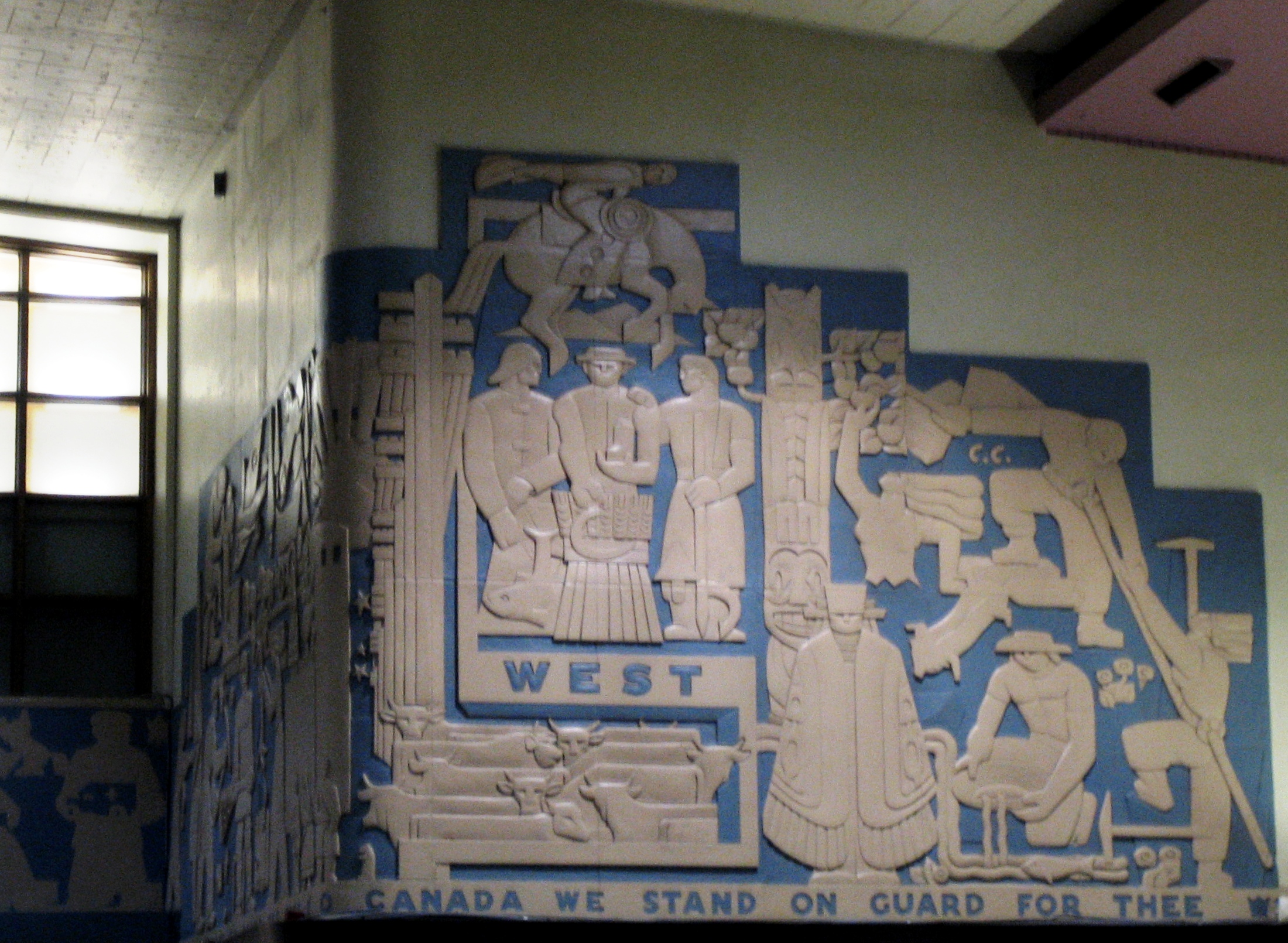
Central Station's architecture blends Art Deco with the international style, and its most striking features are hidden from casual view. The large concourse, designed by John Campbell Merrett, is illuminated by tall windows and flanked by two monumental bas-reliefs on the east and west walls, designed by Charles Comfort and carved by Sebastiano Aiello. The reliefs depict Canadian life, arts, and industry, and embedded in them are lyrics from "O Canada" -- French on the east wall, English on the west -- at a time when the anthem was still unofficial. On the north exterior wall, artist Fritz Brandtner created three chiseled stone reliefs of Mercury, Apollo, and Poseidon. Apollo is the largest, but good luck seeing any of them -- the construction of the Queen Elizabeth Hotel in 1958 obscured most of the exterior artwork. The 14 underground tracks are reached by seven stairwells, five equipped with escalators, and access is still controlled by ticket examiners who verify each passenger before allowing them onto the platforms.
The City That Grew Over It
The station's gradual disappearance beneath Montreal is one of the great feats of urban layering in North America. In 1948, ICAO built its headquarters over the northeast corner. In 1959, the Queen Elizabeth Hotel rose on the western portion -- the hotel where John Lennon and Yoko Ono would hold their famous 1969 Bed-In for Peace. In 1960, the old Tunnel Station building was demolished to make way for CNR's new headquarters. The Terminal Tower of 1966 completely hid the station from Dorchester Boulevard. Then came Place Ville-Marie to the north, with four skyscrapers and an underground shopping mall that became the seed of Montreal's famous Underground City -- the 20-mile network of pedestrian tunnels connecting metro stations, offices, and shopping complexes. Place Bonaventure was built directly over the tracks in the mid-1960s. Today, the only visible portion of Central Station's exterior is a small stretch along Belmont Street. Everything else has been absorbed.
Consolidation and Catastrophe
Central Station became the sole intercity terminal for Montreal through a gradual consolidation. When Via Rail was created in 1978 and absorbed Canadian Pacific's passenger trains, traffic from the rival Windsor Station was slowly redirected. The last Via trains switched from Windsor Station were the Quebec City services via Trois-Rivieres on April 29, 1984. Amtrak's Adirondack followed on January 12, 1986. Between those two milestones, tragedy struck. On September 3, 1984, a pipe bomb exploded inside a station locker, killing three people and injuring thirty. The bomber, retired American military officer Thomas Bernard Brigham, claimed he was protesting Pope John Paul II's visit to Canada. The station endured, as infrastructure does, absorbing the horror and continuing to function.
Crossroads of a Continent
Today Central Station sits at the heart of the Quebec City-Windsor Corridor, Canada's busiest intercity rail service area. Via Rail connects Montreal to Toronto, Ottawa, Quebec City, Halifax, and smaller communities as far as Gaspe and Senneterre. Amtrak's Adirondack runs daily to New York City via the Lake Champlain corridor. Exo commuter rail serves suburban lines to Mont-Saint-Hilaire and Mascouche. And since July 31, 2023, the station has served as a hub for the Reseau express metropolitain, Montreal's new automated light metro connecting the South Shore, North Shore, West Island, and Trudeau Airport. Nearly 11 million passengers pass through each year, making it Canada's second-busiest station after Toronto Union Station. The station is also linked to the Bonaventure metro station on the Orange Line, and through the underground city to McGill station on the Green Line. Nearly a century after its conception, the invisible station beneath the skyscrapers remains the point where Montreal's transportation lines cross.
From the Air
Montreal Central Station is located at 45.500N, 73.567W in downtown Montreal, but is almost entirely underground and invisible from the air. The station occupies the block bounded by De la Gauchetiere Street, Robert-Bourassa Boulevard, Rene Levesque Boulevard, and Mansfield Street, directly beneath Place Ville-Marie and adjacent to the Queen Elizabeth Hotel. The Mount Royal Tunnel entrance to the north and the rail viaduct approach from the south are the best aerial indicators of the station's location. Nearby airports: Montreal-Trudeau International (CYUL) 20 km west, Montreal-Saint-Hubert (CYHU) 15 km southeast. Best viewed at 3,000-5,000 feet AGL. The distinctive cruciform tower of Place Ville-Marie serves as the primary visual landmark.