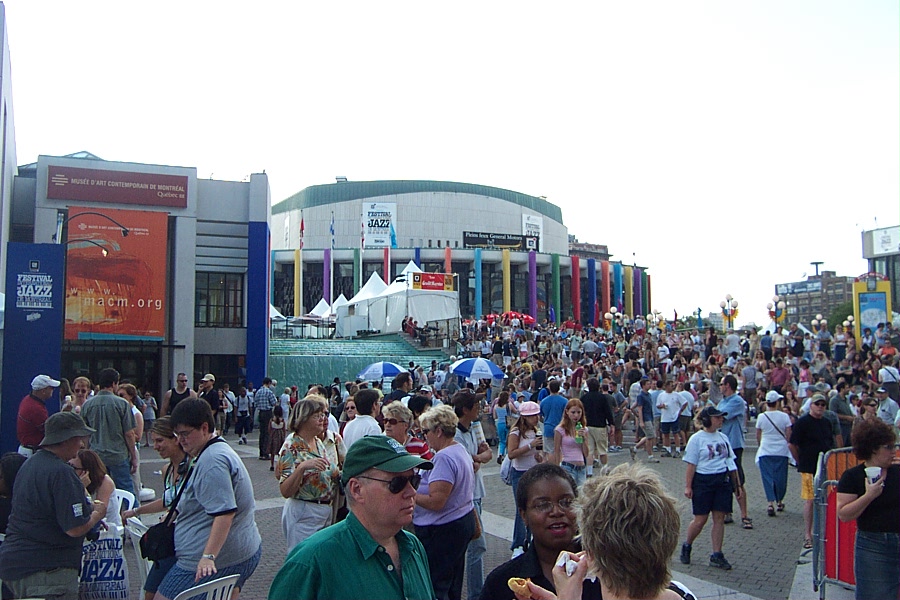
Montreal International Jazz Festival: The World's Largest Stage
On a May evening in 1980, Ray Charles sat at a piano in Montreal and played to a crowd of 12,000 people who had gathered for something that did not yet have a name. The Montreal Jazz Festival -- barely organized, precariously funded, conjured into existence by a promoter named Alain Simard who had spent the previous decade bringing American blues and jazz legends north of the border -- was officially underway. Gary Burton, Chick Corea, and Vic Vogel shared the bill that first weekend. Nobody knew it would grow into the largest jazz festival on Earth. By 2004, the Guinness Book of World Records made it official: more than 650 concerts, 3,000 artists from over thirty countries, 450 free outdoor performances, and over 2 million visitors pouring through downtown Montreal every summer. The festival did not just put Montreal on the jazz map. It redrew the map entirely.
A Dream That Almost Died Twice
Alain Simard had spent much of the 1970s working with Productions Kosmos, bringing artists like Chuck Berry, Dave Brubeck, Bo Diddley, John Lee Hooker, and Muddy Waters to perform in Montreal. In 1977, he partnered with Andre Menard and Denyse McCann to form Spectra Scene -- now known as L'Equipe Spectra -- with the ambition of creating a summer festival that would gather these artists together in one place at one time. They planned their inaugural festival for the summer of 1979. When funding fell through, the grand vision collapsed to two nights at the Theatre-St-Denis featuring Keith Jarrett and Pat Metheny. It was a beginning, barely. The following year, with backing from Alain de Grosbois of CBC Stereo and Radio-Quebec, the proper festival materialized. Montreal already had jazz festival precedent: Roue-Doudou Boicel had founded the Rising Sun Festijazz in 1978, and bassist Charlie Biddle had organized the three-day Jazz de Chez Nous in 1979. But Simard's vision was larger, and from that first 12,000-person weekend in 1980, it never stopped expanding.
Twenty Stages and Open Streets
The festival occupies the Quartier des Spectacles in downtown Montreal, centered around Place des Arts -- the city's premier performing arts complex. Over twenty stages range from intimate jazz clubs to the grand concert halls of Place des Arts, from cordoned-off street stages to terraced parks where crowds can occasionally swell past 200,000 for a single outdoor show. The genius of the festival's design is its layered accessibility: roughly 450 of its 650-plus concerts are free outdoor performances, drawing casual listeners who might stumble upon a Brazilian trio on one block and a New Orleans brass band on the next. For those willing to buy tickets, the indoor concerts offer headline performances in world-class acoustics. This mix of free and ticketed, outdoor and indoor, familiar and experimental, turns the entire downtown core into a living instrument for ten days each summer. About 12.5 percent of the festival's 2 million annual visitors are tourists, and 300 accredited journalists cover the event each year.
Sounds Captured on Tape
The festival has generated some of jazz's most celebrated live recordings. Miles Davis recorded tracks for his 1984 album Decoy at the festival. Ahmad Jamal's Live at the Montreal Jazz Festival 1985 captured the pianist at the height of his powers. Diana Krall's Live at the Montreal Jazz Festival became one of the best-selling jazz albums of 2004. Perhaps the most significant body of work to emerge from the festival is Charlie Haden's Montreal Tapes, a series of recordings from 1989 released across six albums on Verve Records between 1994 and 2003, featuring collaborations with Don Cherry, Ed Blackwell, Paul Bley, Paul Motian, Geri Allen, and Gonzalo Rubalcaba. These recordings document not just individual performances but a moment in jazz history when the festival had become a place where legends came to play with the freedom that only a dedicated jazz audience can inspire.
Breeding Ground for Canadian Jazz
Since 1982, the Concours de Jazz -- now the TD Grand Jazz Award -- has served as an annual competition for Canadian groups performing original music. The prize has launched some of the country's most prominent jazz careers, including pianist Lorraine Desmarais (1984), trombonist Hugh Fraser (1987), and pianist David Virelles (2006). The competition's history of name changes reflects four decades of corporate sponsorship shifts, from Alcan to du Maurier to General Motors to TD Bank, but the mission has remained constant: identify and elevate emerging Canadian jazz talent. Not everyone was satisfied. In 1999, a group of Montreal jazz musicians created L'OFF Festival de Jazz de Montreal as an alternative, arguing that the main festival did not showcase local talent sufficiently. L'OFF continues as a week-long annual event programmed largely by musicians themselves -- a testament to the depth of Montreal's jazz ecosystem and the creative tension that keeps it vital.
Silence, Then the Music Returns
In 2020, for the first time in its forty-year history, the festival was cancelled entirely due to the COVID-19 pandemic. What would have been the 41st edition simply did not happen. The streets around Place des Arts went quiet in July for the first time since 1979. The following year, the 41st edition was postponed to autumn, reduced to five days, and limited to outdoor performances only. Indoor shows returned in 2022. The pandemic pause did something unexpected: it reminded Montreal of exactly what the festival meant. The silence of those summers -- no saxophones echoing off Saint-Laurent Boulevard, no crowds spilling between stages after midnight, no impromptu sessions in the bars along Sainte-Catherine -- made the return feel less like a resumption and more like a reunion. The festival endures because it belongs to the city in a way that transcends any single year or lineup. It is the sound Montreal makes when summer arrives.
From the Air
The Montreal International Jazz Festival is centered at 45.500N, 73.567W in the Quartier des Spectacles area of downtown Montreal, around Place des Arts. From the air, the festival area is identifiable by the large open plazas and pedestrian zones east of the Bell Centre and south of the Complexe Desjardins. Nearby airports include Montreal-Trudeau International (CYUL) approximately 20 km west and Montreal-Saint-Hubert (CYHU) 15 km southeast. Best viewed at 3,000-5,000 feet AGL during the festival's summer dates (typically late June to early July), when outdoor stages and large crowds are visible in the streets. Mount Royal rises to the northwest, and the Old Port district lies to the south along the St. Lawrence River.