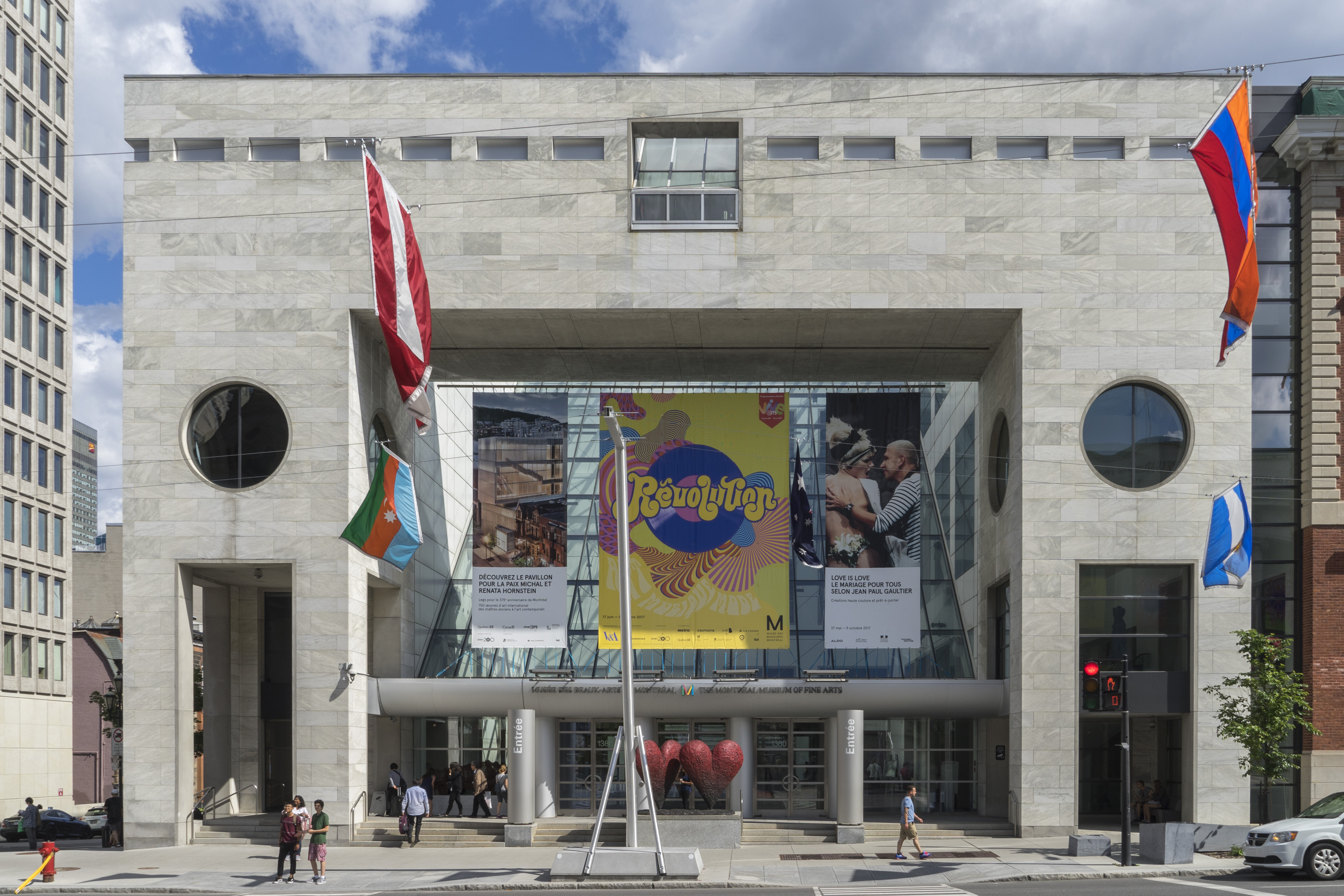
Montreal Museum of Fine Arts
On September 4, 1972, armed thieves climbed through a skylight on the roof of the Montreal Museum of Fine Arts, tied up three security guards, and walked out with 18 paintings, jewellery, and figurines worth $2 million. Among the haul was a rare Rembrandt landscape. More than fifty years later, the paintings have never been recovered, and the thieves have never been identified. The heist is Canada's largest art theft -- and it is only one chapter in the extraordinary 165-year history of a museum that began when an Anglican bishop persuaded Montreal's elite that their city deserved a gallery worthy of its ambitions.
A Bishop's Gift and a Businessman's Wager
Anglican bishop Francis Fulford founded the Art Association of Montreal in April 1860, making it the oldest art institution in Canada. For its first two decades, the association drifted between borrowed venues, unable to store or display a permanent collection. That changed in 1877 when Benaiah Gibb, a Montreal businessman, offered a transformative gift: 72 canvases, 4 bronze sculptures, a building site on the northeast corner of Phillips Square, and $8,000 in cash -- on the condition that a proper museum be built within three years. The association met the deadline. On May 26, 1879, the Governor General inaugurated the Art Gallery of the Art Association of Montreal, the first building in Canadian history constructed specifically to house an art collection. Gibb's gamble worked: donations multiplied as the public's appetite for fine art grew.
The Move to the Golden Square Mile
By the early 1900s, the Phillips Square gallery had become hopelessly cramped. The Art Association looked west to the Golden Square Mile, the neighborhood where Montreal's financial elite built their mansions along Sherbrooke Street. Senator Robert Mackay sold the site of the abandoned Holton House at a favorable price, and a committee of the city's most powerful men -- James Ross, Richard B. Angus, Vincent Meredith, Louis-Joseph Forget, and David Morrice -- oversaw the project. Brothers Edward and William Sutherland Maxwell, trained in the Beaux-Arts tradition, designed a building that was sober and majestic, blending classical proportions with French refinement. On December 9, 1912, Prince Arthur, Duke of Connaught, inaugurated the new museum before 3,000 guests. That Beaux-Arts pavilion, now named the Michal and Renata Hornstein Pavilion, still anchors the museum campus on the north side of Sherbrooke Street.
The Skylight Caper
The 1972 robbery remains one of the art world's great unsolved mysteries. The thieves entered through the skylights and descended into the galleries with alarming efficiency. Among the stolen works were pieces by Delacroix, Gainsborough, Corot, and the Rembrandt landscape that The Globe and Mail later estimated would be worth at least $1 million. One painting -- initially attributed to Jan Brueghel the Elder but later reattributed to a student -- was returned by the thieves to open ransom negotiations. Nothing else ever came back. With the insurance payout, the museum purchased a large Peter Paul Rubens painting called The Leopards, promoted as the biggest Rubens in Canada. Years later, pigment testing revealed the red paint was mixed around 1687, four decades after Rubens died. It was reattributed to his students and quietly removed from display in 2007. The museum had been robbed, and then fooled by its own replacement purchase.
Five Pavilions, One Street
Today the museum sprawls across five pavilions on both sides of Sherbrooke Street, connected by underground passages. The Liliane and David M. Stewart Pavilion, a modernist concrete structure designed by Fred Lebensold, opened in 1976 and houses nearly 900 objects of decorative art and design. Moshe Safdie's Jean-Noel Desmarais Pavilion arrived in 1991, cleverly incorporating the facade of the 1905 New Sherbrooke Apartments into its contemporary design. The Claire and Marc Bourgie Pavilion, opened in 2011, converted a Romanesque Revival church with Tiffany stained glass -- a National Historic Site dating from 1893 -- into a showcase for Quebec and Canadian art. The newest addition, the Michal and Renata Hornstein Pavilion for Peace, inaugurated in 2016, won a Governor General's Medal in Architecture in 2018 and made the campus the eighteenth largest art museum in North America. The permanent collection now encompasses approximately 44,000 works spanning continents and millennia.
Reckonings and Returns
The museum's relationship with its own collection has not always been straightforward. In 1964, the Budapest Museum of Fine Arts demanded the return of a 16th-century Giorgio Vasari painting that had appeared in a 1952 catalog of war losses. In 2013, the museum returned Gerrit van Honthorst's The Duet to the heirs of Jewish art collector Bruno Spiro, from whom it had been confiscated by the Nazis. The museum now publishes an online list of artworks with incomplete provenances for the years 1933 to 1945. More recently, the institution has invested deeply in Indigenous art, doubling its Inuit art galleries and allocating more than ten percent of its annual budget to expanding its Indigenous collection. In 2023, it hired its first curator of Indigenous arts. The museum that began as a Victorian gentleman's club for Anglophone connoisseurs has become something far more expansive -- a five-pavilion campus that wrestles openly with questions of ownership, restitution, and whose stories deserve wall space.
From the Air
The Montreal Museum of Fine Arts sits at 45.50N, 73.58W on Sherbrooke Street West in the Golden Square Mile district. From the air, the museum's five pavilions straddle both sides of Sherbrooke Street, with the Beaux-Arts Hornstein Pavilion and the modernist Desmarais Pavilion facing each other. Best viewed from 2,000-3,000 feet AGL. Montreal/Pierre Elliott Trudeau International Airport (CYUL) lies 10 nm to the west. Montreal/Saint-Hubert Airport (CYHU) is 10 nm to the southeast. Mount Royal rising immediately to the north provides a dominant visual reference.