Montrose Air Station Museum
On 26 February 1913, two Royal Flying Corps biplanes touched down on a grass field beside the Angus coast. It was an unremarkable landing on an unremarkable strip of ground, but it marked the opening of the first operational military airfield in Great Britain. Montrose Air Station would train the pilots who flew the earliest combat missions over France, produce aces and innovators, and remain active through both world wars before finally closing in 1952. The museum that now occupies the surviving buildings preserves that story - from canvas-and-wire biplanes to Spitfires funded by the pennies of local schoolchildren.
First to Fly
The Royal Flying Corps chose Montrose for practical reasons: the flat coastal terrain offered long approaches free of obstacles, the prevailing winds were manageable, and the site was far enough from populated areas to reduce the risk to civilians from what was still a hazardous and experimental form of transport. No. 2 Squadron RFC established the station, and it quickly became a centre for pilot training. The aircraft were fragile - B.E.2 biplanes with 70-horsepower engines, open cockpits, and a tendency to kill their pilots in routine training as readily as in combat. When war was declared in August 1914, Lieutenant H.D. Harvey-Kelly of No. 2 Squadron earned the distinction of being the first RFC pilot to land in France, flying his B.E.2a across the Channel on 13 August. He took off from Dover, but he had learned to fly at Montrose.
Training Ground for Two Wars
Throughout the First World War, Montrose trained hundreds of pilots who went on to fly over the Western Front. The casualty rates among trainee pilots were grim - underpowered aircraft, limited instruments, and the Angus weather conspired to make training almost as dangerous as combat. The station closed briefly after 1918 but reopened in 1936 as war again loomed. During the Second World War, it served as a training base for fighter and bomber crews, and its coastal position made it a target. German aircraft attacked the station on several occasions, and anti-aircraft defences were installed along the perimeter. The pilots who trained here during the Second World War flew Hurricanes, Spitfires, and the twin-engine aircraft that served Coastal Command's patrols over the North Sea.
The Red Lichtie Spitfire
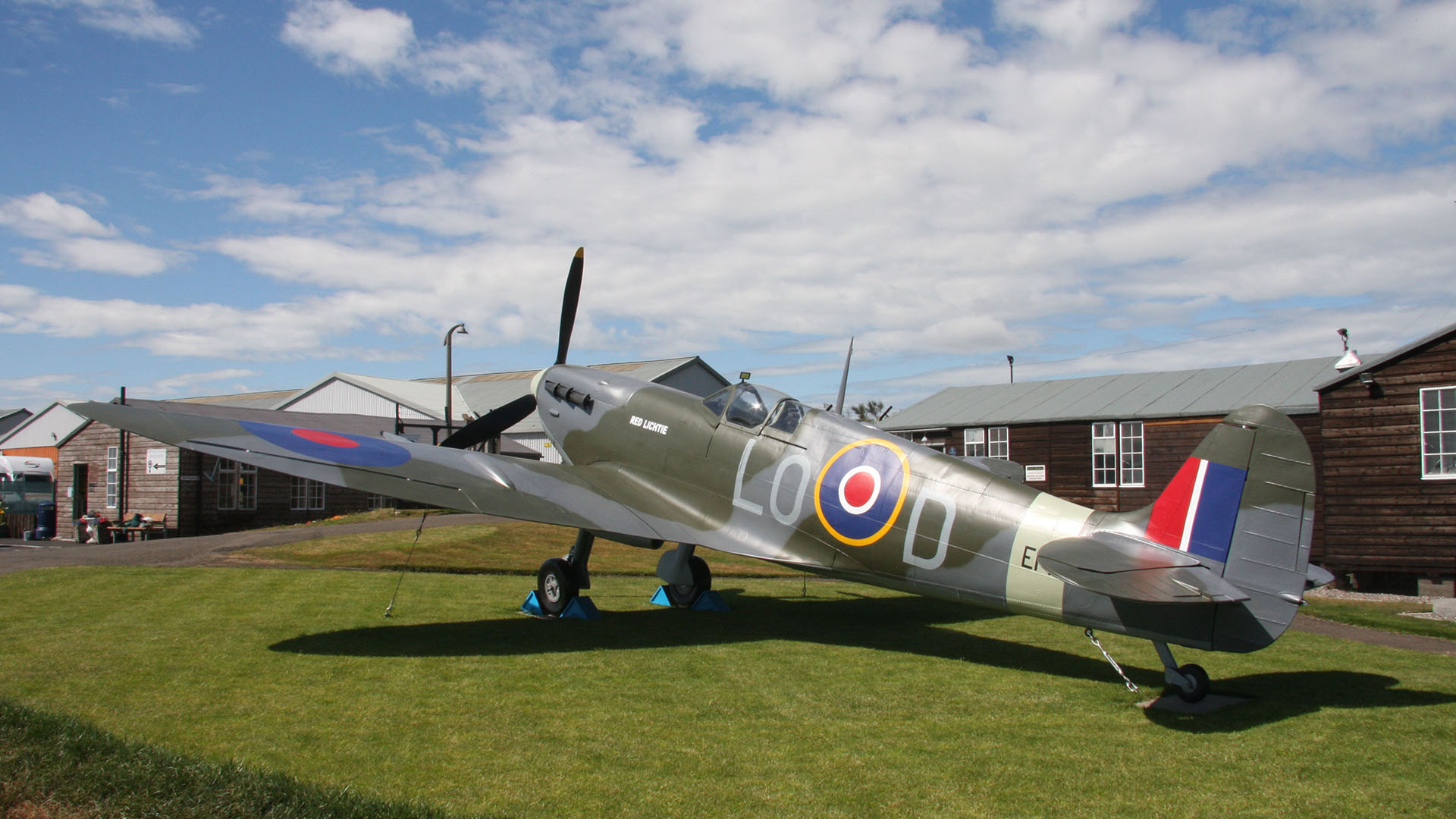
In 1942, the people of nearby Arbroath - known locally as 'Red Lichties' after the red warning light that once marked their harbour - raised five thousand pounds to buy a Spitfire for the RAF. It was a remarkable sum, equivalent to roughly a quarter of a million pounds today, collected from a fishing town during wartime austerity. The aircraft, a Spitfire Vb, was duly delivered and marked with the town's name. The museum now houses a replica of this Spitfire, along with replicas of a First World War B.E.2a and a Sopwith Camel. These are not models behind glass cases but full-scale reconstructions that fill the original hangars, giving visitors a visceral sense of the machines' scale and fragility.
The Heritage of the Hangars
The museum occupies the original station buildings, including hangars, workshops, and administrative blocks that date from the earliest years of military aviation. The architecture itself tells a story - these were buildings designed for a technology that barely existed, improvised structures that evolved as the aircraft they housed grew larger, faster, and more complex. The watch office, the dispersal huts, and the technical blocks are preserved as they were, their wartime identities still legible in the layout and the paint on the walls. The collection includes personal effects, uniforms, logbooks, and photographs that put faces and names on the statistics of two world wars. A memorial garden honours the aircrew who died during training and operations from the station.
Where Aviation Began
Montrose Air Station closed in 1952, and the airfield eventually returned to agricultural use. The museum, run by volunteers, preserves what remains. Its significance lies not in its size or its collection, impressive though both are, but in its primacy. This is where British military aviation began - not at Farnborough or Hendon, but on a grass strip beside the North Sea in Angus. The pilots who trained here in 1913 and 1914 were pioneers in the most literal sense, flying machines that were barely five years old over a landscape that had known nothing faster than a horse. The museum captures that transition: from a world without flight to a world defined by it, all within the span of a single generation and a single airfield.
From the Air
Montrose Air Station Museum is located at approximately 56.726°N, 2.462°W on the Angus coast, just northeast of Montrose. The former airfield site is identifiable from the air by the remaining hangars and buildings on flat coastal ground. The Montrose Basin, a tidal lagoon and nature reserve, is immediately to the south. Nearest active airport is Dundee Airport (EGPN), approximately 28 miles south-southwest. The coastline and flat agricultural land surrounding the site reflect the same terrain that made it suitable for aviation in 1913.