Montserrat
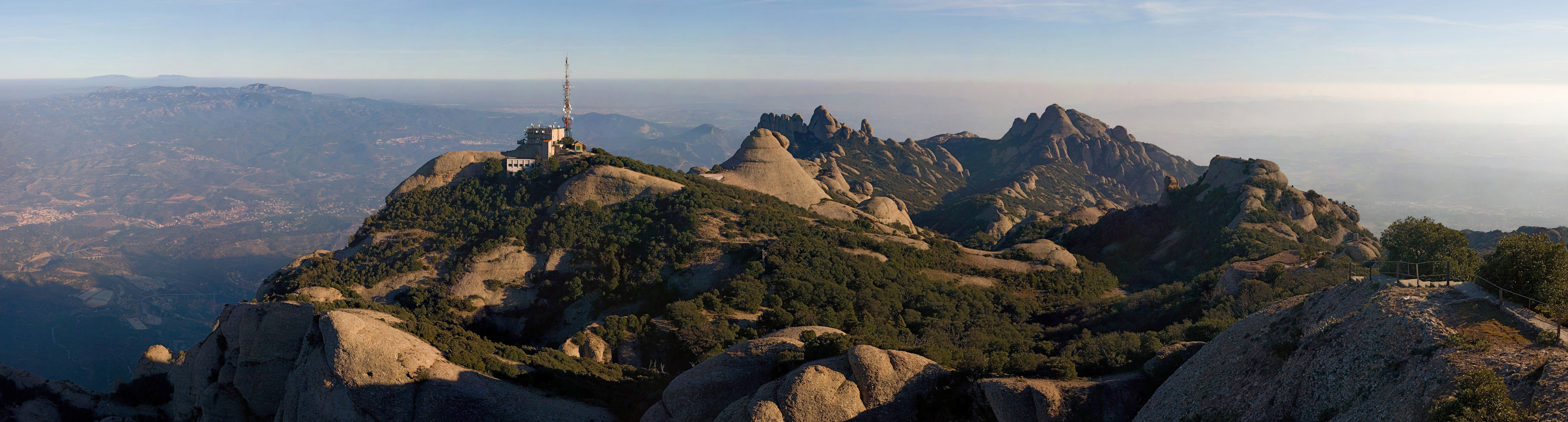
The name is a description. Montserrat -- serrated mountain in Catalan -- looks exactly like what it says: a jagged ridge of rounded pillars and fingers punching skyward from the flat country northwest of Barcelona. From a distance, the silhouette is unmistakable, a saw blade of pale pink rock that seems to belong to a different geological era than the gentle hills surrounding it. It does. These towers are the remains of a 40-million-year-old fan delta, conglomerate rock so resistant to erosion that it has outlasted the softer sediments of the Ebro Basin and risen into one of the most distinctive mountain profiles in all of Europe.
Stone Teeth of the Eocene
Montserrat's geology reads like a chapter from deep time. During the middle Eocene, rivers draining the rising Catalan Coastal Ranges dumped vast quantities of sediment into the western margin of the Ebro Basin, building a fan delta that originally covered between 100 and 150 square kilometers. The clasts -- rounded cobbles and boulders of Triassic limestone -- were cemented together by calcite into a conglomerate so durable that, while the softer basin fill around it eroded away, the fan delta stood firm. The result is Montserrat: a mountain made not of volcanic fire or tectonic uplift but of persistence, the slow victory of hard rock over soft. The dominant limestone in the conglomerate has also created karst features -- caves and towers shaped by water dissolving carbonate -- adding another layer of sculptural complexity to an already extraordinary landscape.
The Sacred Mountain
Montserrat's spiritual significance is inseparable from its physical presence. The Benedictine abbey of Santa Maria de Montserrat, founded in 1025, nestles into the crags partway up the mountain, a human settlement dwarfed by the rock formations above and around it. The monastery houses the Virgin of Montserrat, a Romanesque wooden statue known affectionately as La Moreneta -- the little dark one -- and venerated as the patron saint of Catalonia. Legend places the statue's discovery around 880, and pilgrims have been climbing the mountain ever since. Groups of young people from Barcelona and across Catalonia still make overnight hikes to watch the sunrise from the heights, a tradition that blends the secular with the sacred in a way that feels natural on a mountain this dramatic.
Peaks, Paths, and Iron Rungs
The highest summit, Sant Jeroni, stands at 1,236 meters above sea level. From the top, on a clear day, almost all of Catalonia spreads out below, and the island of Mallorca is visible across the Mediterranean. Hiking trails connect Sant Jeroni with the monastery and the base of the mountain, while the Sant Joan funicular offers a mechanical shortcut to the upper slopes. Montserrat is part of the GR 172 long-distance footpath, and the mountain draws climbers as well as hikers. The Cavall Bernat, a distinctive rock tower reaching 1,111 meters, is a classic climbing objective, and the via ferrata Canal de las Damas, graded at difficulty level D, provides a protected route through one of the mountain's steep canals from the village of Collbato. The mountain was designated a Natural Park in 1987, formalizing protections for a landscape that Catalonia had long considered sacred.
A Mountain That Traveled the World
Montserrat's fame spread far beyond Catalonia. Christopher Columbus reportedly named the Caribbean island of Montserrat after this mountain, and in 1606, the Spanish expedition of Luis Vaez de Torres charted an island in the Torres Strait as Santa Maria de Montserrate, struck by its resemblance to the Catalan original. In Bogota, the Monserrate mountain -- at 3,152 meters, considerably taller than its namesake -- was named in homage and even has a funicular and aerial lift echoing those at Montserrat. The mountain's distinctive profile made it a reference point, a shape so particular that explorers reaching unfamiliar shores reached for its name when they encountered peaks that reminded them of home.
From the Air
Located at 41.61N, 1.81E, Montserrat rises prominently from the Catalan lowlands approximately 48 km northwest of Barcelona. The serrated rock formations are unmistakable from altitude, with Sant Jeroni peaking at 1,236 m (4,055 ft). Nearest major airport is Barcelona-El Prat (LEBL). The mountain sits within the Catalan Pre-Coastal Range and is visible from great distance on clear days. Recommended viewing altitude 4,000-6,000 feet to appreciate the dramatic contrast between the flat surroundings and the jagged peaks.