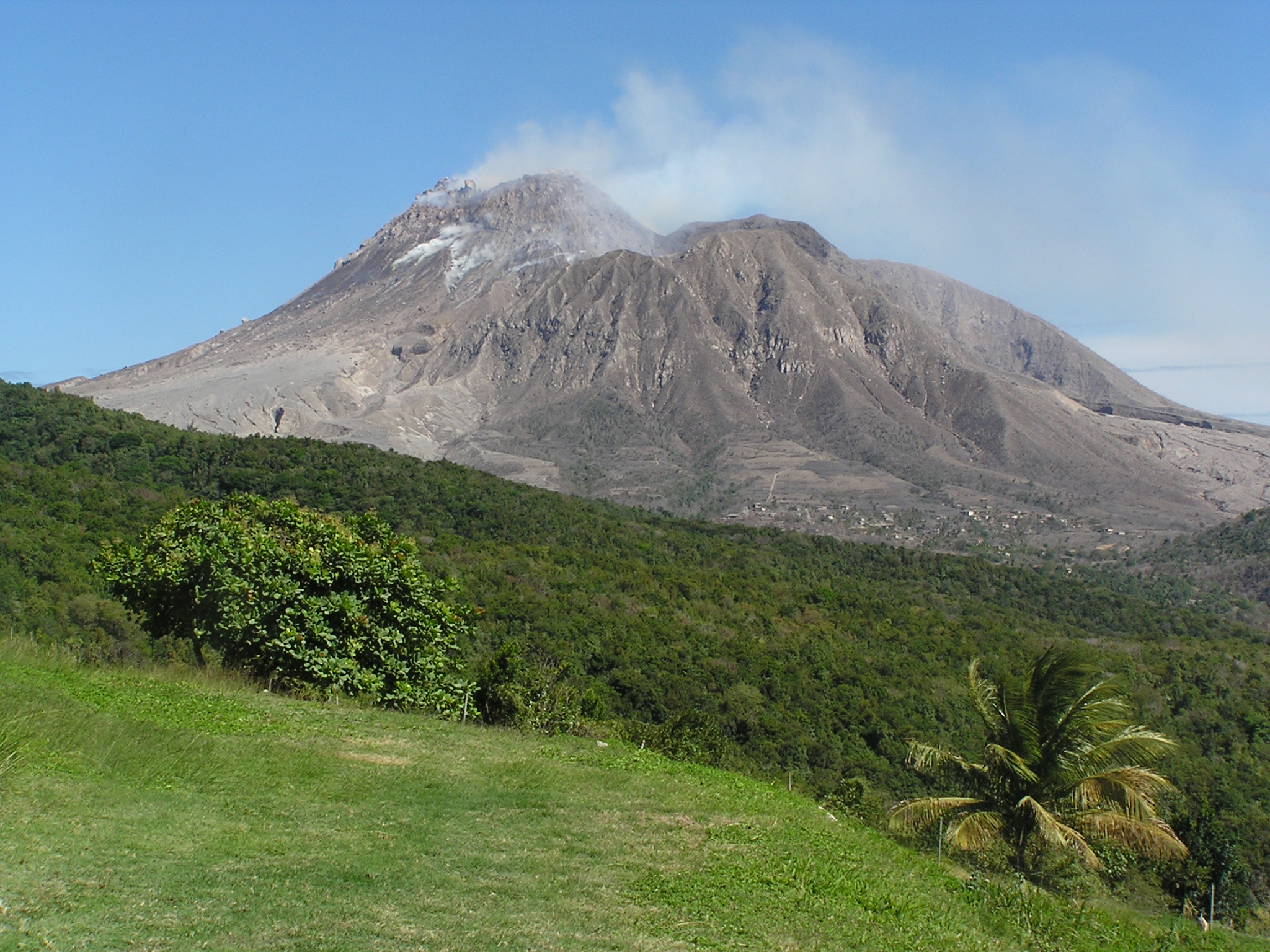
Montserrat Volcano Observatory
Until July 1995, nobody on Montserrat was particularly worried about the Soufrière Hills. The volcano had been silent for centuries -- so long that Plymouth, the island's capital, had grown up within easy reach of its slopes. Then, on 18 July 1995, the first phreatic explosions ripped through the summit, and the Montserrat Volcano Observatory was born out of necessity. Scientists from the University of the West Indies Seismic Research Unit arrived to set up an operational base almost immediately, building the monitoring infrastructure from scratch while the ground shook beneath them. What began as an emergency field station has evolved into one of the world's most sophisticated volcano observatories, a permanent institution that tracks every tremor, every gas emission, every shift in the dome that grows and collapses atop the Soufrière Hills.
Built Where the Danger Dictates
The MVO sits in the village of Flemmings, near Salem in the parish of St. Peter, on the western side of Montserrat. This is not where you would build an observatory if you had a choice. It is where you build one when a volcano has already destroyed the southern half of your island and you need eyes on it from whatever safe ground remains. The original monitoring station had to be relocated as the eruption's reach expanded -- the volcano kept redrawing the map of what counted as safe distance. The current building, managed by the Seismic Research Centre of the University of the West Indies, houses the instruments that keep Montserrat's remaining population informed about whether they can stay in their homes on any given day. The observatory's hazard level system divides the island into colored zones: green for unrestricted, yellow for daytime access, orange for controlled access, and red for authorized personnel only.
Science Under Political Pressure
The volcanologists who arrived in 1995 walked into a nightmare that was scientific, humanitarian, and political all at once. They faced a volcano that had been dormant for so long that no living scientist had studied its behavior. The eruption was high-profile and hard to predict, and every assessment they offered carried life-or-death consequences for thousands of people. Political pressure was immense. Officials wanted certainty -- evacuation orders disrupted lives, damaged the economy, and created refugees. Scientists could offer only probabilities. After initial difficulties in communicating risk, the MVO team developed statistical models to estimate the likelihood of specific events, a method that was subjective but allowed them to incorporate local knowledge and growing experience. A 2012 academic study used the Montserrat eruption as a case study in how scientists generate and communicate expert advice during volcanic crises, drawing on interviews with researchers in the UK, Montserrat, Italy, and Iceland.
Watching the Dome Breathe
The Soufrière Hills volcano operates on a cycle that the MVO has spent decades learning to read. Lava domes grow at the summit, building steadily for months or years until they become unstable and collapse. Those collapses generate pyroclastic flows -- superheated avalanches of rock, ash, and gas that race down the mountainside at highway speeds. Between dome collapses come periods of ash venting and explosive eruptions. The observatory monitors this cycle through seismometers, gas analyzers, GPS stations, and visual observation. A multi-component gas analyzer system tracks volcanic degassing, detecting the subtle chemical signatures that signal rising magma before it reaches the surface. The volcano's last eruption was in 2013, but the MVO continues its watch. Silence, as the observatory's history teaches, is not the same as safety.
A Rotating Guard
The MVO's leadership reads like a relay race run over three decades. In its early years, chief scientists rotated through rapidly -- the posting was demanding, remote, and unpredictable. Since 2000, a succession of directors has guided the observatory through the volcano's most active periods and its quieter intervals: Dr. Simon Young, Dr. Peter Dunkley, Dr. Gill Norton, and others, each inheriting the accumulated knowledge of their predecessors. Dr. Paul Cole served the longest modern tenure, from 2009 to 2013, overseeing the observatory during the volcano's most recent eruptive phase. Dr. Rod Stewart followed with a six-year term through 2019, and Dr. Graham Ryan has led the MVO since then. Each director has had to balance scientific rigor with the practical reality that their assessments determine whether families stay or leave, whether businesses open or close, whether Montserrat functions as a livable place or an evacuation zone.
From the Air
Located at 16.75°N, 62.21°W on the western coast of Montserrat, in the village of Flemmings near Salem. From the air, the observatory's position makes geographic sense -- it sits in the safe northern zone, with a clear line of sight to the Soufrière Hills volcano to the south and southeast. The contrast between the green, inhabited north and the ash-grey devastation of the south is stark and unmistakable from altitude. The dome atop the volcano changes shape over months and years, and the pyroclastic flow deposits are visible as grey fans extending from the mountain toward the coast. Nearest airport: John A. Osborne Airport (TRPM) in the island's north. Antigua (TAPA) is approximately 27nm northeast. For the best view of the volcano and observatory relationship, approach from the west over the Caribbean Sea.