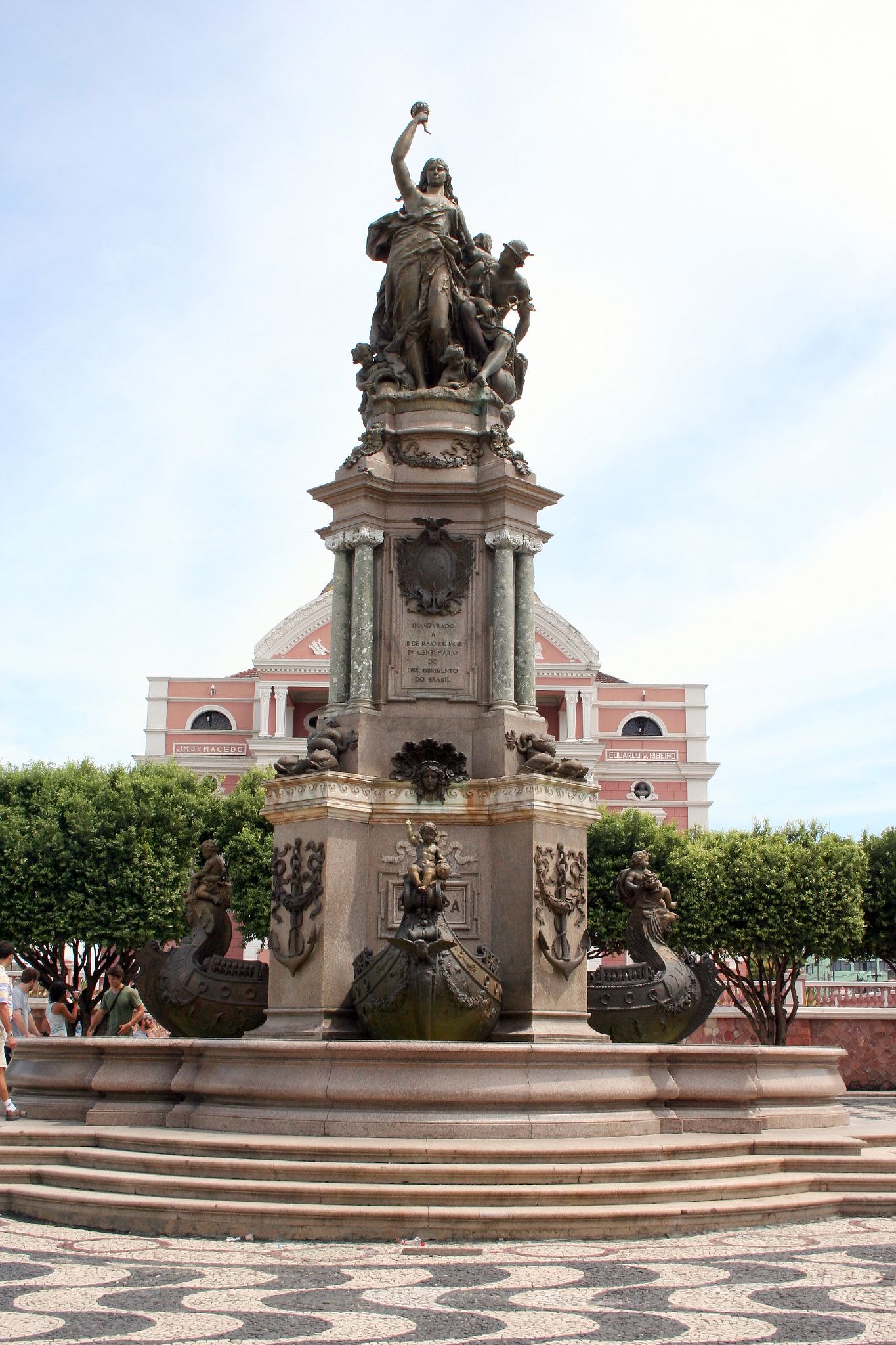
Monument Abertura dos Portos
Before 1866, no foreign ship could legally enter the Amazon. The river and its tributaries belonged to Brazil, full stop - a closed commercial system dating from Portuguese colonial policy and maintained by Brazilian independence. Merchant captains watching from the Atlantic could see the river's muddy plume stretching fifty miles out to sea and know they could not enter. That changed on December 7, 1866, when D. Pedro II signed an imperial decree opening the ports of the Amazon River to international trade, effective beginning the following year. A third of a century later, in 1900, a grateful city celebrated by erecting a monument on the Largo de Sao Sebastiao, directly in front of the Amazon Theater. Four stone ships. Four continents. One central woman holding a torch. The marble and bronze announced that Manaus had become - briefly, magnificently - a world port.
The Opening That Changed the River
The 1866 opening of the Amazon was politically radical for its time. For three centuries Portuguese and then Brazilian policy had reserved the river's trade for national flags. Opening it meant British, French, German, and American ships could now sail up the Amazon to Manaus and beyond, buying rubber, Brazil nuts, and timber directly at source. The decision coincided with the acceleration of rubber demand in industrializing North America and Europe, and together the two forces remade the Amazon economy. Within a decade, Manaus had transformed from a frontier trading post into a boom town with electric streetlights, paved streets, and foreign consulates. The monument, inaugurated in 1900, looked back on that transformation with the self-congratulation of a city at its commercial peak. No one yet knew the boom would collapse within fifteen years.
Four Ships, Four Continents
The monument reads as an allegorical atlas. At the quadrangular pedestal, four faces carry sculpted ships - one for each continent that traded with Manaus. Africa's vessel sits atop an Egyptian head, with Egyptian motifs around it; a boy on the prow holds two elephant tusks. Europe's vessel features an eagle at the bow; the seated boy holds a globe. Asia's vessel is marked by a croissant - a stylized crescent meant to symbolize Islam - with ancient characters carved at the bow and the boy sitting astride a lion. The Americas' vessel groups together decorative motifs of the New World; the boy sits at the bow while a snake coils around the keel. The iconography is nineteenth-century European in its symbolic conventions - the Orientalist imagery of Africa and Asia, the lion and snake as continental avatars. Read today, it tells us as much about how the Manaus elite saw the world as about the world itself.
Mercury and the Amazon
Atop the monument stands the Roman god Mercury - divine patron of commerce and industry, herald and messenger. Mercury is a common figure in nineteenth-century commercial monuments; he appears on bank facades and stock exchanges across Europe and the Americas. What makes this monument distinctive is the figure below him. The main sculpture is a woman representing the Amazon itself. She holds a torch in her right hand. Her left hand rests on Mercury's shoulder. The composition is explicit: the Amazon leads, Mercury follows. The river that had been closed is now paired with commerce, carrying trade up its waters with a torch to light the way. The allegory is paternalistic and colonial in its assumptions - the female figure as personification, the god of commerce legitimating exploitation - but its symbolism was meant proudly in 1900. The rubber barons who paid for this monument saw themselves as Mercury's heirs.
Imported Everything
The marble came from Italy. The bronze was cast in Europe. The granite was quarried abroad. Like most of the ambitious building projects of rubber-boom Manaus, the monument to the opening of the ports was assembled from materials the region did not produce - shipped up the Amazon on the very foreign vessels whose access the monument celebrated. The irony is worth noting. A monument built to mark the opening of the Amazon to foreign trade was itself a product of that trade, constructed almost entirely from components that arrived on ships the city had previously barred. The monument also bears the date November 15, 1889 - the Proclamation of the Republic of Brazil - and carries the name of Jose Cardoso Ramalho Junior, governor of Amazonas State when the work was commissioned. History layers here, the city's memory of its political milestones inscribed alongside its economic ones.
Patterns in Stone and Sidewalk
Look down at your feet in the Largo de Sao Sebastiao and you will see sinuous black-and-white curves radiating across the pavement. The design is meant to symbolize the Meeting of the Waters - the famous confluence east of Manaus where the black Rio Negro runs beside the tan Solimoes without mixing for kilometers. Years later, architects working on Copacabana Beach in Rio de Janeiro adopted a similar wave pattern for that world-famous boardwalk. The Manaus pavement came first. In 1995, the prefecture of Manaus restored the entire square, cleaning the monument and renewing the stonework. Today the Largo is one of the city's most photographed spots, with the pink Amazon Theater rising behind the monument and the wave-patterned stones underfoot connecting Manaus's memory to Brazil's most famous beach. The local version remains less famous than its imitator. That is often how things go, in the Amazon and elsewhere.
From the Air
Located at 3.1303 S, 60.0225 W, in the Largo de Sao Sebastiao of downtown Manaus, directly in front of the Amazon Theater. Manaus Air Force Base (SBMN) is 4 km south; Eduardo Gomes International Airport (SBEG/MAO) is 20 km north. From the air, the monument is visible as a sculpted pillar with bronze and marble work at the center of the square, surrounded by the distinctive wave-pattern pavement. Recommended viewing altitude 1,500-3,500 feet for the historic downtown context - the monument sits at the cultural heart of Manaus near the pink Teatro Amazonas, Sao Sebastiao Church, and Palace of Justice.