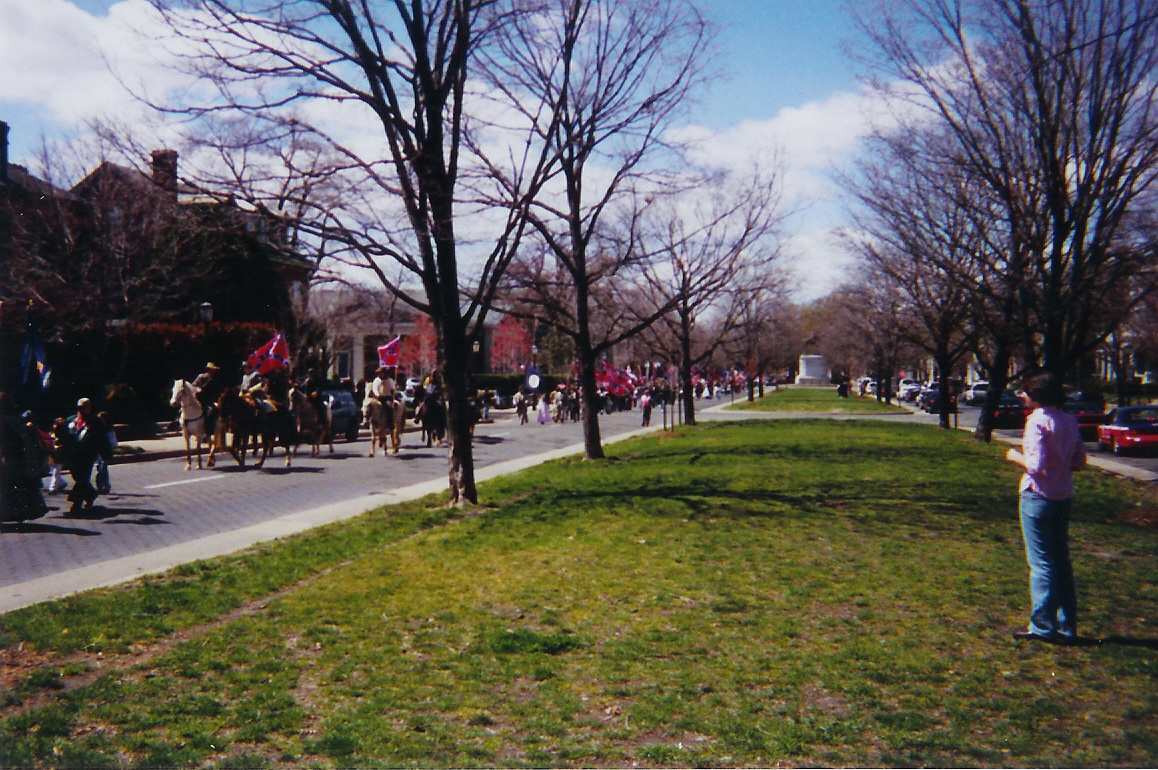
Monument Avenue
For over a century, five bronze figures towered above the oak-lined median of Monument Avenue, casting long shadows across one of America's grandest residential boulevards. By September 2021, every one of them was gone. The story of Monument Avenue is not simply a tale of statues raised and statues removed. It is the story of Richmond itself -- a former Confederate capital that spent 130 years building a mythology in bronze and stone, then dismantled it in a matter of weeks.
A Boulevard Born of Grief and Pride
The avenue began with a death. When Robert E. Lee died in 1870, Richmond citizens launched a campaign for a memorial statue. City plans from 1887 show the proposed site: a circle of land owned by wealthy Richmonder Otway C. Allen, just beyond the end of West Franklin Street. The vision went far beyond a single monument. Planners imagined a grand avenue extending westward, lined with trees along a central grassy median, following the fashionable City Beautiful style of urban design. The Lee Monument was dedicated in 1890, the first and largest on the street. Between 1900 and 1925, Monument Avenue exploded with architecturally significant houses, churches, and apartment buildings designed by firms including John Russell Pope and William Bottomley. Statues of J.E.B. Stuart, Jefferson Davis, Stonewall Jackson, and Matthew Fontaine Maury followed, turning the boulevard into an open-air shrine to the Lost Cause. The American Planning Association later named it one of the ten great streets in America for 2007, citing its historical residential design and diversity of land uses.
Gilded Age Grandeur and Quiet Decline
The Fan District section of Monument Avenue is lined with mansions from the end of the Gilded Age, their elaborate facades a catalog of Colonial Revival, Georgian, and Gothic styles. The Museum District stretch features a mix of large houses, apartment buildings, and smaller residences. For decades, this was where Richmond's upper class lived. But beginning in the 1950s and accelerating through the 1960s, many grand homes were subdivided into apartments or boarding houses as wealthy families decamped for newer suburbs in Henrico County. Parking lots replaced a few demolished houses. Modern additions squeezed between older buildings. The avenue's preservation owes much to Zayde Rennolds Dotts, who in 1969 incorporated The Residents and Associates for the Preservation of Monument Avenue, later renamed the Monument Avenue Preservation Society. City designation as an Old and Historic Neighborhood brought protections that maintained the architectural integrity of the corridor, even as its social character shifted.
The Reckoning of 2020
The Unite the Right rally in Charlottesville in August 2017 forced a new conversation about the Confederate statues. Richmond Mayor Levar Stoney formed a Monument Avenue Commission, but Virginia law at the time prohibited local governments from removing war memorials. That changed in April 2020, when the Democratic-controlled legislature passed a new law effective July 1. Events overtook the calendar. On June 10, 2020, amid protests following the murder of George Floyd, demonstrators toppled the Jefferson Davis statue from its pedestal. On July 1, the first day the new law took effect, Mayor Stoney ordered the removal of Stonewall Jackson's statue. Maury's monument came down July 2. Stuart's followed on July 7. The Lee Monument, owned by the Commonwealth rather than the city, required a Virginia Supreme Court ruling before its removal on September 8, 2021. Richmond-based artists Dustin Klein and Alex Criqui had spent the intervening months projecting powerful images onto the Lee statue at night, a project they called Reclaiming the Monument.
What Remains on the Avenue
Today, one statue still stands on Monument Avenue. Dedicated in 1996, the Arthur Ashe Monument honors the Richmond-born tennis champion who broke racial barriers in professional sports. Sculpted by Paul DiPasquale, it shows Ashe standing with racket in hand atop a pedestal bearing a Biblical inscription: "Since we are surrounded by so great a cloud of witnesses, let us lay aside every weight, and the sin which so easily ensnares us, and let us run with endurance the race that is set before us." The statue's placement was controversial from the start -- some argued an African-American champion did not belong among Confederate generals, while others saw it as a necessary corrective. Now Ashe stands alone on the avenue, the only monument left. The fallen Confederate statues have been transferred to the Black History Museum and Cultural Center of Virginia, which will determine their future. The empty traffic circles where generals once loomed have been converted to gardens, a quiet transformation that speaks louder than bronze ever did.
From the Air
Monument Avenue runs east-west through Richmond, Virginia at 37.558N, 77.468W. The wide tree-lined boulevard with its central grassy median is clearly visible from low altitude. Look for the distinctive traffic circles where monuments once stood, now converted to gardens. The Fan District's dense row houses and the Museum District's larger lots are distinguishable from the air. Richmond International Airport (KRIC) lies 7 miles southeast. Richmond Executive-Chesterfield County Airport (KFCI) is 12 miles south. Best viewed at 1,500-2,500 feet AGL on clear days.