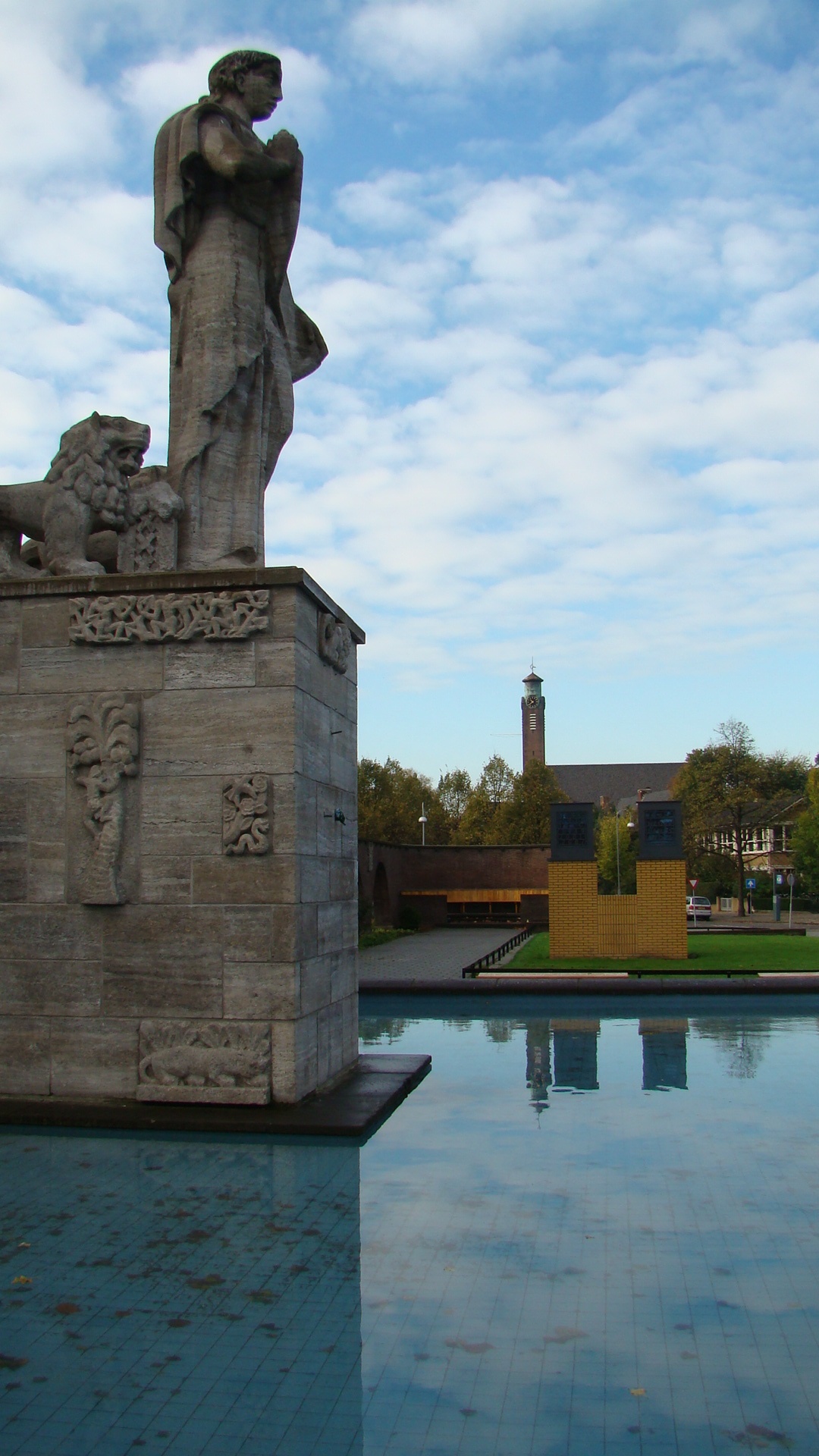
Monument Indië-Nederland
The stone woman on the Olympiaplein has been bombed twice and renamed once. Unveiled in 1935 as a tribute to General Joannes Benedictus van Heutsz, the soldier who conquered Aceh for the Kingdom of the Netherlands in 1903, the monument was contested from the day Queen Wilhelmina pulled the cloth off it. Communists and social democrats protested at the unveiling. Bombs went off in 1967 and 1984. The bronze portrait of the general was prized off the pedestal and stolen. By 2004 the Netherlands had a different relationship with its colonial past, and the monument got a new name: Monument Indië-Nederland. The same stone woman still stands. What she means has changed.
A General Who Won Too Hard
Van Heutsz was the kind of officer the Dutch East Indies army produced - a competent, ruthless, decorated general who became governor-general of the Dutch East Indies. His campaign against the Sultanate of Aceh in northern Sumatra began in 1898 and culminated in the formal Dutch victory of 1903, which ended a thirty-year war that had cost tens of thousands of Acehnese lives and perhaps fifteen thousand Dutch and colonial soldiers. The methods were extreme even by the standards of nineteenth-century colonial warfare. Counterinsurgency operations under Van Heutsz's command included the systematic destruction of villages, mass executions of suspected insurgents, and a campaign of attrition against the civilian population that historians have since described in terms of war crimes. When he died in 1924, the Dutch establishment buried him as a hero. There was leftover funding from his mausoleum. In 1930 the government agreed to put the money toward a monument.
The Stone Woman
The competition was won by the architect Gijsbert Friedhoff and the sculptor Frits van Hall. Their design centered on a tall standing female figure in stone, holding a scroll of law - the personification of Dutch authority in the East Indies. A lion sat on each side of her: one for Batavia, the colonial capital, the other for Amsterdam. A pond ran around the base of the monument to represent the ocean separating the metropole from its colony, and on the arched walls flanking the figure ran reliefs of the Indonesian archipelago. A bronze portrait of Van Heutsz was set into the pedestal. The whole composition was about possession - the Dutch holding Indonesia in stone. The neighborhood gave the woman a more Dutch name: Mien met de hondjes, Mien with the doggies. Or sometimes de Nederlandse maagd, the Dutch virgin. The lions did not really look like lions.
Bombs and Removals
The monument went up in 1935. Within thirty-two years someone tried to blow it up. The first attack came in 1967 - the era of Provo and Dutch decolonial protest, with Indonesia an independent nation for two decades and the wounds of the late colonial wars still fresh in public memory. The second bomb came in 1984. By then the Dutch government had quietly removed the bronze portrait of Van Heutsz from the pedestal in response to mounting criticism. The plaque was stored. Soon afterward it was stolen, never recovered. The peculiar family note in the monument's history: Van Heutsz Junior had protested against the statue in 1943 - not because he objected to honoring his father, but because he thought the design was too weak. Three generations have argued about what the stone woman stands for and none have agreed.
Renaming
The 1997 attempt to renovate the monument set off the next wave of protests. The government scaled back its plans to a simple sandblasting. Then in 2001 the monument was formally reframed - not a tribute to Van Heutsz, but a memorial to the long entangled relationship between the Netherlands and Indonesia. A 2004 proposal to rededicate it to Multatuli, the nineteenth-century writer whose novel Max Havelaar had exposed Dutch colonial abuses, was rejected. The current name - Monument Indië-Nederland - took hold. In 2007 the monument was expanded. Brick pedestals were added in different colors, eastern and western, to mark the difference between Indonesia and the Netherlands. Six dates were inscribed: 1596, when Cornelis de Houtman and Pieter Dirkszoon Keyser landed at Banten and opened Dutch trade with the East Indies; 1935, the unveiling; 1945, the Proclamation of Indonesian Independence; 1949, the Dutch recognition of that independence; 2001, the change of name; and 2007, the expansion itself.
What a Monument Can Hold
The Indonesian war of independence between 1945 and 1949 killed roughly 100,000 Indonesians and several thousand Dutch soldiers, with civilian deaths in the hundreds of thousands. Dutch military operations in that war - politely called police actions at the time - included massacres of villagers that the Dutch government has only recently begun to formally acknowledge. In 2022 a comprehensive state-funded historical study concluded that the Dutch had systematically used extreme violence in Indonesia and that the conduct constituted a moral failure. The official apologies followed. The monument on the Olympiaplein had been quietly carrying the weight of this reckoning for two decades by then. The same female figure that once symbolized Dutch authority in the East Indies now stands as a memorial to the people on both sides of those Indonesian archipelago reliefs - the soldiers, the civilians, the colonial subjects, the independence fighters. The stone has not moved. The country around it has.
From the Air
Coordinates 52.350°N, 4.866°E in the Zuid district of Amsterdam, just south of the Vondelpark on the Olympiaplein - the square laid out for the 1928 Summer Olympics. About 12 km northeast of Schiphol (EHAM), best viewed from 1,500-2,500 ft on approach or departure routes that pass over south Amsterdam. The Olympiaplein and its surrounding 1920s-1930s architecture are visible as a planned grid south of the Museumplein and the Rijksmuseum.