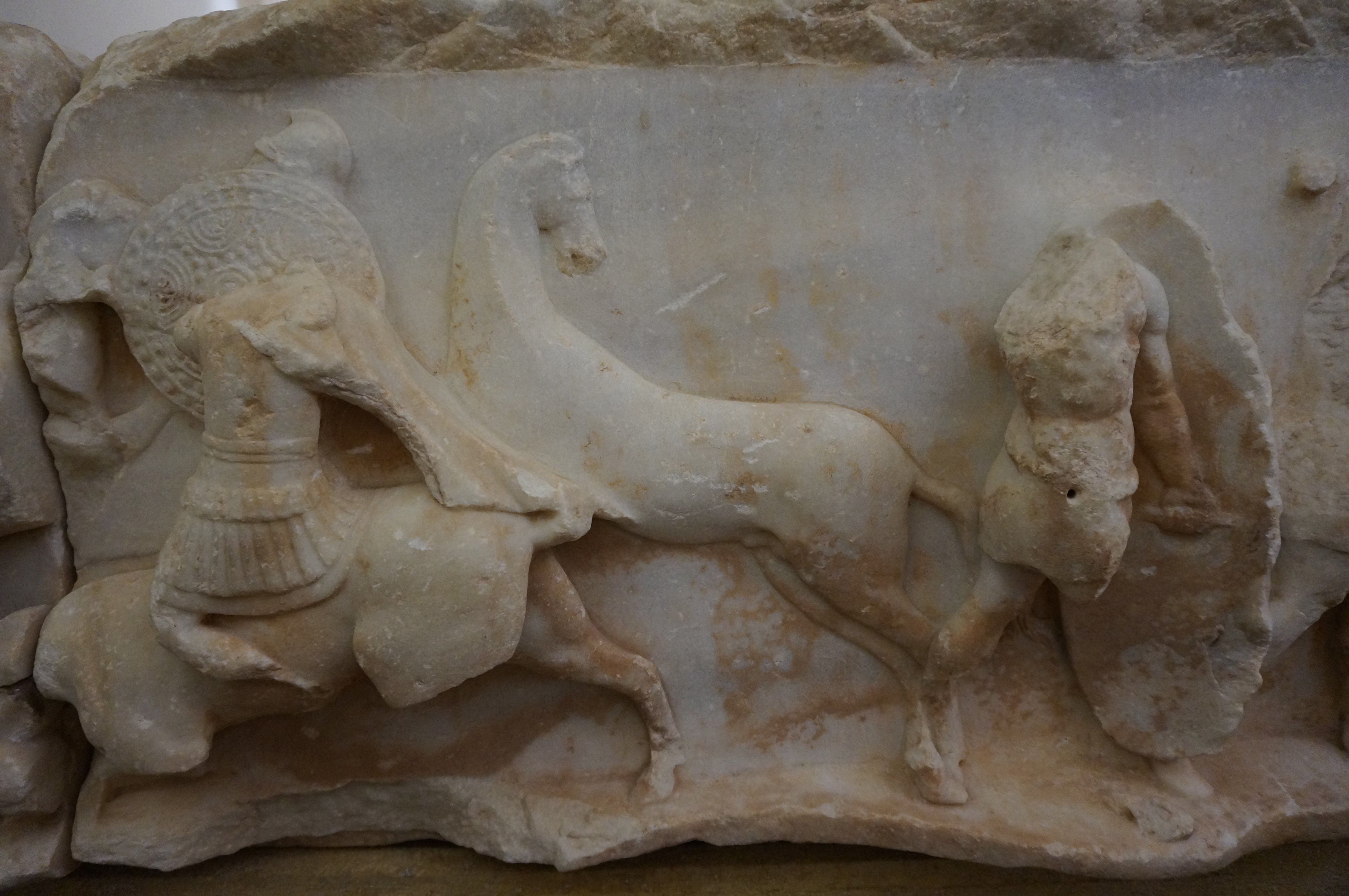
Monument of Aemilius Paullus
The pillar at Delphi was supposed to hold a portrait of King Perseus of Macedon. He never got the chance to put it there. In June of 168 BC, on a plain in northern Greece called Pydna, the Roman general Lucius Aemilius Paullus broke the Macedonian phalanx in less than an hour and ended a kingdom that traced its lineage to Alexander the Great. Roughly twenty thousand Macedonians died on that field, and another eleven thousand were taken as captives to be sold. Aemilius Paullus came to Delphi the following year. He saw the unfinished column standing in front of the Temple of Apollo, learned what it had been meant for, and ordered the work continued, with himself on top. 'It was only proper,' he is reported to have said, 'that the conquered should give way to the victors.'
Stealing a pedestal
The Sanctuary of Apollo at Delphi was the most cosmopolitan address in the Greek world. Treasuries lined the Sacred Way, each one a small temple full of gifts from a different city, a different king, a different navy that had won a battle and wanted Apollo to know about it. Three royal pillars stood near the Temple of Apollo when Aemilius Paullus arrived. Eumenes II of Pergamon had one. Prusias II of Bithynia had one. The third was unfinished, meant for Perseus, and would have reminded every Greek visitor that the Macedonian royal family had been friends of Delphi for centuries. By taking that pillar over, Aemilius Paullus did something subtle and brutal. He did not destroy Macedonian memory; he overwrote it. The same plinth, the same height, the same prominent location, but a Roman name now, in Latin, in an inscription that still survives: 'Lucius Aemilius, son of Lucius, Imperator, took it from King Perseus and the Macedonians.'
What was on top
Crowning the rectangular marble pillar over nine meters tall stood a bronze equestrian statue of Aemilius Paullus himself. The statue is gone, melted down somewhere in late antiquity, but the cuttings in the plinth show that the horse reared on its hind legs, frozen mid-charge. Bronze equestrian statues of Roman generals were rare in 167 BC; the convention belonged to Hellenistic kings. Aemilius Paullus was making a claim. He was not just a general who had won a campaign, he was a king-equivalent, planted permanently among the kings, in the most sacred panhellenic space the Greek world possessed. The visual argument worked. Within a generation, Greek artists would be carving Roman generals into Hellenistic conventions as a matter of routine.
The frieze and the day
Around the top of the pillar, on all four sides, runs a sculpted frieze. It depicts the Battle of Pydna itself, the only such Roman commemorative frieze that survives from the Hellenistic period and the earliest known example of Greek sculpture made for a purely Roman patron. The relief is 6.5 meters long and just 31 centimeters tall, white veined marble with a brown patina where centuries of weather have taken hold. Romans carry oval shields, the scuta of the legions. Macedonians carry round ones. Naked figures, once thought to be heroically idealized Romans, are now believed to be Celtic mercenaries who fought under Perseus and were the first to fall when the phalanx broke. Between scenes of combat lie dead and dying men. One panel includes a riderless horse, and that horse is a clue: legend held that an oracle predicted whichever side started the battle would lose, and a stray Roman horse running toward Macedonian lines tricked Perseus into attacking. The riderless horse in the relief tells the viewer that this is Pydna and not some generic combat scene.
The cost on both sides
The Romans lost about a hundred men at Pydna. The Macedonians lost twenty thousand killed and eleven thousand captured, and after the battle the Roman senate forced the dissolution of the Macedonian kingdom into four small republics that paid tribute to Rome. Aemilius Paullus marched south through Epirus on his way home and, on senate orders, sacked seventy towns, enslaving an estimated 150,000 people in a few weeks of organized cruelty. The pillar at Delphi celebrates none of this directly. It celebrates a single dramatic moment of Roman victory, frozen in marble, with a bronze general above. But every visitor who walked the Sacred Way after 167 BC saw the message clearly: the Macedonian kingdom that Alexander built and his successors held for two centuries was finished, and something new was running Greece. The frieze is in the Delphi Archaeological Museum now. The pillar still stands.
From the Air
38.482 N, 22.502 E. The Sanctuary of Apollo at Delphi clings to the southern slope of Mount Parnassos at roughly 600 m elevation, looking south across the Gulf of Corinth toward the mountains of the Peloponnese. Best viewed from 4,000-6,000 ft MSL on a clear day; the dramatic terraced site is unmistakable. Athens (LGAV) lies 165 km southeast. Nearest small field is Lamia (LGLM), 80 km north-northeast. Mountain wave turbulence common over Parnassos in winter; Mediterranean haze in summer can obscure the gulf below.