Monument of States
The day after Pearl Harbor, a retired doctor in Kissimmee, Florida, decided to build something. Not a weapon, not a bunker - a pile of rocks. Charles W. Bressler-Pettis, a World War I veteran who had served in both the Royal Army Medical Corps and the United States Army, was president of the local All-States Tourist Club, a social group for senior citizens who had relocated to central Florida from across the country. His response to the Japanese attack was characteristically personal and slightly eccentric: he would erect a monument containing a stone from every state in the union. One nation, bound together by geology. The result, completed in 1943 and still standing on Monument Avenue in Kissimmee, is a 100,000-pound step-pyramid crowned with an American eagle perched on a blue concrete globe - a strange, beautiful, deeply American structure that weighs as much as a locomotive and contains a piece of its creator's body.
The Doctor's Grand Obsession
Bressler-Pettis was a collector by nature. He had amassed thousands of rocks during his travels, and he donated many of them to his own project. But the monument demanded more. He wrote to every governor in the country, asking each to send a representative stone from their state. He solicited donations from civic organizations, businesses, and individual residents of Kissimmee. His collaborator, a friend named J. C. Fisher, helped design the structure: a step-pyramid reinforced with three and a half tons of steel rails, rising in tiers to support the eagle and flag at its summit. The National Park Service has speculated that Pettis may have been inspired by the Fireplace of States in Bemidji, Minnesota, built by the Works Progress Administration in 1934-35 using stones from each of the then forty-eight states. Whether or not Bemidji planted the seed, Pettis grew it into something entirely his own.
Assembled by Retirees, Blessed by a President
The monument was built entirely by volunteer labor, most of them elderly members of the All-States Tourist Club. Locals contributed 507 individual bags of cement. Area businesses donated materials. Everyone who helped in any capacity had their name inscribed in the adjacent sidewalk - a democratic roll call of ordinary people who decided to do something extraordinary in wartime. President Franklin D. Roosevelt contributed a rock from his estate in New York. By the time of its completion, the monument contained 1,500 stones and objects from around the world. Florida's United States Senator Claude Pepper presided over the dedication ceremony in 1943. The finished structure was part patriotic statement, part roadside curiosity, part community art project - a tower of other people's geology, cemented together with wartime solidarity and Florida sunshine.
The Man Inside the Monument
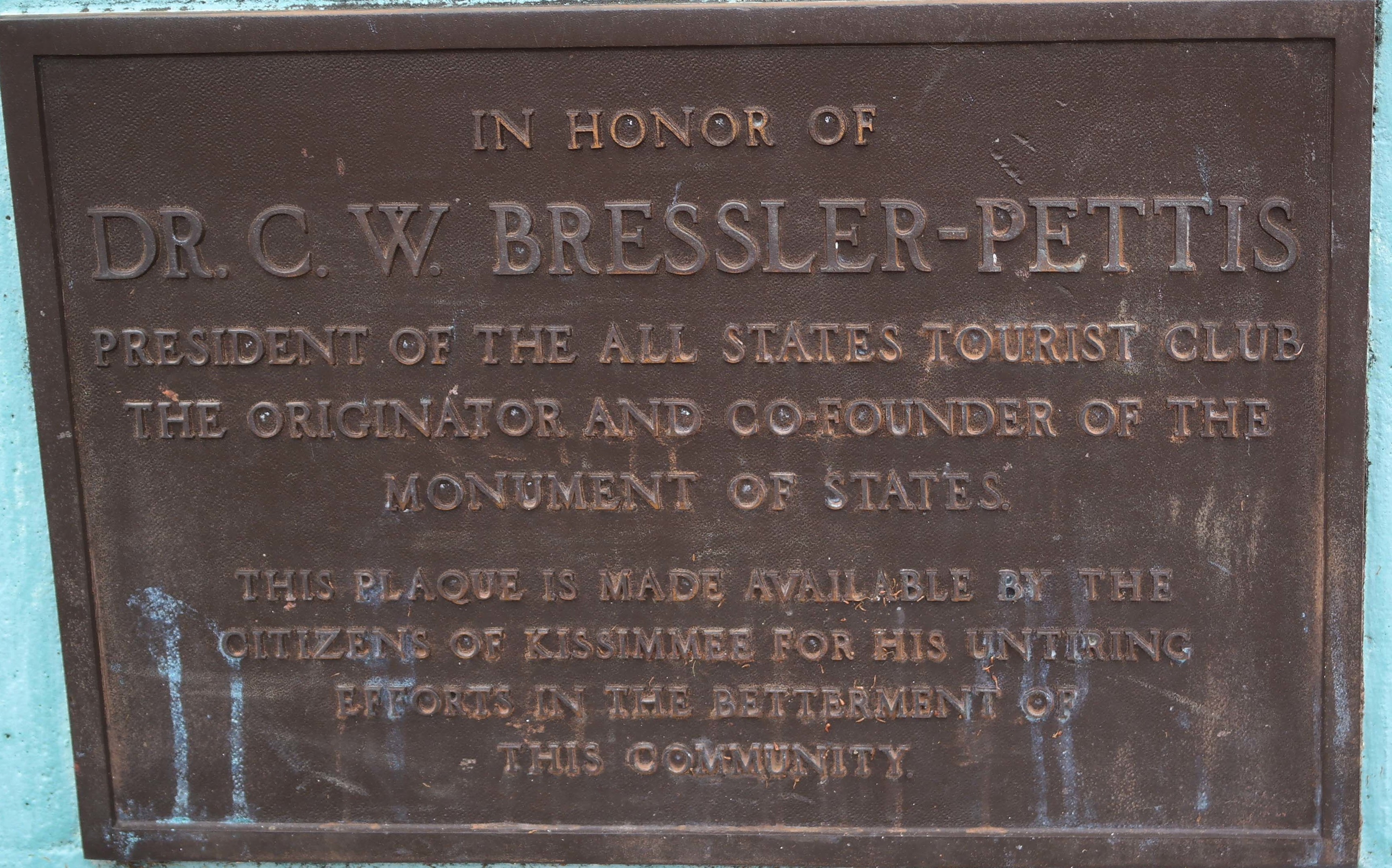
When Bressler-Pettis died in 1954, the city of Kissimmee did something remarkable: it changed its burial regulations to allow a portion of his remains to be sealed inside the monument he had created. A plaque honoring Pettis was placed on the structure, and his ashes joined the 1,500 stones he had spent years collecting and assembling. It was a fitting tribute for a man who had literally built himself into the landscape. Pettis had conceived the monument as both a patriotic symbol and a tourist draw for Kissimmee, and for a time it succeeded at both. Visitors stopped to marvel at the odd pyramid on their way through central Florida, reading the inscriptions and trying to identify which stone came from which state.
The Mouse That Stole the Tourists
In 1971, Walt Disney World opened in Orlando, just twenty miles to the north. Almost overnight, the flow of tourists through Kissimmee changed. Visitors no longer drifted through town looking for diversions - they drove straight to the theme parks. The Monument of States, which had thrived on the curiosity of passing travelers, fell into neglect and disrepair. A roadside attraction cannot compete with a Magic Kingdom. For two decades the pyramid weathered quietly, its stones cracking, its eagle watching over an avenue that fewer and fewer people bothered to walk. On March 28, 1993, the city held a rededication ceremony and sealed a time capsule within the monument, attempting to breathe new purpose into Pettis's creation.
Stones That Still Hold
The Monument of States was added to the National Register of Historic Places on December 8, 2015 - seventy-two years after its dedication, and nearly the exact anniversary of the Pearl Harbor attack that inspired it. The timing feels deliberate. Today the monument stands in a small park on Monument Avenue, modest by the standards of central Florida's sprawling attractions but monumental in its own stubborn way. It is a time capsule in more than the literal sense: a snapshot of wartime America, when a retired doctor could write to every governor, rally a club of elderly snowbirds, and build a 100,000-pound pyramid held together by cement, steel, and the conviction that putting a rock from each state into one structure might somehow hold a rattled nation together. The eagle still watches from the top. The stones still hold. And somewhere inside, Pettis remains part of the thing he built.
From the Air
Located at 28.292N, 81.405W in Kissimmee, Florida, on Monument Avenue near the shore of Lake Tohopekaliga. The monument itself is too small to spot from altitude, but the Kissimmee lakefront and the distinctive shape of Lake Tohopekaliga provide orientation. The monument sits in the historic downtown area between the lake and US-192. Nearby airports: Kissimmee Gateway (KISM) approximately 3nm south; Orlando Executive (KORL) approximately 15nm north; Orlando International (KMCO) approximately 12nm east. Walt Disney World's distinctive layout is visible approximately 15nm northwest. Best approached from the south over Lake Tohopekaliga for orientation. Central Florida's flat terrain and lake-studded landscape make ground features easy to identify in clear conditions.