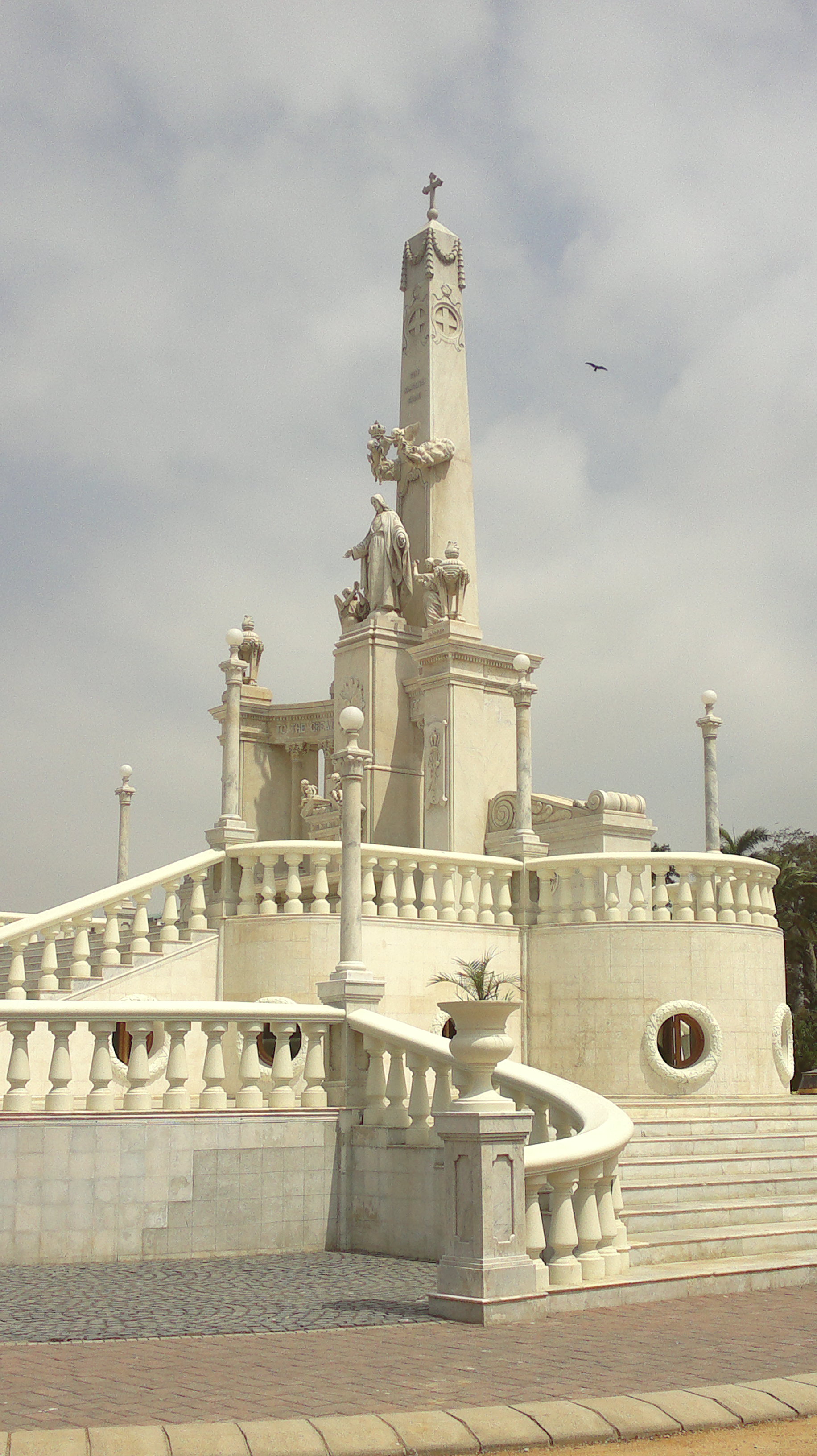
Monument to Christ the King
When the Monument to Christ the King was inaugurated on October 17, 1931, the celebrations lasted nine days. Eleven committees organized everything from music to street decorations. A Passion play ran for four nights at St. Patrick's School, introducing microphones and loudspeakers to the venue for the first time. Jamshed Nusserwanjee Mehta, the Parsi president of Karachi's Municipal Corporation, led a large contingent of non-Catholics in a two-mile-long procession. Fireworks closed the festivities. The monument that inspired all this was 54 feet of white Carrara marble, and it has stood on Shahrah-e-Iraq ever since.
From Feast Day to Foundation Stone
The monument's story begins in 1925, when Pope Pius XI established the Feast of Christ the King. Vincent Gimenez, the Jesuit parish priest of St. Patrick's in Karachi's Saddar Town, introduced the first Christ the King procession through the streets in October 1926. The following year, the local branch of the Apostleship of Prayer conceived the idea of a permanent monument. Catholics from across Karachi and the surrounding region formed a 26-member board. Fourteen Catholic associations, representing about 80 people, collected donations and oversaw planning. The project was designed by M. X. Andrade, with construction supervised by August Rodrigues, a retired Superintendent Engineer from Bombay's Public Works Department.
Carrara Marble via Coutinho
The marble for the monument was imported from Carrara, Italy, shipped to Karachi through Anthony Coutinho and Company, the same firm that had been handling burial services at Gora Qabaristan since 1885. The statue of Christ the King was a gift from Major Quadros of Cincinnatus Town, Karachi. Below the monument, a crypt seats 150 people and contains two murals by a Goan artist named Vaz, one depicting heaven and the other hell. A replica of St. Francis Xavier also resides in the crypt. The total cost came to 81,500 rupees, funded entirely by donations from the local Catholic community.
Processions Silenced
For decades after its inauguration, the Feast of Christ the King brought an annual procession from St. Patrick's Cathedral through Saddar, a quarter-mile column of Catholic worshipers winding through Karachi's busiest commercial district. The procession was discontinued in the mid-1960s due to street congestion and incidents of harassment. The monument itself continued to weather on Shahrah-e-Iraq, absorbing salt from the soil, rain, and the exhaust of a growing city. By its eightieth anniversary, the structure was severely damaged. Bordering and pavements had been removed. The base was crumbling from salinity.
Saved at Eighty-Two
In September 2011, a fundraising drive sought 10 million rupees to save the monument. The Archbishop Emeritus of Karachi formed a restoration committee in 2012, appointing Menin Rodrigues as Project Head and Roland deSouza as Technical Coordinator. NED University of Engineering and Technology contributed expertise and resources. The work cost 8.5 million rupees and was completed in 2013. On November 24, 2013, the Feast of Christ the King, Archbishop Edgar Pena Parra, Apostolic Nuncio to Pakistan, blessed the restored monument. The Carrara marble had been cleaned, the base repaired, and the structure stabilized for another generation of standing watch over one of Karachi's busiest streets.
From the Air
Located at 24.862N, 67.035E on Shahrah-e-Iraq in Karachi's Saddar Town, within the grounds of St. Patrick's Cathedral. The 54-foot white marble monument may be visible at lower altitudes. Jinnah International Airport (OPKC) is approximately 13 km to the east. The surrounding area is a major commercial district.