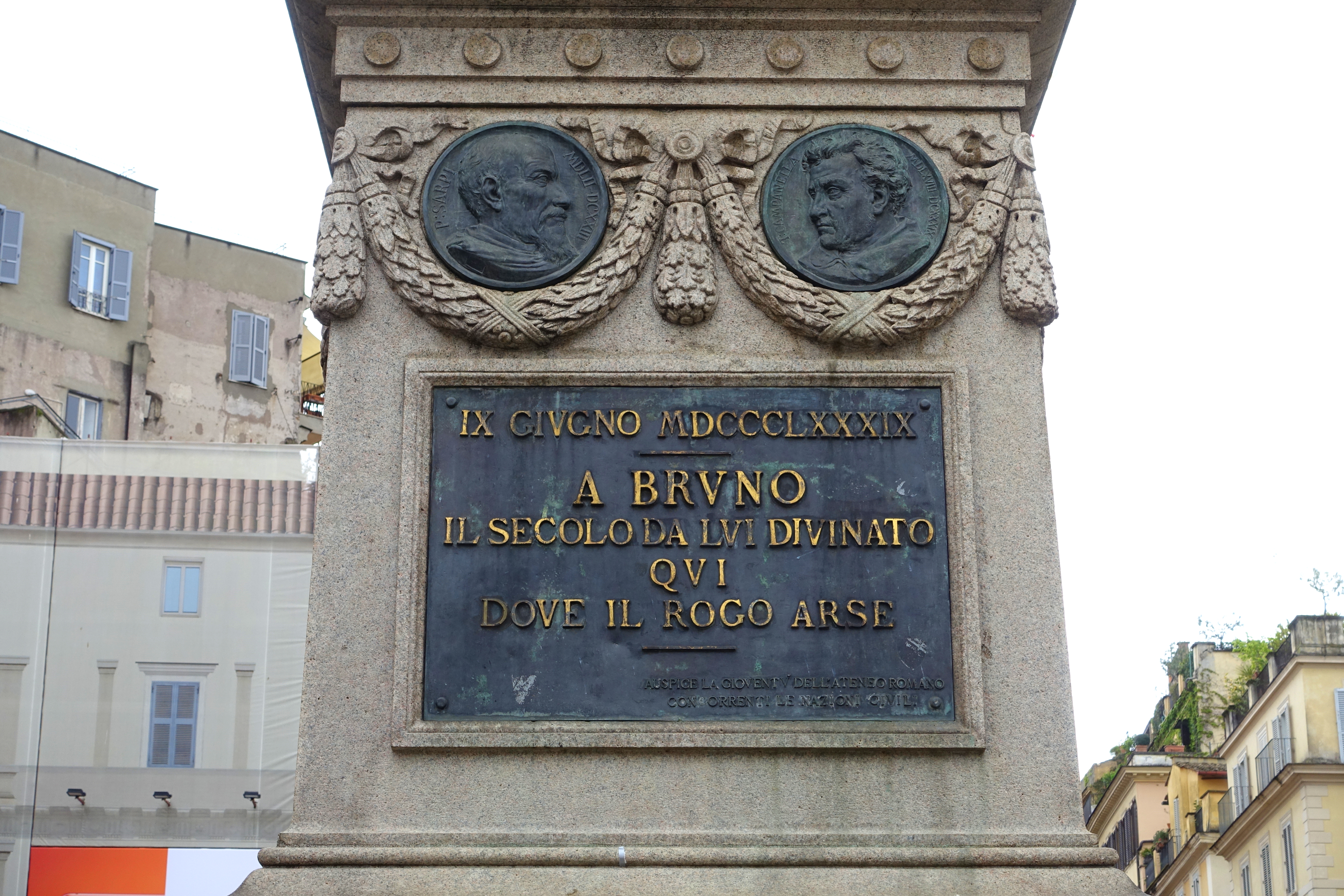
Monument to Giordano Bruno
Every morning, the flower vendors of Campo de' Fiori set up their stalls around a hooded bronze figure who stares down at the cobblestones with an expression that might be defiance, or grief, or both. This is Giordano Bruno, the philosopher and cosmologist who was burned alive on this exact spot on February 17, 1600, after the Roman Inquisition convicted him of heresy. The statue was erected in 1889 - not as a quiet memorial, but as a deliberate provocation. Its unveiling brought thousands of anticlerical demonstrators into the streets and forced the Vatican to shutter its doors.
The Philosopher Who Would Not Recant
Bruno's crime was thinking too broadly. A Dominican friar from Nola, near Naples, he developed a cosmology that went far beyond the Copernican model - proposing an infinite universe with innumerable worlds, each potentially inhabited. He embraced pantheism, the idea that God and the universe were one and the same. For these and other theological positions the Church deemed heretical, Bruno was imprisoned for seven years before being sentenced to death. According to tradition, when the Inquisition read his sentence, Bruno replied: "Perhaps you, my judges, pronounce this sentence against me with greater fear than I receive it." He was burned at the stake with his tongue clamped in a metal gag to prevent him from speaking. The sculptor Ettore Ferrari, who later became Grand Master of Italy's Masonic order, chose to depict Bruno in his Dominican habit, cowl raised, clutching a book to his chest - a thinker, not a martyr in agony.
A Monument as Weapon
The statue was never merely a tribute. It was ammunition in a decades-long war between Italy's secular republican movement and the Catholic Church. Freemasons had championed the unification of Italy and the end of papal temporal power, and a monument to a man the Church had executed was an unmistakable message about who now controlled Rome. Students at the University of Rome launched a subscription campaign to fund the work. The Rome city council approved the Campo de' Fiori location on December 10, 1888, by a vote of 36 to 13. Pope Leo XIII, who had published his anti-Masonic encyclical Humanum genus just four years earlier, was furious. On unveiling day, June 9, 1889, the radical politician Giovanni Bovio gave a speech surrounded by roughly 100 Masonic flags while thousands of anticlerical supporters flooded the city. The Vatican closed its museum and ordered local churches to lock their doors against what it called an "atheistic mob."
Eight Faces of Dissent
Along the top of the plinth, eight bronze medallions depict thinkers who clashed with religious authority: the Venetian friar Paolo Sarpi, the utopian philosopher Tommaso Campanella, the French logician Petrus Ramus, the Italian philosopher Lucilio Vanini, the reformer Aonio Paleario, the Spanish physician Michael Servetus, the English theologian John Wycliffe, and the Bohemian reformer Jan Hus. In 1991, a small hidden portrait of Martin Luther was rediscovered on the Vanini medallion. The selection was deliberate and pointed - all but Servetus, who was burned by Swiss Calvinists, had run afoul of the Catholic Church specifically. One notable absence: Galileo. The medallion originally intended for him went to Paolo Sarpi instead, because Galileo had recanted his beliefs under pressure. In this company, recantation disqualified you. Only those who refused to bend were honored.
The Heretic's Annual Wreath
Pope Leo XIII responded to the monument with the encyclical Ab Apostolici in October 1890, calling it "that eminently sectarian work" erected to "insult the Papacy." He was not wrong about the intent, even if the insult was also a statement of principle. The battle lines the monument drew in 1889 have never fully dissolved. Every February 17, on the anniversary of Bruno's execution, groups of freethinkers, Masons, atheists, and pantheists gather at the statue. A representative of Rome's municipal government places a wreath at its feet. The market stalls crowd around the base as they do every other day, and tourists photograph the bronze figure without always knowing what it represents. Bruno stands where he fell, in a piazza that was once a place of execution and is now a place of flowers, looking down at the ground that burned him with an expression the sculptor made impossible to read.
From the Air
Located at 41.90N, 12.47E in the heart of Rome's historic center. Campo de' Fiori is a rectangular piazza south of Piazza Navona, identifiable from the air by its open market space amid dense medieval streets. Fiumicino Airport (LIRF) is approximately 28 km southwest. Ciampino Airport (LIRA) is about 16 km southeast. Best viewed below 3,000 feet to distinguish the piazza from surrounding rooftops.