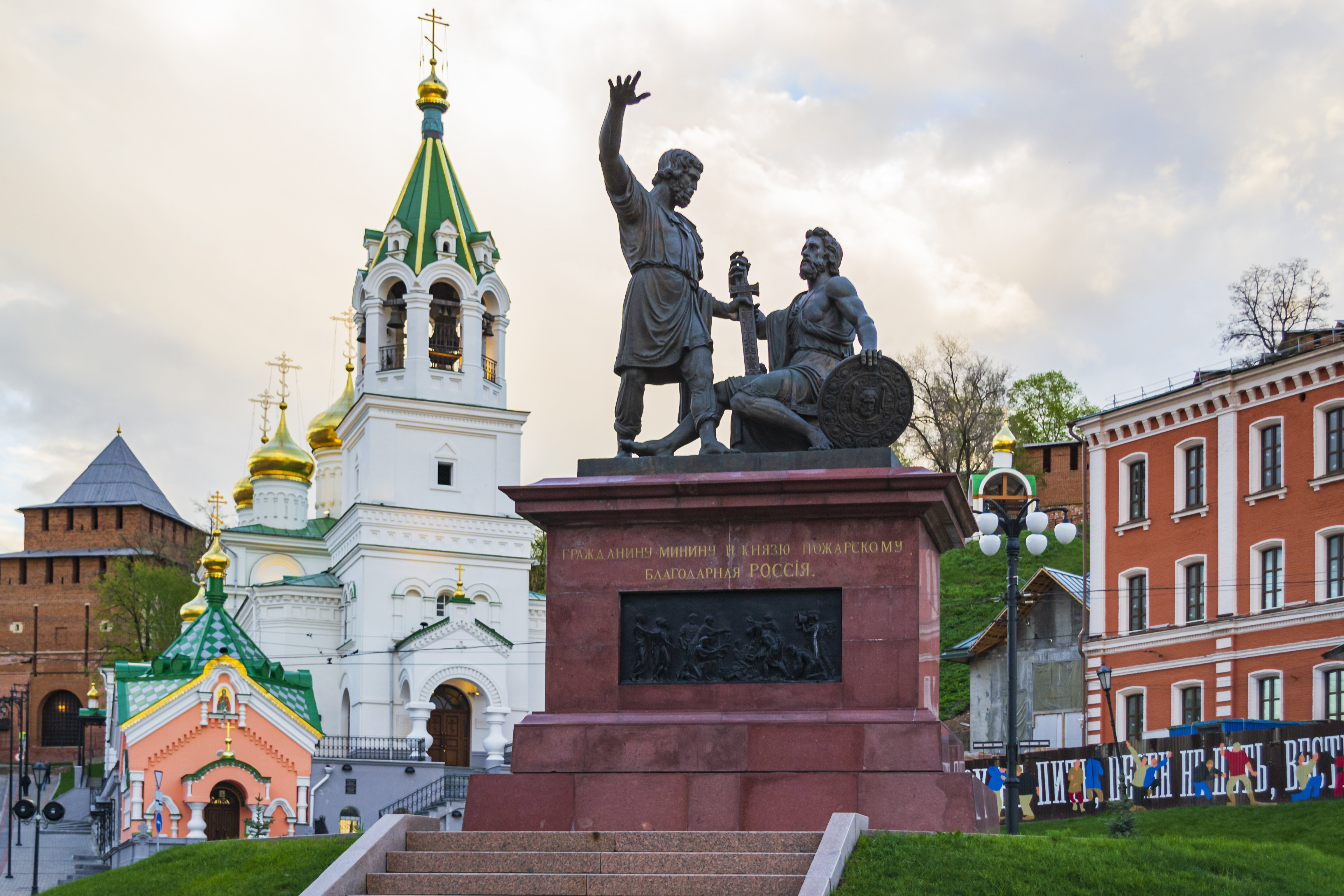
Monument to Minin and Pozharsky, Nizhny Novgorod
Moscow has the original. Nizhny Novgorod has the story. The bronze figures of Kuzma Minin and Prince Dmitry Pozharsky stand on National Unity Square, beneath the walls of the Nizhny Novgorod Kremlin, near the Church of St. John the Baptist. The statue is a copy of the famous monument on Red Square, and it is five centimeters smaller than the Moscow version. But the history it commemorates belongs to this city first -- because it was here, in 1611, that a butcher rallied a nation.
The Butcher's Call to Arms
The early 17th century was the Time of Troubles, a period of famine, civil war, and foreign invasion that nearly destroyed the Russian state. Polish-Lithuanian forces had occupied Moscow. The Tsardom of Russia was fragmenting. In Nizhny Novgorod, a zemstvo elder named Kuzma Minin -- by trade a butcher and merchant, not a soldier or nobleman -- began calling on the people to take up arms against the occupiers. He was supported by the city council, the local governors, and the clergy. At the ringing of a bell, citizens gathered in the Kremlin's Transfiguration Cathedral. After the service, Minin delivered his appeal: donate your wealth, raise a people's militia, fight for the liberation of the Russian Tsardom. Funds poured in. What the militia needed next was a military commander. The people of Nizhny Novgorod chose Prince Dmitry Pozharsky, a veteran warrior, to lead the force.
Liberation and Memory
The militia marched on Moscow and, on October 22, 1612 (November 4 by the modern calendar), drove the Polish garrison from the capital. It was a turning point that preserved Russian sovereignty and eventually led to the founding of the Romanov dynasty. The original monument to Minin and Pozharsky, sculpted by Ivan Martos and unveiled in 1818, was initially intended for Nizhny Novgorod. But the work was judged to be of such national significance that it was placed on Red Square instead. Nizhny Novgorod received a consolation prize -- an obelisk erected in the Kremlin in 1828. Plans for a proper monument resurfaced in the 1910s but collapsed amid revolutionary upheaval. The Bolsheviks melted down the prepared materials and used them to cast a monument to the Victims of the Revolution of 1905, installed on Freedom Square.
The Copy Comes Home
Nearly four centuries after Minin's appeal, the city finally got its statue. In 2004, Moscow Mayor Yury Luzhkov commissioned the renowned Georgian-Russian sculptor Zurab Tsereteli to create a copy of the Red Square monument for Nizhny Novgorod. On November 4, 2005 -- the newly established Day of National Unity, chosen to mark the anniversary of Moscow's liberation -- the monument was unveiled on National Unity Square. The location was deliberate: this was the ground from which the people's militia of 1611 had set out. The square sits beneath the Kremlin walls, near the same Church of St. John the Baptist where Minin once rallied his neighbors. The date itself carried layered significance. In 1649, Tsar Alexis had ordered the celebration of the Our Lady of Kazan on this day, linking religious devotion to the memory of liberation. The modern holiday folded centuries of meaning into a single afternoon ceremony.
Five Centimeters of Difference
The Nizhny Novgorod monument is five centimeters smaller than the Red Square original, and the inscriptions on the pedestals differ. These are the only material distinctions. In every other way, the two figures of Minin and Pozharsky are identical: the butcher gesturing urgently outward, calling the prince to action, while the seated Pozharsky grips a shield and prepares to rise. The original on Red Square is a national treasure, photographed by millions. The copy in Nizhny Novgorod occupies something rarer -- the exact place where the events it depicts began. History often migrates to capital cities, taking its monuments with it. Here, it migrated back.
From the Air
Located at 56.33N, 44.00E in the historic center of Nizhny Novgorod, on National Unity Square beneath the Kremlin walls. The Nizhny Novgorod Kremlin is a prominent red-brick fortress visible from altitude along the high bank of the Volga at its confluence with the Oka River. Nizhny Novgorod Strigino Airport (UWGG) is approximately 18 km southwest. The historic center is best viewed at 2,000-4,000 feet, where the Kremlin walls, churches, and riverside promenades are clearly visible.