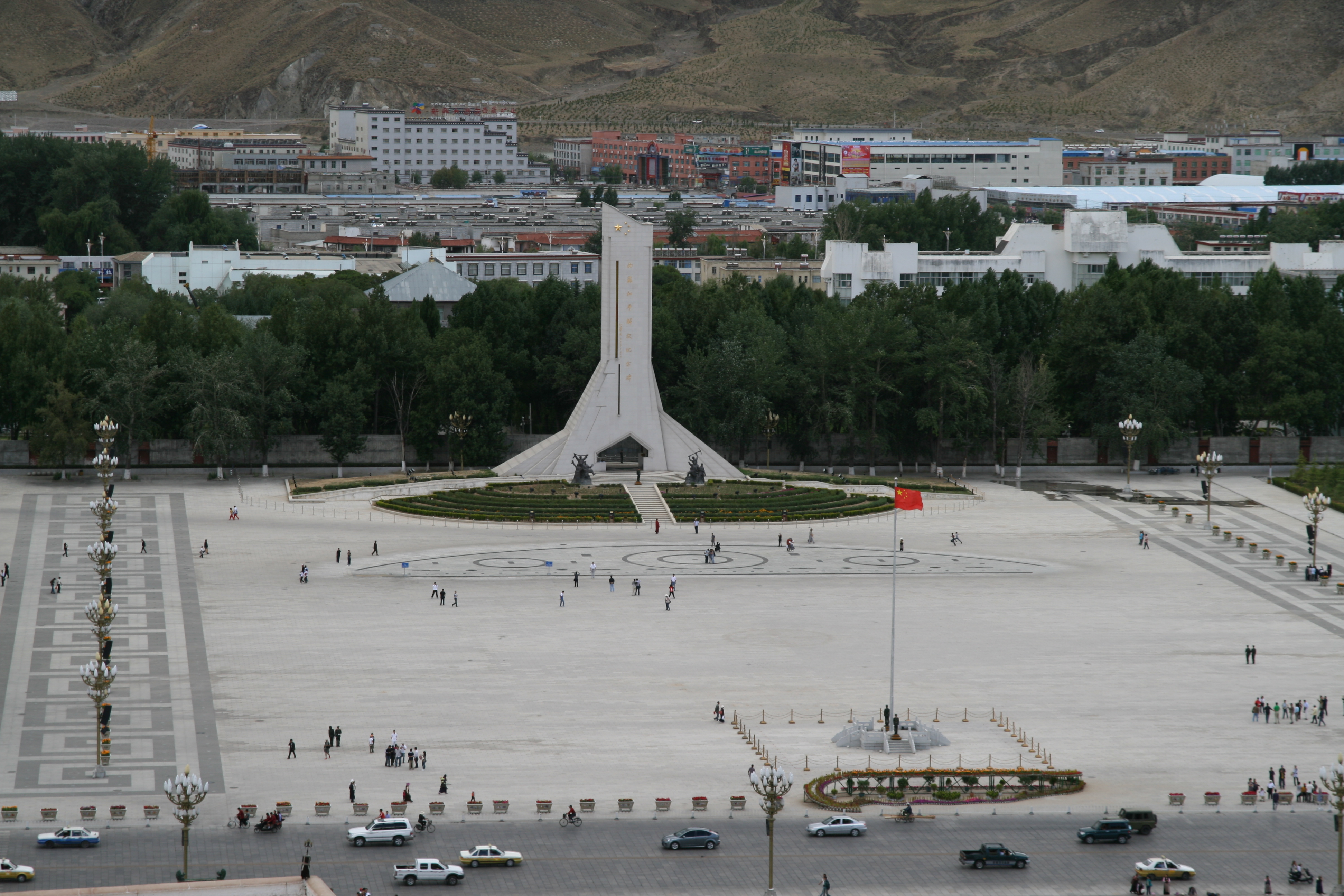
Monument to the Peaceful Liberation of Tibet
Two narratives collide in concrete at the southern end of Potala Square. The Monument to the Peaceful Liberation of Tibet rises 37 meters into the thin Lhasa air, a spire abstractly shaped like Mount Everest, placed within sight of the Potala Palace but carefully outside the World Heritage Site's protective buffer zone. What the monument commemorates depends entirely on who you ask. The People's Republic of China calls 1951 the year Tibet was peacefully liberated from imperialist forces. The Tibetan government-in-exile calls it the year of invasion and annexation. The monument speaks only in the first language.
A Foundation Stone Laid by a Future President
The monument's origins are precisely documented. On July 18, 2001, Hu Jintao, then China's vice-president, laid the foundation stone in the southern part of Potala Square. Hu was no stranger to Tibet. He had served as the region's Communist Party Secretary from 1988 to 1992, a tenure that included the imposition of martial law in Lhasa in 1989. The choice of Hu for the ceremony was deliberate, connecting the monument to a continuity of Chinese authority in the region. Construction cost approximately 1.7 million US dollars. The monument was unveiled on May 22, 2002, just under a year after the groundbreaking, its completion timed to coincide with the anniversary period of the 1951 Seventeen Point Agreement that formalized Chinese control over Tibet.
Everest in Abstract
Professor Qi Kang of Southeast University in Nanjing designed the structure. The spire's form abstracts Mount Everest, known in Tibetan as Chomolungma, a choice that folds Tibet's most iconic natural landmark into the narrative of Chinese sovereignty. The monument bears its name engraved in the calligraphy of Jiang Zemin, who served as general secretary of the Communist Party and president of China during the monument's conception. Flanking the spire are sculptural groups: statues depicting figures from the liberation narrative stand at the left and right of the memorial. The southern face carries an inscription in both Tibetan and Chinese characters. The text references the expulsion of "imperialist" forces from Tibet in 1951, an allusion to the Anglo-Russian Great Game rivalries that had shaped foreign interest in the region for over a century. The inscription also catalogs socioeconomic development achievements since that date.
The View from Two Sides
The monument's placement is its most eloquent statement. It stands in the square that also serves as the grand approach to the Potala Palace, the historical seat of the Dalai Lama and the most recognizable symbol of Tibetan sovereignty. Visitors to the Potala cannot avoid the monument; it asserts itself in the foreground of every photograph taken from the south. UNESCO's World Heritage Committee had noted the sensitivity of development near the Potala complex. The monument was positioned just outside the designated protective and buffer zones, threading a bureaucratic needle. For the Chinese government, the spire represents progress and unity. For many Tibetans, particularly those in exile, it represents the architectural imposition of a narrative they reject. The monument does not acknowledge the existence of a counternarrative. Monuments rarely do.
Illuminated After Dark
At night, the monument is lit dramatically, with water features playing at its base. The illumination transforms Potala Square into a display of modern Chinese infrastructure and aesthetic ambition, a deliberate contrast to the ancient Tibetan architecture looming behind it. The square itself was created as part of Lhasa's modern redevelopment, replacing older structures with an open public space that frames both the Potala and the monument. Whether you read the scene as celebration or erasure depends on which history you carry with you into the square. What is not in dispute is the monument's physical presence: 37 meters of reinforced concrete shaped like the world's highest mountain, bearing inscriptions in two languages that tell one story, standing in the shadow of a palace that tells another.
From the Air
The monument stands at 29.653N, 91.117E in Potala Square, central Lhasa at approximately 3,650m elevation. It is directly south of the Potala Palace and visible as a tall spire in the open square. Lhasa Gonggar Airport (ZULS) is about 60km to the southwest. The monument is best identified by its position in the large open square in front of the Potala. Night illumination makes it visible after dark. High-altitude flying conditions prevail.