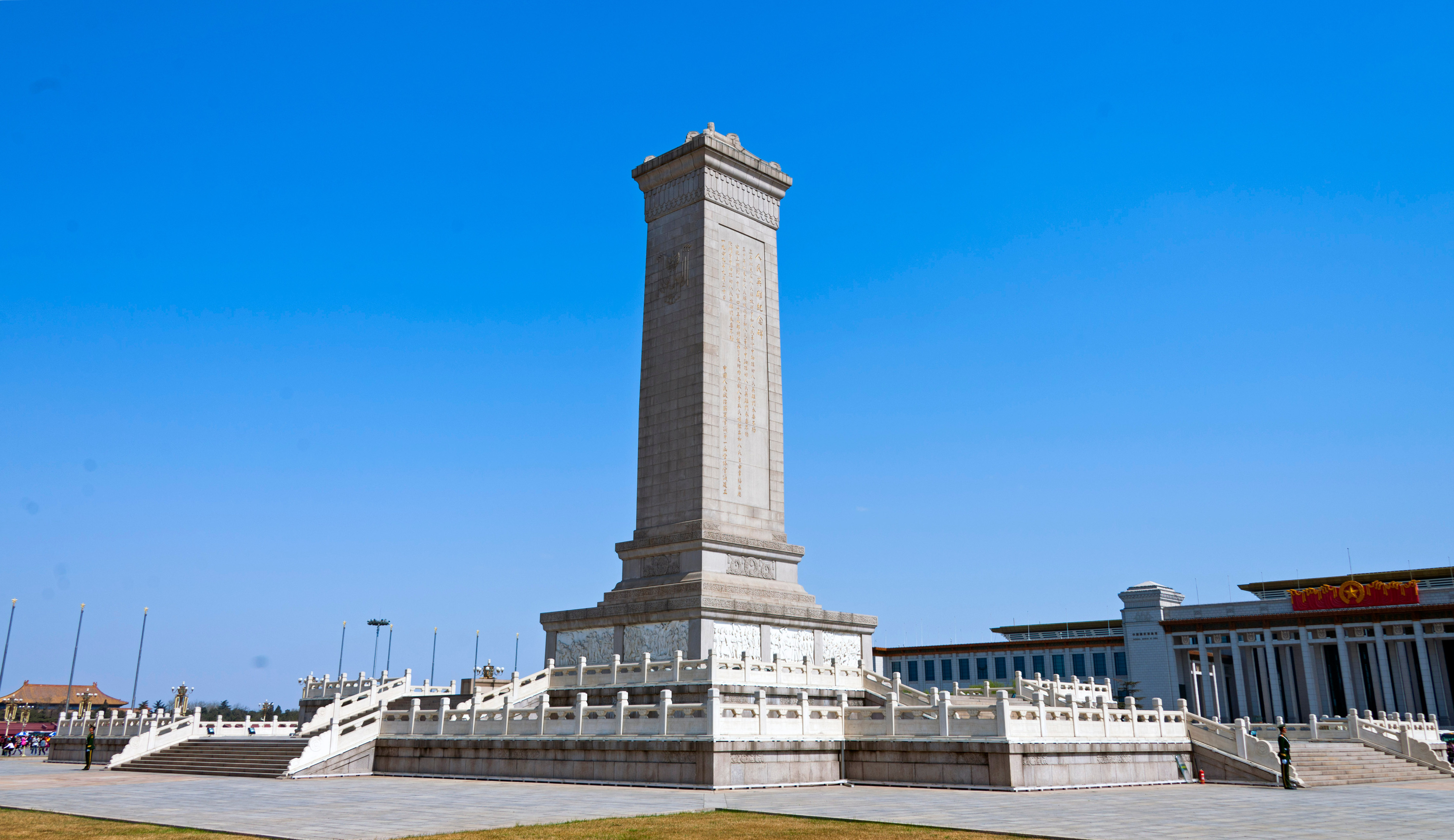
Monument to the People's Heroes
The centerstone came from Laoshan Mountain in Qingdao, hauled by three tractors and shipped by rail on a specially requisitioned wagon rated for 90 tons. When it arrived at Xizhimen Railway Station on October 13, 1953, the most physically demanding part of building the Monument to the People's Heroes was over. But the most contentious part, deciding what the monument should look like and what story it should tell, had been consuming architects, sculptors, and party officials for four years and would continue for four more. The result, completed in 1958, is a 37.94-meter obelisk made of 13,000 pieces of granite and alabaster, standing in the southern part of Tiananmen Square with Mao Zedong's handwritten inscription facing north: "Eternal glory to the people's heroes!"
Choosing What to Remember
The decision to build a monument to revolutionary martyrs was made in September 1949, just days before the founding of the People's Republic. The first plenary session of the Chinese People's Political Consultative Conference debated where to place it. Babaoshan and Dongdan Square were proposed, but Tiananmen Square won because delegates felt the revolutionary tradition of the May Fourth Movement was embodied there, and the location was convenient for public visits. What followed was a design competition that attracted more than 140 proposals. Some called for sculptures flat on the ground, others for monumental columns. The committee, led by architect Liang Sicheng with elements designed by his wife Lin Huiyin, settled on a towering obelisk form. But the top of the monument remained undecided for years, delaying construction between 1952 and 1954 as committees argued over whether it should be crowned with an architectural element or a sculpture.
Eight Panels, One Century
The monument's pedestal carries eight large bas-reliefs and two smaller ones, readable in clockwise order from the east. They begin with the destruction of opium at Humen in 1839, the provocation that launched the First Opium War, and end with the Yangtze River Crossing Campaign of 1949, the final major offensive of the Chinese Civil War. Between those bookends: the Jintian Uprising of 1851 that ignited the Taiping Revolution, the Wuchang Uprising of 1911 that catalyzed the end of imperial rule, the May Fourth Movement of 1919, the May 30 Movement of 1925, the Nanchang Uprising of 1927, and the War of Resistance Against Japan. Together, the reliefs frame the period from the 1840s to the 1940s as a single continuous arc, an anti-imperialist and revolutionary century. The sculptor Liu Kaiqu oversaw the relief work, which was completed by late 1956 and installed by August 1957.
Two Hands, Two Messages
The monument carries the handwriting of both Mao Zedong and Zhou Enlai, a pairing that embeds the early leadership of the People's Republic directly into the stone. Mao's bold calligraphy on the front declares "Eternal glory to the people's heroes!" Zhou Enlai's more measured script on the back provides the longer epitaph, honoring those who died in revolutionary struggle over the preceding century. The inscription deliberately reaches back to the 1840s, connecting the Opium Wars to the communist victory and framing the entire modern era as a story of resistance. The monument cost 405,000 yuan to build, a modest sum even in 1958 terms, reflecting the use of domestic materials and labor. It was unveiled on May 1, 1958, International Workers' Day, linking its completion to the global labor movement.
Protected in Perpetuity
In 1961, the monument was designated a Major Cultural Heritage Site under national-level protection. Repairs have been carried out multiple times, including a significant restoration from February to July 2006 that cleaned the bas-reliefs, repaired cracks, and restored the pedestal and railing. In 2014, China established Martyrs' Memorial Day, and national leaders are now required to present flower baskets to the monument annually. A 2018 law, the Law on the Protection of Heroes and Martyrs, specifically designates the monument as a permanent memorial facility and extends legal protection to its name, inscriptions, reliefs, and associated symbols. The monument occupies 3,000 square meters of Tiananmen Square, positioned 440 meters from the Tiananmen gate wall, sitting at the symbolic center of the People's Republic. It is at once a memorial, a political statement, and a piece of architecture that makes granite carry the weight of national narrative.
From the Air
Located at 39.90°N, 116.39°E in the southern part of Tiananmen Square, between the Mausoleum of Mao Zedong and the square's center. The obelisk is visible from altitude as a vertical element amid the vast flat expanse of the square. Best viewed at 2,000-4,000 feet. Nearest airport: Beijing Capital International (ZBAA), approximately 25 km northeast.