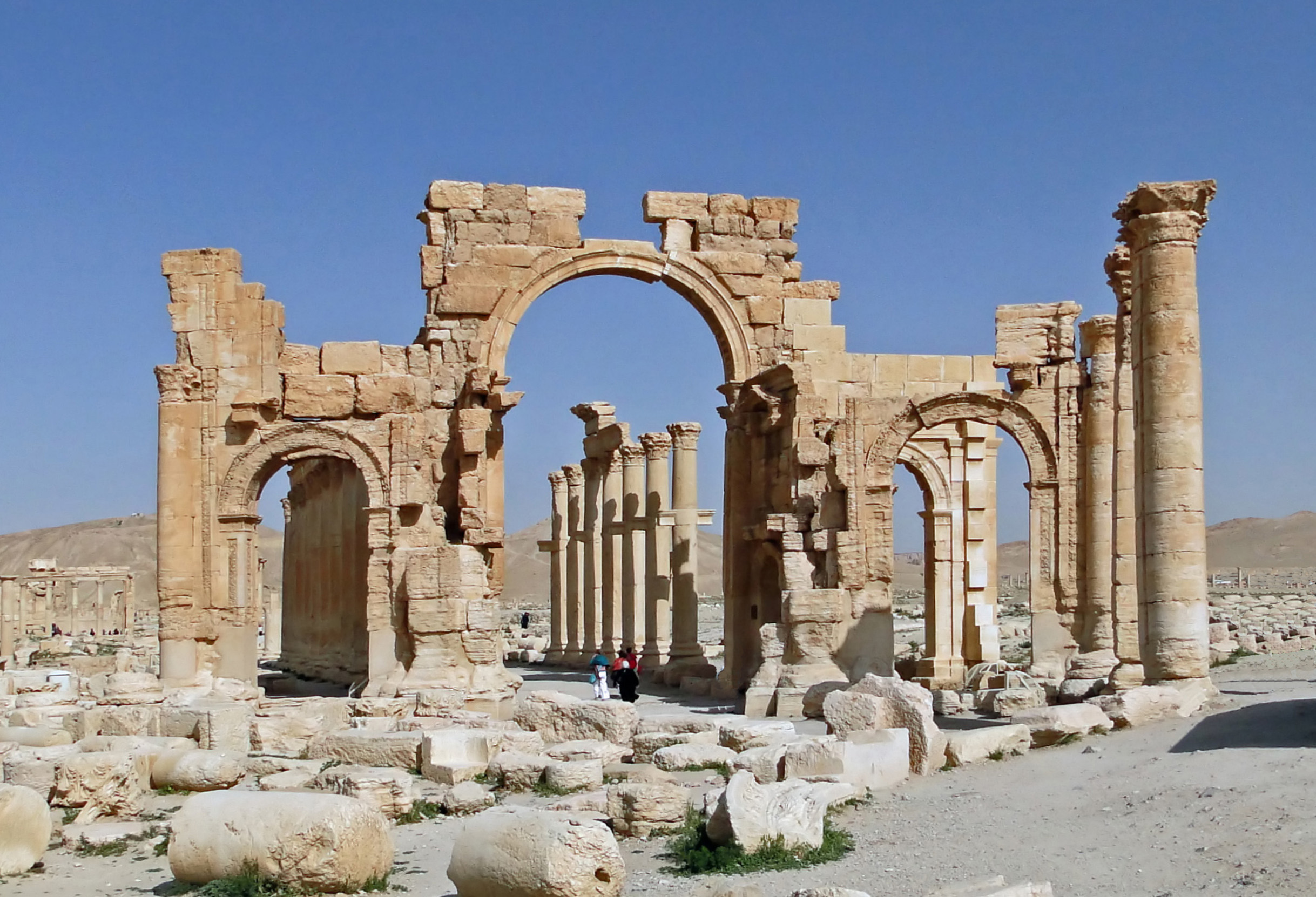
Monumental Arch of Palmyra
From a distance, it looked like a simple triumphal arch. Walk closer, and the geometry revealed itself: two facades set at a 30-degree angle to each other, an elegant architectural trick that disguised a sharp bend in Palmyra's Great Colonnade. Built during the reign of Emperor Septimius Severus between 193 and 211 AD, the Monumental Arch was never a monument to military victory. It was a solution to a problem -- how to connect the colonnade's central section to the Temple of Bel when the street changed direction -- wrapped in ornamental grandeur that UNESCO would later call "an outstanding example of Palmyrene art."
An Architect's Sleight of Hand
The challenge was geometric. Palmyra's main colonnaded street ran roughly east-west from the Temple of Bel, but partway through its 1.1-kilometer length, the road shifted direction by 30 degrees at the Tetrapylon. Rather than leave an ugly kink, Severan-era architects designed a triple archway -- a large central gateway flanked by smaller openings on each side -- whose two facades faced different directions. Approaching from the temple, travelers saw one face; approaching from the Tetrapylon, they saw another. The angled facades made the transition feel natural, almost invisible. Stone carvings of plants and geometric patterns covered the surfaces, closely resembling reliefs found at Leptis Magna in modern Libya, another city that flourished under Severus. After centuries of sand burial, the arch was restored in the 1930s, becoming one of Palmyra's most photographed monuments.
Five Minutes with Dynamite
On 4 October 2015, ISIS detonated explosives around the arch. Footage released four days later showed half the structure still standing, but by the time the Syrian Army recaptured Palmyra in March 2016, very little remained upright. The United Nations declared that the destruction proved ISIS was "terrified by history and culture." Syria's president and UNESCO's director-general both condemned the act. Yet amid the rubble lay an unexpected reprieve: most of the arch's individual stones survived the blast. They were scattered, broken in places, but identifiable -- the raw material for reconstruction through anastylosis, the archaeological method of reassembling a structure from its original fragments.
A Replica Travels the World
While the original lay in pieces in the Syrian desert, a 20-foot replica of the arch's central section began a global tour. The Institute for Digital Archaeology in Oxford carved it from Egyptian marble using a 3D computer model and robotic milling machines. On 19 April 2016, the replica was installed in London's Trafalgar Square, where it stood for three days. From there it traveled to New York City, Florence, Geneva, Washington, D.C., and Dubai -- a defiant symbol meant to counter the ideology behind the original's destruction. Plans called for the replica to eventually reach Syria, though as of 2023 that transfer had not yet happened. The original, meanwhile, awaited a more painstaking journey back to form.
Reassembling the Puzzle
The first phase of physical restoration began on 12 November 2021, using the surviving stones scattered around the site. Syrian officials described the reconstruction as feasible precisely because so much material remained. In October 2022, the Syrian Directorate-General of Antiquities and Museums and the Institute for the History of Material Culture of the Russian Academy of Sciences signed an agreement to begin the second and third phases of restoration. The arch would be rebuilt alongside two other ISIS-destroyed landmarks -- the Temple of Bel and the Temple of Baalshamin -- all using the same anastylosis method. Whether the restored arch will carry the same emotional weight as the original is a question only time and visitors will answer. But the stones remember their positions, and the geometry of that 30-degree turn endures in every fragment.
From the Air
Located at 34.55°N, 38.27°E in the Syrian Desert, roughly 215 km northeast of Damascus. The ruins of Palmyra are visible as a sprawling archaeological complex on the southwestern fringe of the modern town of Tadmur. Nearest airports include Palmyra Airport (decommissioned military facility) and T4/Tiyas Airbase (OSTY) approximately 60 km to the west. Best viewed from 3,000-5,000 ft AGL in clear desert conditions. The Great Colonnade alignment running east-west is a useful visual reference for locating the arch site.