Monumental Cemetery of Bonaria
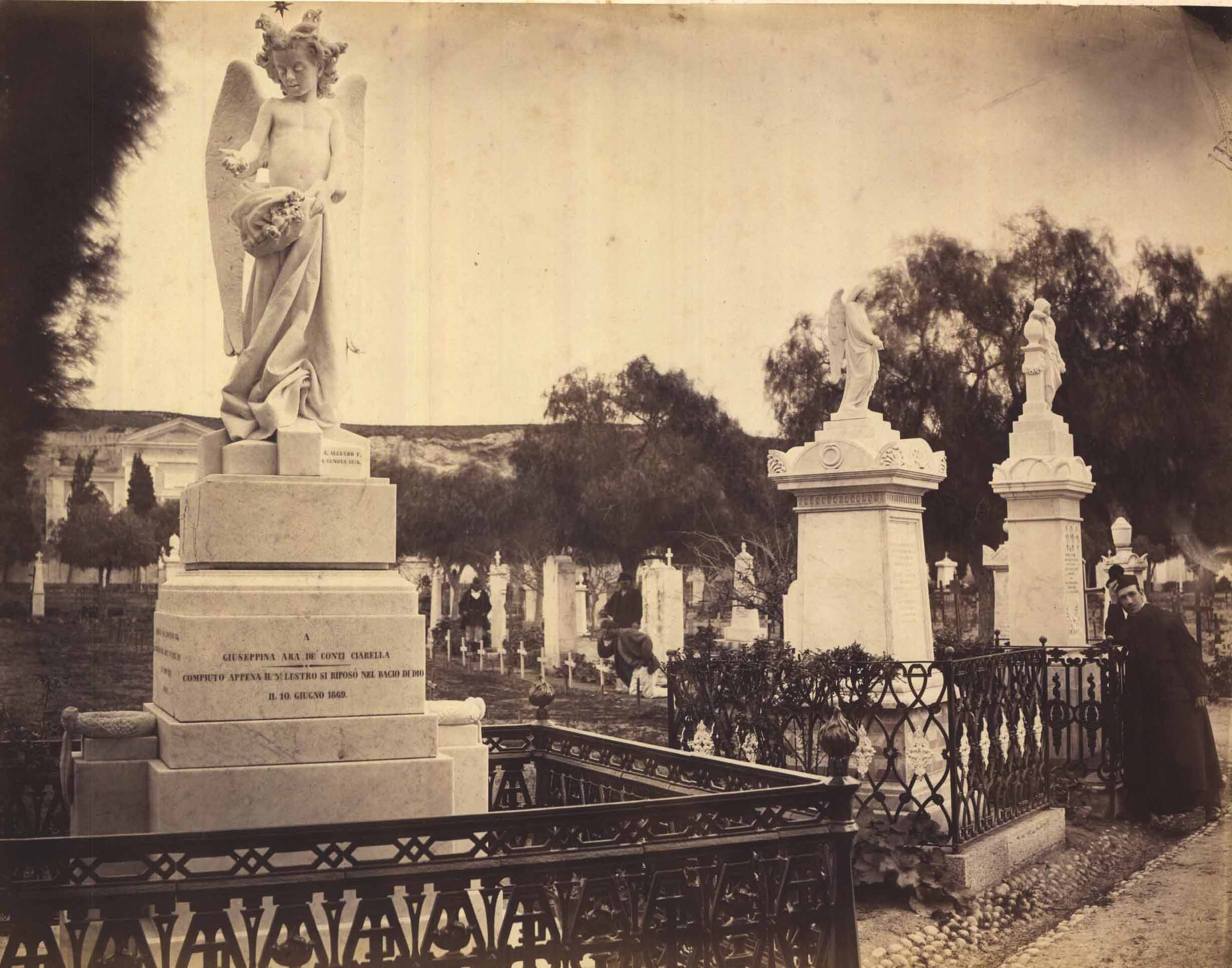
An angel presses a finger to his lips. Sculpted by Giuseppe Sartorio for the Birocchi-Berol mausoleum, this marble figure guards a ceiling painted with clouds and plaster angels, its single gesture -- silence -- the only instruction the dead require. The Monumental Cemetery of Bonaria is filled with such moments: sculpture and sentiment woven into stone across a hillside that people have been burying their dead on for millennia. Before the modern cemetery opened on January 1, 1829, this ground held Punic tombs, Roman graves, and early Christian burials carved into the limestone. The living built their city of the dead on top of another one.
A Hill of the Dead, Old and New
Captain of Engineers Luigi Damiano designed the modern cemetery in 1828 at the base of Bonaria hill, and it grew upward over the following century through multiple extensions -- the work of architects including Gaetano Cima, who designed the expansion thirty years after the original opening. Until 1929, the 12th-century church of Santa Maria de Portu Gruttis, also known as San Bardilio, stood at the entrance, linking the modern cemetery to medieval Cagliari. The church was demolished, but its name survives in the Square of San Bardilio, the central gathering point where the tombs of Cagliari's most prominent citizens cluster. Among them rests Ottone Baccaredda, the mayor who built the Palazzo Civico and the Bastion of Saint Remy, and historian Pietro Martini, whose tomb dates to 1866.
The Sculptor's Gallery
Walking through Bonaria is like walking through an open-air sculpture museum where artistic tastes shift with every row. Giuseppe Sartorio dominates -- his works span decades and styles, from the massive marble Ezekiel in the Chapelle family mausoleum to the tenderly realistic statue of Jenny Nurchis, depicted in the fashion of her era, completed in 1884. The monument to Warzee Frances, wife of a Belgian entrepreneur, shows her son lifting a blanket from his mother's deathbed, bending to kiss her face -- a private moment frozen in public marble by Sartorio in 1894. The memorial to two-year-old Maria Ugo Ortu, executed in 1891, places the child resting beside a broken column behind a trachyte stone balustrade from Serrenti, the barrier symbolizing the divide between life and death.
An Archaeologist Buries Himself
Perhaps the most characteristic tomb belongs to Giovanni Spano, the canon and archaeologist who wrote his own Latin epitaph while still alive and designed his final resting place using archaeological remains he himself had excavated from Bonaria hill. The result is a Roman-style sarcophagus supported by four columns, topped by a marble bust carved by Sartorio -- a scholar's monument that doubles as an exhibit. Nearby, the Cugia family vault holds multiple generations of military service: a bust of Colonel Francesco Cugia by Tito Sarrocchi, a monument to General Efisio Cugia, and a sculptural group of Caterina and Speranza Cugia by Giovanni Pandiani. The styles range from neoclassical through Realism and Symbolism to Art Nouveau, charting the evolution of Italian taste across a century.
Decay and Memory
The cemetery closed to new burials in 1968 -- only private chapels and vaults purchased before that date still accept the dead. New burials go to San Michele Cemetery, opened in 1940. Without the constant attention that active use demands, Bonaria has fallen into decay. The Campo Palme section, named for its palm trees, is among the least maintained areas, and some remains have been transferred to San Michele. French traveler Gaston Vuillier described the cemetery in 1890 as a place of exceptional richness, where white statues peered through cypresses and bouquets from recent funerals still held their freshness. That vitality has faded, but the artistic heritage remains. One square was allocated to non-Catholic burials, absorbing graves from the former English Cemetery that stood on Via XX Settembre until 1895 -- Genoese merchant tombs bearing the emblem of Genoa sit alongside the graves of Protestant visitors who died far from home.
From the Air
Located at 39.21N, 9.12E on the hill of Bonaria in southeastern Cagliari, adjacent to the Basilica of Our Lady of Bonaria. The cemetery terraces are visible from the air as a green hillside dotted with white monuments, climbing from the base of the hill toward the summit. Best viewed at 1,500-2,500 feet. Nearest airport: Cagliari-Elmas (LIEE), approximately 7 km west. The port of Cagliari lies directly to the south.