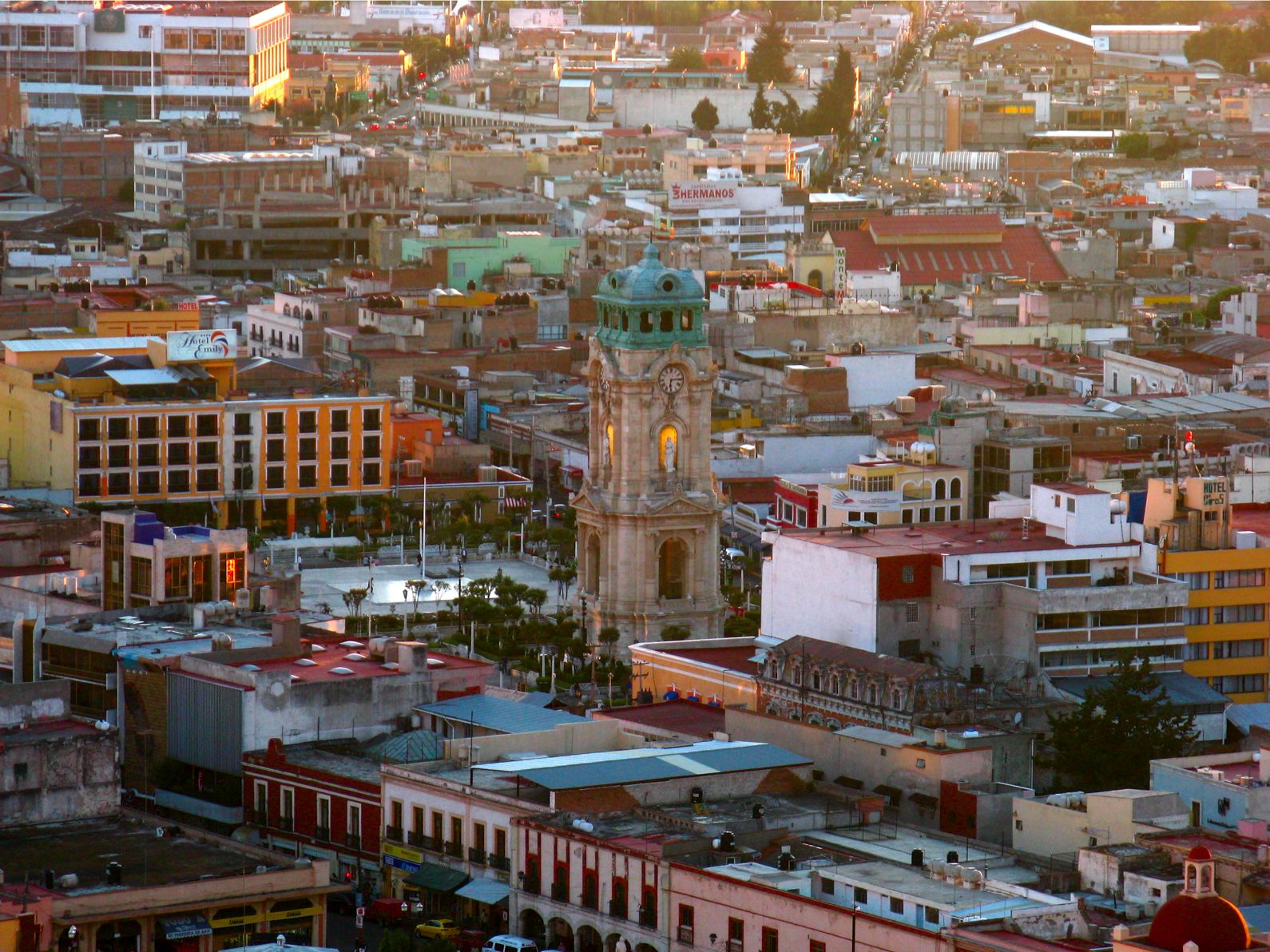
Monumental Clock of Pachuca
Every evening at six o'clock, eight bells in the key of C Major ring out the Mexican National Anthem from a copper dome above Plaza Independencia in Pachuca. The bells were forged in England. The tower they hang in was financed by a Cornish mining magnate. The white quarry stone was cut from nearby Tezoantla by teams of local stonemasons who fitted each block without mortar, using a tongue-and-groove technique that locked the tower together like a puzzle. The Monumental Clock of Pachuca stands 40 meters tall at the heart of the city, a monument that took six years, roughly 300,000 gold pesos, and an international cast of artisans to complete. It remains the most recognized symbol of a city whose fortune was built on silver.
A Tower Born from Music
The story begins not with a clock but with a brass band. On January 20, 1901, the Banda de Rurales gave its first performance in a wooden bandstand on what was then the Plaza de las Diligencias. The band became wildly popular, and a group of British mining companies saw an opportunity: they proposed building a grand concert tower to Governor Francisco Valenzuela. The project was approved in 1904 but stalled a year later when funding ran dry. It was Francis Rule, a mining magnate originally from Cornwall, England, who stepped in with the capital to revive construction in 1906. Architect Tomas Cordero designed the neoclassical structure, and engineers Francisco Hernandez and Luis Carreon oversaw the build. Thirty-five quarry workers shaped the stone for the first phase, twenty-nine for the second. The open balconies at the second level were meant for the band to perform from, but the idea proved impractical -- at that height, the audience below could barely hear the music. The band returned to a kiosk at the tower's base, and the monument found a different purpose: it would commemorate the centennial of Mexican independence.
Bells from London, Fire from the Hills
The clock machinery came from the Dent company in London, the same firm founded by the man who built Big Ben's mechanism. But the popular belief that Pachuca's clock is a replica of Big Ben is false -- Edward John Dent himself made Big Ben's five-tonne mechanism, while Pachuca's much smaller clockwork was produced decades later by his successors, to a different design. Jesus Zenil, a collaborator of Mexico's minister to Austria-Hungary, purchased the machinery in England and shipped it to Pachuca, where it sat waiting in the Capilla de la Asuncion and later in Francis Rule's own house while the tower was still being completed. German watchmaker Alberto Dross installed and maintained the mechanism. On the night of September 15, 1910, Dross arranged the bells to ring continuously for fifteen minutes. As the chimes echoed across the plaza, mining companies detonated dynamite charges in the hills surrounding the city, and fireworks followed. Governor Pedro L. Rodriguez pulled the curtain from a marble plaque on the ground floor, then climbed to the open balcony to deliver the Grito de Dolores and lead the national anthem. The clock had taken its first strokes at 11 o'clock that night.
Four Women in Marble
At the third level of the tower, four female statues stand three meters tall on each face of the structure, carved in Italy from Carrara marble. Each represents a defining moment in Mexico's constitutional history. Independence, commemorating 1810, holds a sword and a torch, her upper torso bare. Freedom, for 1821, raises a laurel of victory in her right hand and grips a broken chain in her left. Constitution, marking the 1857 charter, clutches the Magna Carta with grave, deep-set eyes, one finger pointing as if to emphasize its importance. Reform, honoring the 1859 laws, holds an unrolled parchment and an open book, her robes and wavy hair suggesting forward motion. Above the four clock dials, eagles with spread wings frame the faces, topped by acroteria bearing images of Time itself. The copper and wrought-iron dome that crowns everything was manufactured in Monterrey and brought by rail. One small curiosity on the clock faces has delighted visitors for over a century: the Roman numeral for four is written not as IV, but as IIII.
A Second Century
On September 15, 2010, the clock turned one hundred alongside Mexico's bicentennial celebrations. The Philharmonic Orchestra of Pachuca performed in the plaza, and the centennial flag from the elementary school Julian Villagran -- the same flag used when the tower's foundation stone was laid -- was displayed again. Nine days later, Ranchera singer Pepe Aguilar performed before roughly 10,000 spectators, and a commemorative plaque was unveiled. An urban art exhibition titled "100 Years, 100 Watches" lined the corridor along the street Rio de las Avenidas. In 2011, the Pachuca City Council declared the clock and its surroundings a protected area. That same year, a new LED lighting system was inaugurated, using 60 projectors, 40 meters of LED strip, and 14 digital controllers -- all managed by a single digital memory unit the installers called "the Brain." The system cut energy use by 88 percent compared to the old halogen lights. The tower now shifts color for civic occasions: in October 2011, it glowed pink for breast cancer awareness. The bells still chime every quarter hour, and every evening at six, the anthem still plays from the hilltop mining town that a Cornish fortune helped build.
From the Air
Located at 20.1275N, 98.732W in the center of Pachuca, Hidalgo, at roughly 2,400 meters elevation. The white neoclassical tower is visible in Plaza Independencia in the historic center. Nearest airports include Pachuca (MMPC) and Mexico City (MMMX/AICM) approximately 90 km to the southwest. Best viewed at lower altitudes; the surrounding hills and mining terrain are distinctive landmarks.