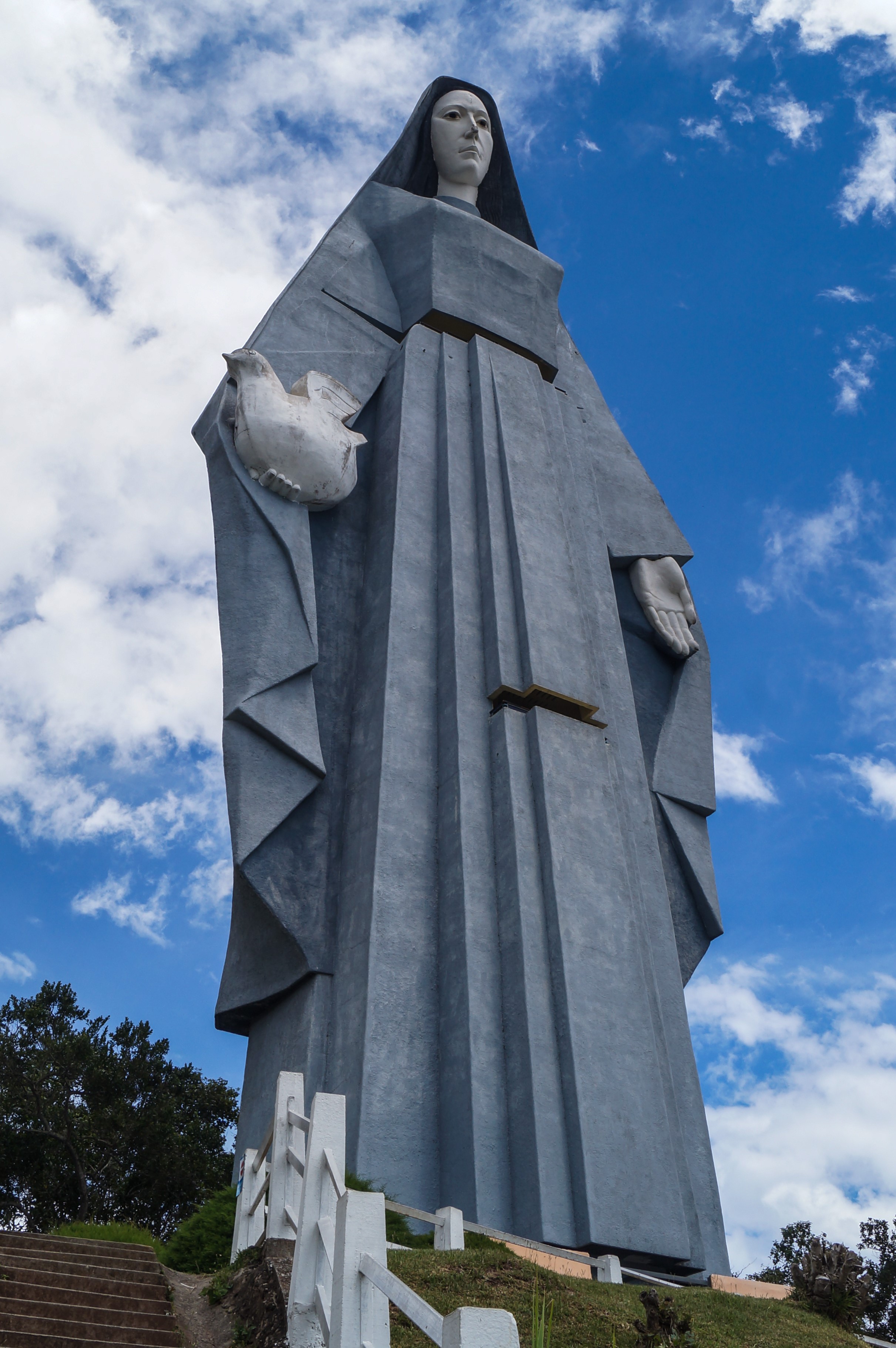
Monumento a la Virgen de la Paz
You can climb inside the Virgin and look out through her eyes. Forty-four meters above the hilltop called Pena de la Virgen, after ascending more than 200 wide steps through the hollow concrete interior, visitors reach the fifth and highest lookout -- set into the face of South America's tallest statue. From there, on a clear day, the view stretches across the entire state of Trujillo, south to the ridges of the Sierra Nevada de Merida, and north to the gleaming surface of Lake Maracaibo. The Monumento a la Virgen de la Paz stands 46.72 meters tall, weighs 1,200 tonnes, and sits at roughly 1,600 meters above sea level in the Venezuelan Andes. It is the second-tallest statue in the Americas, the fourth-tallest depicting a woman anywhere in the world, and one of the least visited tourist attractions in Venezuela.
Where a Goddess Became a Virgin
The hilltop where the statue stands was not always a Christian site. Before the Spanish arrived, this land belonged to the Eskuke people. It was here that the Cacique Pitijoc, of the Cuicas ethnic group, led an indigenous uprising against the colonists. The uprising failed, and the city of Trujillo was founded in 1557. The Spanish introduced the devotion to the Virgin of Peace -- Nuestra Senora de la Paz -- to replace Ikake, the indigenous goddess who had been worshipped in these mountains. By 1568, the Virgin of Peace had been installed as the spiritual patron of Trujillo. The devotion traces its roots to the 7th century and Saint Ildefonsus of Toledo, an archbishop famous for his veneration of the Virgin Mary, who reportedly witnessed a luminous apparition of her in the Cathedral of Santa Maria de Toledo.
The Legend of Pena de la Virgen
According to local tradition from the late 1550s, a young woman began appearing in the town of Carmona, walking through the streets each afternoon to buy candles. Some men in a grocery store asked why she was always alone. She answered: "I am not alone, but with God, the sun, and the stars." When the townspeople followed her, they saw her slip behind a rock on the hillside, which began to spark with light. The young woman, they realized, was not mortal -- she was the Virgin Mary. The hill became Pena de la Virgen, and the legend wove itself into the identity of a region that would, four centuries later, place a 1,200-tonne statue on that same spot. Below the monument, a network of caves called the Cuevas de la Pena de la Virgen remains a place of pilgrimage, where followers leave candles and offerings in the same darkness where indigenous ceremonies were once held.
A Colossus of Concrete
The idea for the monument came from Betty Urdaneta de Herrera Campins, First Lady of Venezuela and a native of Trujillo, along with state governor Dora Maldonado de Falcon. On December 21, 1983 -- during the bicentennial year of Simon Bolivar's birth -- the statue was inaugurated with a liturgical blessing by newly ordained Cardinal Jose Ali Lebrun Moratinos. Sculptor Manuel de la Fuente and engineer Rosendo Camargo designed a hollow concrete form over a steel skeleton: 46 meters of poured concrete, 16 meters across, with a base 18 meters deep. The head alone weighs 8 tonnes. The entire project cost 9 million bolivares. Inside, stairs fill the body from base to crown, connecting five lookouts at different heights -- one at the knee, one in each hand, one at the waist, and the final one behind the eyes. The monument also contains a chapel whose dome is decorated with a stained glass dove, and a bell tower that rings every half hour.
Overlooked and Overlooking
Despite its staggering scale and its significance as a symbol of the state's patron saint, the monument draws remarkably few visitors. During Easter 2010, the Trujillo government counted just 11,000 people at the site, while the Jose Gregorio Hernandez sanctuary nearby received close to 80,000, and the traditional Way of the Cross in Tostos drew 57,000. The statue presides over an emptiness that seems almost intentional, as though the mountain and its monument prefer solitude. Yet the faithful still come each January 24 for the patron fairs, which stretch into processions, masses, and gastronomic festivals lasting until January 30. Every Easter, the Peace March departs at dawn from the Catholic Seminary in the city of Trujillo and ends with a mass in the monument's chapel. From the lookout in her right hand, 26 meters up, pilgrims can see the Teta de Niquitao, the highest point in the state of Trujillo at 4,006 meters. From her eyes, they can see everything.
From the Air
Located at 9.35°N, 70.46°W on a hilltop at approximately 1,600 meters above sea level, 11 km southwest of the city of Trujillo in the Venezuelan Andes. The 46.72-meter white concrete statue is visible from considerable distance against the green mountain backdrop. Lake Maracaibo is visible to the north. The nearby Teta de Niquitao rises to 4,006 meters to the east. Nearest airports include Trujillo (SVTC) and Valera (SVVL). Best viewed at 3,000-8,000 ft AGL on approach from the north, where the statue stands prominently on the ridgeline.